
Transportation
The existing transportation network in Tysons Corner, developed beginning in the 1950s, was designed to allow the vast majority of people traveling to, from, within and through Tysons do so using private automobiles. The network has successfully completed its goal and has contributed to creating one of the most successful, auto-oriented commercial centers in the country.
Although the roadway network in Tysons is extensive, it has become
increasingly strained as Tysons Corner and the Washington D.C.
Metropolitan Area have grown.
If Tysons is to remain successful and accommodate future growth, it must
transform its existing auto-oriented transportation network and
development pattern into a more sustainable, transit-oriented, walkable,
urban environment. The coming of Metrorail’s Silver Line, with
four new stations in Tysons, as well as the adoption of the Comprehensive
Plan for the Tysons Corner Urban Center in 2010, provide tremendous
opportunity for this transformation to take place.
The Comprehensive Plan for the Tysons Corner Urban Center envisions a 24-hour urban center for Tysons that will be home to 100,000 residents and 200,000 jobs by 2050. If this vision is to be realized, the transportation network in the future must give people choices for making trips while still accommodating automobiles. Creating a livable, walkable Tysons will require that the needs of pedestrians, bicyclists and transit users be given preference, in many circumstances, over the need to move people by automobile. Providing choices requires a balanced transportation system that provides attractive public transportation connections, an enhanced network of connected, pedestrian friendly streets and bicycle facilities.
In order to maximize the use of four new Metrorail Stations and support the goals of the Comprehensive Plan to transform Tysons from a suburban office park into a thriving, transit-oriented, pedestrian and bicycle friendly urban center, the Fairfax County Department of Transportation has completed or is in the process of conducting the studies and plans listed below. To allow for transit-oriented development to occur in Tysons, the existing transportation system must be redesigned. A redesigned transportation system with Metro stations, circulator routes, community shuttles, feeder bus service, and vastly improved pedestrian and bicycle routes and connections must be created. These improvements will reduce the time, cost and inconvenience of getting to and moving within Tysons.
Fairfax County is moving forward to implement this new transportation system. The links below will continue to keep residents informed on the status of this transformation:
Comprehensive Plan: The Comprehensive Plan for the Tysons Corner Urban Center envisions a 24-hour urban center for Tysons that will be home to 100,000 residents and 200,000 jobs by 2050.
Transit
- Dulles Metrorail Project: Expected to open in late 2013, Phase 1 of the Dulles Metrorail Project will include 4 stops in Tysons.
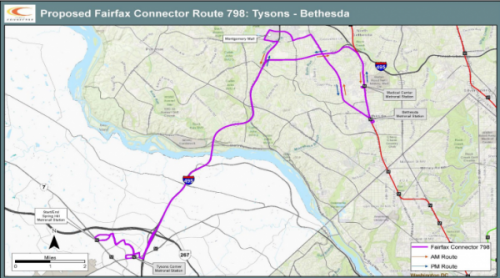
- Tysons Circulator Study: The Tysons Circulator Study identifies and recommends mode options, routes, right-of-way requirements and phasing for a transit circulator system in Tysons.
- Countywide Transit Network Study: Will identify necessary transit improvements to accommodate desired growth throughout the county over the coming decades.
- I-66 Environmental Impact Statement (EIS): Will study potential multimodal improvements to address existing and future transportation needs in the Interstate 66 corridor from U.S. Route 15, in Prince William County, to Interstate 495, in Fairfax County.
-
Fairfax County Transit Development Plan:
Ten year bus service plan for Fairfax County.
Roads
- Transportation Design Standards for Tysons Corner Urban Center, Memorandum of Agreement, September 13, 2011 and Transportation Design Standards for Tysons Corner Urban Center, Attachment D, September 13, 2011.
- Ramps to the Dulles Toll Road: The operational analysis and conceptual design of up to 3 new connections to the Dulles Toll Road as well as an analysis of the existing Dulles Toll Road connections to Rt.7 and Spring Hill Road.
- Jones Branch Connector: Conceptual roadway design for extending the Jones Branch HOT Lane connection to Rt.123, providing a new 1-495 crossing.
- Operational analysis of grid of streets for the whole of Tysons This analysis will evaluate the planned grid of streets in Tysons to determine how to make it function most efficiently.
-
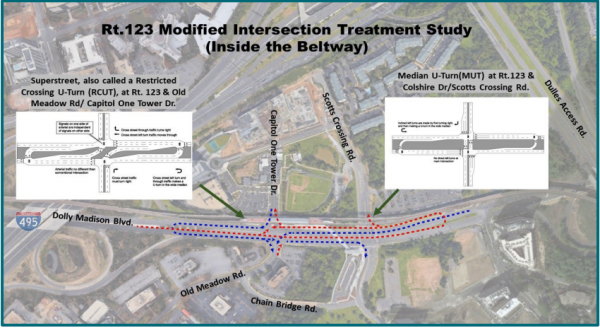
Neighborhood intersection improvements: Formulation of policies and
procedures, including measurable strategies to be included as part of
the overall plan monitoring, to address traffic congestion in
communities surrounding Tysons Corner.
Pedestrian and Bicycles
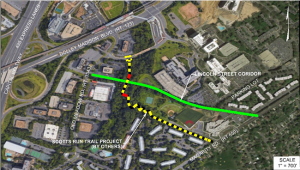
- Tysons Corner Bicycle Master Plan: A detailed plan to identify and implement bicycle facility improvements within a 3-mile radius of Tysons.
-
Tysons Metrorail Station Access
Management Study: Engages the public to identify and
prioritize transportation projects that improve bus, pedestrian and
bicycle access to the four new Metrorail Stations in Tysons.
Other
- Tysons Metrorail Interim Parking RFI(PDF file): The Tysons Metrorail Interim Parking Request for Interest seeks to identify opportunities to provide commuter parking at or near the Metrorail Stations in Tysons, on an interim basis, until the demand for development reaches a level where such parking is not practical or desirable.
- Tysons Multimodal Transportation Hub Analysis (PDF file): A document containing detailed plans for each Metrorail station in Tysons, outlining different transportation services that should be provided at each station as well as where these services should be located. The document aims to maximize the synergy between Metrorail service, bus transit service, car-share, bike-share and other pedestrian and bicycle oriented services to reduce the dependence on private automobiles in Tysons.
- Tysons Transportation Service District Advisory Board: On January 8, 2013, the Fairfax County Board of Supervisors approved the creation of a Tysons Transportation Service District, and the Tysons Transportation Service District Advisory Board. The advisory board will work with Fairfax County staff and provide input to the Board of Supervisors on the annual tax rate for the Tysons Transportation Service District; transportation project priorities for projects funded all or in part by the Service District; and, issues related to the Tysons road funds.


Website Survey