

Updates from the Health Department
July 3, 2025
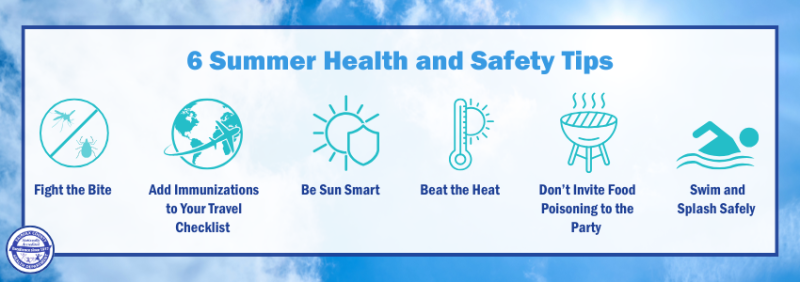
School is out, days are warm, and summer is here. Make the most of it with these six reminders for a healthy and safe summer.
Fight the Bite
Mosquitoes and ticks can ruin outdoor fun. Their bites are more than annoying — sometimes they transmit diseases. West Nile virus and Lyme disease are two of the vector-borne diseases transmitted by mosquitoes and ticks, respectively, in our region. Get in the habit of taking these simple prevention measures when you go outside:
Use insect repellents that contain EPA-registered active ingredients like DEET or picaridin.
Wear long, loose, light-colored clothing when outdoors.
Shower soon after outdoor activities; perform tick checks (on yourself, family members, and pets) after spending time outside.
Find more ways to fight the bite, including how to control mosquitoes and ticks.
Add Immunizations to Your Travel Checklist
International travel increases your chances of getting and spreading diseases that are rare or not found in the United States. If your summer plans including traveling outside the country, check to see what immunizations are recommended for the area you are visiting. Prior to traveling, you should also make sure you are up to date on all of your routine vaccines.
See what immunizations you need before traveling and where to get them.
Don’t Invite Food Poisoning to the Party
Food poisoning peaks in the summer months when warmer temperatures cause foodborne germs to flourish. From burgers at barbeques to potato salad at potlucks, there are steps you can take to prevent foodborne illness, such as cooking food to the correct temperature and storing it properly. Get more food safety tips.
Beat the Heat
Extreme heat is a period of high heat and humidity with temperatures above 90 degrees for multiple days. Extreme heat can be dangerous for everyone, but can be especially dangerous for older adults, infants and young children, and people with chronic medical conditions.
Learn to recognize warning signs and symptoms of heat-related illness, such as heat stroke and heat exhaustion.
Stay cool and stay hydrated.
Stay informed by paying attention to local weather. You can also follow us on social media and sign up for alerts from Fairfax County.
Be Sun Smart
Enjoy the outdoors without raising your risk of skin cancer by protecting your skin from the sun. UV rays damage the skin which leads to wrinkles and increases your risk of skin cancer. Remember, you can be exposed to ultraviolet (UV) light even on cloudy and cool days. Layer up on your protection to be sun safe.
Choose a broad-spectrum sunscreen that filters out both UVA and UVB rays with an SPF of 30 or higher and reapply regularly.
Wear protective layers like a wide-brimmed hat, sunglasses that block UVA and UVB rays, and protective clothing.
Whenever possible, find shade and avoid being in the sun when UV rays tend to be strongest — between 10 a.m. and 4 p.m. daylight saving time.
Swim and Splash Safely
Swimming, and other water-based activities, are a great way to be active while staying cool. Everyone should take steps to prevent illness and injury every time they are in and around the water.
Recreational water illnesses are caused by swallowing, breathing in mist, and having contact with contaminated water. Healthy swimming habits, like not swallowing water, can lower your chance of getting sick. It is also important to stay out of the water if you are sick with diarrhea, to rinse off before getting into pools, splash pads, and hot tubs, and to take young children on bathroom breaks and check diapers (away from the water) every hour.
Drowning often occurs quickly and silently. Follow these drowning prevention tips to keep you and your family safe while swimming:
Provide active supervision when children are in the water
Learn basic swimming skills
Learn CPR
Avoid swimming after dark
Watch for swimming hazards like rip currents and rough waters
Observe any advisories and listen to lifeguards
“Floaties,” arm bands, and water wings are toys, not safety devices
Ensure pools have proper safety features
It is also important to know what drowning looks like and how to prevent it.
June 25, 2025
From the Virginia Department of Health (VDH)
The Virginia Department of Health (VDH) was notified of a confirmed case of measles at Washington Dulles International Airport on Thursday, June 19. The confirmed case is an international traveler visiting North Carolina. Health officials are coordinating an effort to identify people who might have been exposed, including contacting potentially exposed passengers on specific flights.
Listed below is the date, time, and location of the potential exposure site in Virginia:
Dulles International Airport (IAD) on Thursday, June 19:
Concourse A, on transportation to the International Arrivals Building (IAB), and in the baggage claim area between 7:45 p.m. and 11:59 p.m.
Departures area of Main Terminal, East Security Checkpoint, on transportation to Concourse C and inside Concourse C between 8 p.m. and 11:59 p.m.
To date in 2025, Virginia has three reported cases of measles. For the latest information on measles cases and exposures in Virginia, please visit the VDH Measles website.
What should you do if you were at the above locations on the day and time specified?
If you have received two doses of a measles-containing vaccine, or were born before 1957, you are protected and do not need to take any action.
If you have never received a measles containing vaccine (either the measles, mumps and rubella [MMR] vaccine or a measles-only vaccine which is available in other countries), you may be at risk of developing measles. Anyone who might have been exposed and is considered to be at risk of developing measles should contact their healthcare provider immediately.
Non-immune individuals may qualify for post-exposure treatments. People who might have been exposed and are not immune should contact their health care provider or local health department immediately to coordinate administration of post-exposure prophylaxis.
Watch for symptoms for 21 days after the date of your potential exposure. If you notice symptoms of measles, immediately isolate yourself by staying home. Contact your healthcare provider right away. If you need to seek healthcare, call ahead before going to your healthcare provider’s office or the emergency room to notify them that you may have been exposed to measles and ask them to call the local health department. This call will help protect other patients and staff.
Anyone with an immunocompromising condition should consult with their healthcare provider if they have questions or develop symptoms.
If you have received only one dose of a measles-containing vaccine, you are very likely to be protected and your risk of being infected with measles from any of these exposures is very low. However, to achieve the highest level of protection, contact your healthcare provider about getting a second vaccine dose.
Measles is a highly contagious illness that can spread easily through the air when an infected person breathes, coughs, or sneezes. Measles symptoms usually appear in two stages. In the first stage, most people have a fever of greater than 101 degrees, runny nose, watery red eyes, and a cough. These symptoms usually start seven to fourteen days after being exposed. The second stage starts three to five days after symptoms start, when a rash begins to appear on the face and spreads to the rest of the body. People with measles are contagious from four days before the rash appears through four days after the rash appeared.
Measles is preventable through a safe and effective MMR vaccine. Two doses of the vaccine are given to provide lifetime protection. Virginia has high measles vaccination rates, with approximately 95% of kindergarteners fully vaccinated against measles. However, infants who are too young to be vaccinated, and others who are not vaccinated, are very susceptible to infection if they are exposed to measles. Infants six months through 11 months of age who will be traveling internationally, or to an outbreak setting, should receive one dose of MMR vaccine prior to travel. Talk to your healthcare provider if you have questions about the MMR vaccine.
To check your immunization status, call your healthcare provider or request your vaccination records using the VDH Immunization Record Request Form. Virginia residents with additional questions about their potential exposure can email epi_response@vdh.virginia.gov or contact your local health department.
For more information about measles, visit www.vdh.virginia.gov/measles/.
June 26, 2025
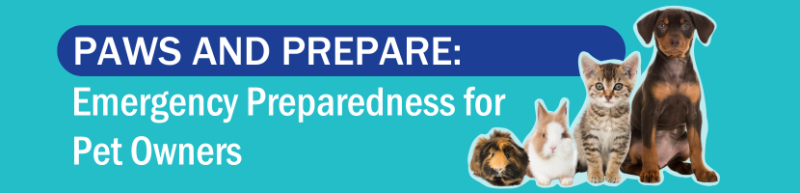
Our furry, feathered, and four-legged companions are part of our families. Just like people, pets can be vulnerable during disasters. Planning ahead can make all the difference in keeping them safe and healthy.
1. Plan Ahead for Service Animals
If you handle a service animal, their well-being is crucial to your own well-being and safety. Here are a few things to consider:
ID and Documentation: Make sure your service animal wears a collar with up-to-date ID tags and is microchipped.
Emergency Contacts: Identify a backup caregiver who understands how to care for your service animal so that you have support during a disaster.
Training: Work with your service dog to train them on specific tasks you might need their support with during a disaster.
2. Build a Pet Emergency Kit
Pack a dedicated emergency supply kit for your pets that includes:
At least three days' worth of food and water.
Your pet's medications, with copies of prescriptions and dosing instructions.
Vaccination records and recent medical history.
Leash, collar, harness, and carrier or crate.
Waste bags, litter, and other hygiene supplies.
Comfort items, like a favorite toy or blanket, to help reduce stress.
3. Protect Your Pet's Health
Disasters can disrupt access to routine care. Stay current on vaccinations and flea/tick preventatives, which can be even more important if your pet is around other animals during a disaster.
Know your vet's emergency plan. Some clinics may close during a major event, so ask how they handle after-hours care or where they refer patients in emergencies.
Keep a photo of your pet with you, both for identification and to prove ownership if you are separated.
4. Make Shelter Plans Now
Not all emergency shelters may accept pets, so it's critical to plan ahead:
Call ahead to a shelter to confirm if it accepts pets.
Consider friends or family outside your area who might be willing to care for or house your animals temporarily.
Have a plan for how to take your pets with you if you have to evacuate.
5. Stay Informed
Sign up for free Fairfax Alerts for timely emergency updates. In a disaster, official channels with share up-to-date information about shelters, health advisories, and other critical resources.
For more public health emergency preparedness resources, visit fairfaxcounty.gov/health/emergency.
June 23, 2025
As Pride Month fills the air with celebration and advocacy, it's a timely moment to recognize those who work tirelessly year-round to improve the health and well-being of the LGBTQ+ community. Among them is Mark O'Neil, a Community Health Specialist for the Health Department, whose work focuses on developing relationships with the LGBTQ+ community in Fairfax County.
Mark's journey into public health was a natural evolution of his passion for community. "Community health feels natural to me, but I wasn’t aware that it could be a career until after I started working for an LGBTQ+ youth program," he explains. His early experiences as an AmeriCorps service member in an LGBTQ+ youth program in Wisconsin, followed by statewide population health work and HIV/STI care navigation in San Francisco and Sonoma County California, laid the foundation for his current role. He joined the Fairfax County Health Department in October 2024.
At its core, Mark describes the role of a community health specialist as a "partner to the communities we serve." This involves offering health education, connecting individuals to vital resources, and building community capacity. For Mark, this translates into actively engaging the LGBTQ+ community in Fairfax County and Northern Virginia, fostering "lasting and authentic relationships with community leaders as well as agencies and programs that serve the LGBTQ+ community."
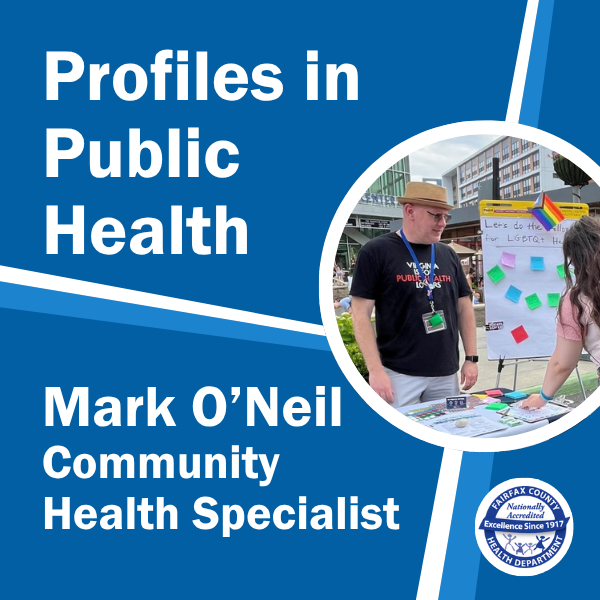
Mark O'Neil staffs an exhibit table at the Mosaic District's Pride event.
What truly drives Mark is the profound impact of his work. "I’m passionate about engaging with communities to show them that they are being seen, heard, and celebrated," he shares. This passion was vividly illustrated during recent local Pride celebrations. "I’m still basking in the gratitude that was given for being present," he recounts. He witnessed firsthand the relief and joy on young people's faces as they shared their thoughts on LGBTQ+ health issues. "Adolescence is a rough time for many and adding the layer of queerness to that can make it even more turbulent. By acknowledging that LGBTQ+ young people have a place to belong and be healthy in Fairfax County makes a difference."
Mark believes a critical challenge facing public health today is addressing the social determinants of health that fuel disparities among vulnerable communities. He advocates for a robust and well-funded public health infrastructure that genuinely engages these communities. His personal history deeply informs this conviction: "I’m part of a population that lost a full generation of people to AIDS. The initial response to that crisis was marked by slow, inadequate, and often dismissive action that preyed upon the community’s vulnerabilities rather than addressing root causes." For Mark, this historical context underscores the vital importance of his current work, ensuring that such failures are not repeated.
His biggest accomplishment, he states, is being "an out, gay man who shows up to work as my authentic self and can leverage that knowledge and experience to think strategically of the LGBTQ+ community." However, this authenticity also presents his biggest challenge: "it is particularly challenging to think well of your community in a climate where it is under attack and that parts of it are being systemically erased." Yet, he draws strength from this, reminding himself of his privilege and utilizing opportunities to amplify LGBTQ+ voices.
For those considering a career in public health, Mark offers simple yet profound advice: "As with any career choice, you need to be passionate about your work. Find what makes you happy, but I would also encourage you to try new things to refine that passion." He points to his own unexpected foray into maternal child health, initially outside his HIV/STI focus, as an example of how embracing new challenges can lead to unforeseen professional joys.
While Pride Month is a significant time for visibility and celebration, Mark O'Neil's work is a powerful reminder that the fight for equitable health and genuine belonging for the LGBTQ+ community is a continuous, year-round endeavor, built on authentic relationships and unwavering dedication.
During Pride Month, the Fairfax County Health Department encourages all residents to take pride in their health and wellness. Taking pride in your health means making decisions that benefit not only yourself but also your family, loved ones, and greater community.
Wash Your Hands Often
Mosquito & Tick Bite Prevention
Health Dept. Strategic Plan

Parents: Get your child's immunizations up-to-date!
 Ensuring children are up-to-date on their vaccinations helps provide immunity before they are exposed to potentially life-threatening diseases.
And remember, vaccination it important at all ages. Parents, grandparents, and caregivers, make sure you are up to date, too!