

Our Office of Environmental and Energy Coordination (OEEC) has released the 2025 Climate Action Progress and Highlights Report, documenting another year of significant gains toward reducing greenhouse gas emissions and building a more climate-resilient Fairfax County.
The report outlines progress across county operations and the broader community, including major steps forward in clean energy, sustainable development, climate-ready infrastructure and support for residents most vulnerable to the impacts of “warmer, wetter and weirder” weather.
While overall greenhouse gas emissions in Fairfax County have decreased by 4.2 million metric tons, or 28%, since 2005, emissions rose slightly between 2020 and 2023, according to the latest inventory from the Metropolitan Washington Council of Governments. This uptick is largely due to vehicle travel bouncing back from the reduced levels seen during the 2020 pandemic.
“Despite a challenging policy and funding environment at the federal and state levels, Fairfax County continues to move forward on climate action,” said OEEC Director John Morrill. “The progress we’ve made is the product of strong partnerships across county agencies and alongside community organizations, businesses, and residents.”
Key Highlights in Emission Reduction and Climate Resilience in 2025
- More energy efficient county facilities: The county’s first geothermal project at Spring Hill Recreation Center cut energy use by more than 30% in its first full year. Energy retrofits across county buildings since 2021 have delivered major savings, including over $660,000 in avoided utility costs in 2025 alone. An LED conversion of 93% of Dominion Energy-served streetlights, reducing electricity use by 56% since 2018.
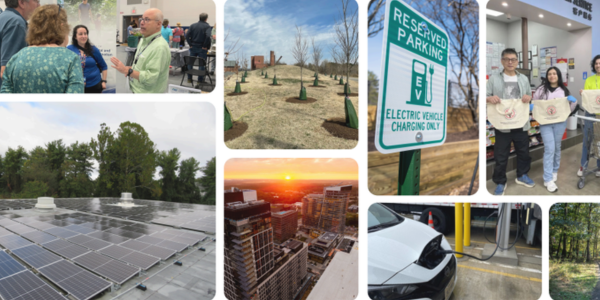
- Expanded solar capacity: Rooftop solar now operates on 13 county buildings with 1.8 megawatts of installed capacity — including a 350-kilowatt array at the I-66 Transfer Station expected to offset 24% of the facility’s electricity use.
- Progress on clean transportation and electric vehicle readiness: Nearly 13% of the county fleet is electric or hybrid, supported by 137 charging ports, while a $2.52 million federal grant and an Electric Vehicle Readiness Strategy are advancing community EV charging and prioritizing equitable access to EV infrastructure.
- Enhanced support for residents taking climate action: Fairfax Energy Compass, a new concierge-style program, is connecting residents with an Energy Navigator for individualized guidance on home energy efficiency, electrification, incentives, and contractors. The Sustain Fairfax Challenge offers a climate action tracking platform that engaged over 230 households in 2025.
- Stronger protections from flooding and extreme heat: A new Flood Risk Reduction Policy and resident-focused programs like the Flood Mitigation Assistance Program and Conservation Assistance Program supported more than 100 projects to reduce flood risk. The AC Rescue program and an expanded network of Cooling Centers and assistance programs helped low- and moderate-income and high-risk residents stay safe during extreme heat.
- Nature-based solutions and climate ready development: The Resilient Trees initiative and other tree planting efforts added more than 1,900 trees at schools and government sites, guided by climate and heat data. The county also advanced stream restorations, living shoreline planning, and Comprehensive Plan and Urban Design Guideline updates that integrate green infrastructure, conservation corridors, and climate adaptation into future development.
- Better climate data and coordination: The new Environment and Energy dashboard has been posted on the Countywide Strategic plan web site, and OEEC posted updated data on the Climate Action dashboard. Our partnerships with regional and academic institutions enhance the county’s ability to track emissions, rainfall, flooding, health risks, and plan implementation, supporting more informed, coordinated climate action.
“As climate impacts intensify, we remain committed to ensuring that all of our residents, especially those most at risk, share in the benefits of a sustainable, more resilient future,” Morrill said.
The full 2025 Climate Action Progress and Highlights Report is available on the Climate Action Dashboard, a single site for explaining and sharing progress with residents on the county’s climate action goals, data and key metrics.
To learn more about the county’s climate plans, programs and progress, visit www.fairfaxcounty.gov/environment-energy-coordination.
 SIGN UP FOR DAILY EMAIL HEADLINES