

Engagement Portal
 Engage Fairfax County is the official public participation portal that features select projects, surveys and opportunities to provide feedback as part of our commitment to inclusive community engagement.
Depending on the project, some feedback options include survey, text message feedback, email feedback, voicemail lines and translated surveys.
6 Core Principles of Inclusive Community Engagement
These principles illustrate our commitment to equity in the creation of public policy, projects, programs, and procedures. Community engagement efforts align with the One Fairfax policy. In prioritizing equity, it is critical that we acknowledge intentional and unintentional inequities as we move towards a more inclusive engagement process.
Work with communities in an honest and transparent manner, considering and respecting history, culture and trauma that may have impacted the community’s relationship with government. Share responsibility of process and outcomes through accountability and follow-through.
Equip staff and residents to utilize data to inform all aspects of the engagement process. Data will help us understand community traits, identify partners, determine goals and outcomes, and evaluate our work. Share data results with our community to create a shared vision and engagement.
What is the promise to the community? Develop clear and transparent processes and plans to achieve expected outcomes for the community. Identify appropriate roles and responsibilities.
Communicate clearly and openly to create opportunities for meaningful public input, broad community participation and engagement in the decision-making process. Aspire to exceed established standards and practices for open meetings, public comment and access to vital information and data. Encourage listening and sharing to facilitate the exchange and creation of ideas and information.
Collaborate with the community to ensure public engagement processes are broadly accessible to all members of the public to promote meaningful participation. Share information in multiple formats and languages appropriate to a given process.
Community Engagement Spectrum
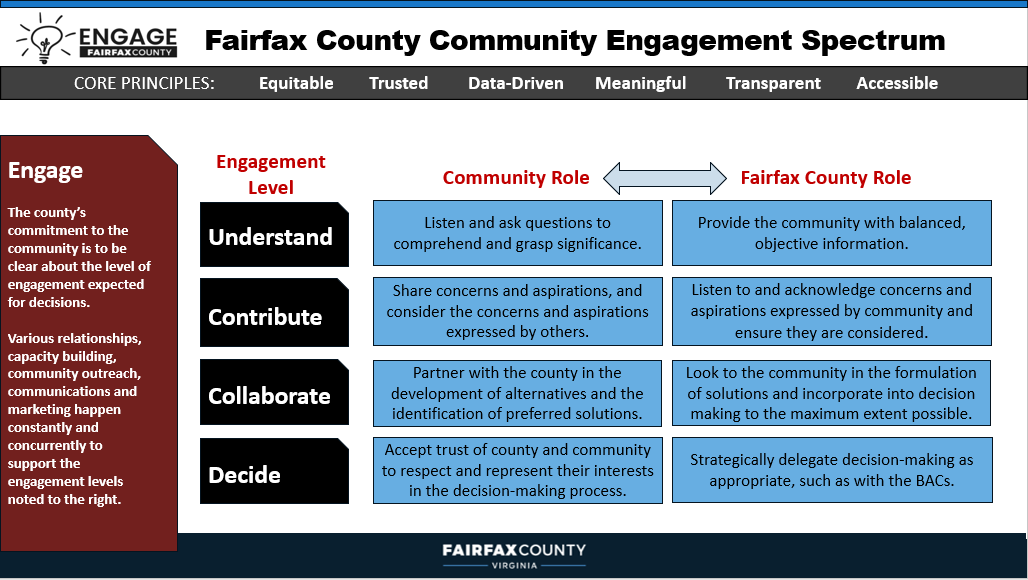
There are many models that illustrate levels of community engagement for a government and its residents. Many jurisdictions have adapted the International Association of Public Participation’s spectrum. For Fairfax County’s purposes, we’ve outlined a fresh approach below that integrates engagement principles, along with equity and relationship building (including an arrow that shows shared roles between the community and county).
Inclusive Community Engagement Considerations
Fairfax County is home to a diverse population, which is reflected in 180+ languages and dialects. Our engagement approaches must consider who we want to engage in our work and then shift our design to meet the needs of our participants, especially for the various languages spoken in the county. We must strive to create multilingual messages that are culturally competent. We recognize this commitment requires a human component and acknowledge there are some improvements that need to be made in this area. In addition, we must ensure language access is planned at the beginning of a process, as well as within public-facing technology solutions.
According to the U.S. Department of Education, more than 43 million adults in the United States cannot read, write or do basic math above a third-grade level, so literacy is important to consider when planning inclusive community engagement. Fairfax County includes people at all literacy levels. Our engagement must be inclusive of the needs for those in our community who are at lower literacy levels, including people from other countries and their native languages.
One way to achieve success is through the use of intentional plain language. We need to respect the time our residents engage, as well as the spectrum of literacy skills within our community. Plain language (also called plain writing or plain English) is communication our community can (ideally) understand the first time they read or hear it.
• Plain language gets our message across in the shortest time possible.
• There is less chance information will be misunderstood, so we spend less time explaining it to people.
• Acronyms, bureaucratic/government terms and legalese are limited as much as possible.
• Be concise – leave out unnecessary words. Don’t use jargon or technical terms when everyday words have the same meaning. Use words and terms consistently throughout documents.
• Plain language keeps literacy levels in mind since that's an issue identified in our root cause analysis.
• Plain language leads to easier translations into other languages.
Cultural, religious and linguistic differences impact how well we are understood and connected with important messages and community efforts. Culture is multidimensional, not only does it include race and ethnicity, but it also includes shared customs, values, rules of behavior, traditions and rituals, and perceptions. Culture is passed down from generation to generation. We can also look at culture through a systemic perspective – the cultural factors around the individual, the family/group and the broader community. It is important to consider the historical factors that are very much present today, including a history of enslavement, marginalization, racism, violations of trust and abuse. These factors have significant implications at the individual and community level with respect to collaboration, partnership building, and developing and maintaining trust and must be recognized in any engagement effort.
Accessible meetings promote meaningful participation from all in our community. Approximately 11 percent of Virginians have a disability. The right resources will need to be identified to support any requests for needed accommodations, such as American Sign Language interpreters, closed captioning, document adjustments and facility access. Related accessibility considerations include transportation and childcare availability.
Digital equity is a key consideration across our community, especially in a county our size where digital participation allows people from all over the county to participate. A recent One Fairfax workgroup explains:
“Digital equity ensures opportunities for Fairfax County residents to participate and engage in a connected community. The ability to access, understand and use digital tools is essential for many tasks in modern life, including applying for jobs, paying bills, enjoying recreational activities, completing homework, staying informed and connecting with government/community services.”
In Fairfax County, the ideal state of digital equity means:
1. Affordable digital hardware and connections
2. Awareness of digital resources and services
3. Access to specific digital tools
4. Advancement of digital literacy skills
In-person, face-to-face engagement (pre-pandemic) has its advantages, but a shift to virtual formats may be necessary to show we are still listening and meeting people where they are in their busy lives. From the perspective of our community, engaging online can provide a better engagement experience than the traditional face-to-face approach – no travel, more convenient and people can participate in a more relaxed manner. Moreover, in an online environment, younger people are more likely to participate, and introverts may find the experience less intimidating. Online engagement platforms can help reach a broader audience, and smartphone mobile technology is often more prevalent than laptops or desktop computers for many communities. Like in-person community engagement, virtual engagement requires a significant amount of planning time to determine purpose and appropriate methods to be successful. While planning, consider digital equity and technical access. Take into consideration these potential barriers to participation:
• Lack of internet access or unreliable/slow access
• Prevalence of mobile phones as a primary device to participate
• Sharing devices/connection with other family members
• Limited data plans
• Quiet space to participate
• Headset or headphones for better sound quality
• Access to a printer to print materials shared in advance
When engaging communities, whether it is a specific location or an identified population, we have to acknowledge that not all groups/ people/ communities have had the same experience with the county. The impact of county policies, programs and practices must be considered. This should be intentional and reviewed throughout the process.
A key consideration for community engagement efforts is the time we choose for meetings and gatherings. Traditionally, evening meetings have been the norm, but that’s not always ideal for parents, those who work evening jobs and for other reasons.