
CSB By the Numbers
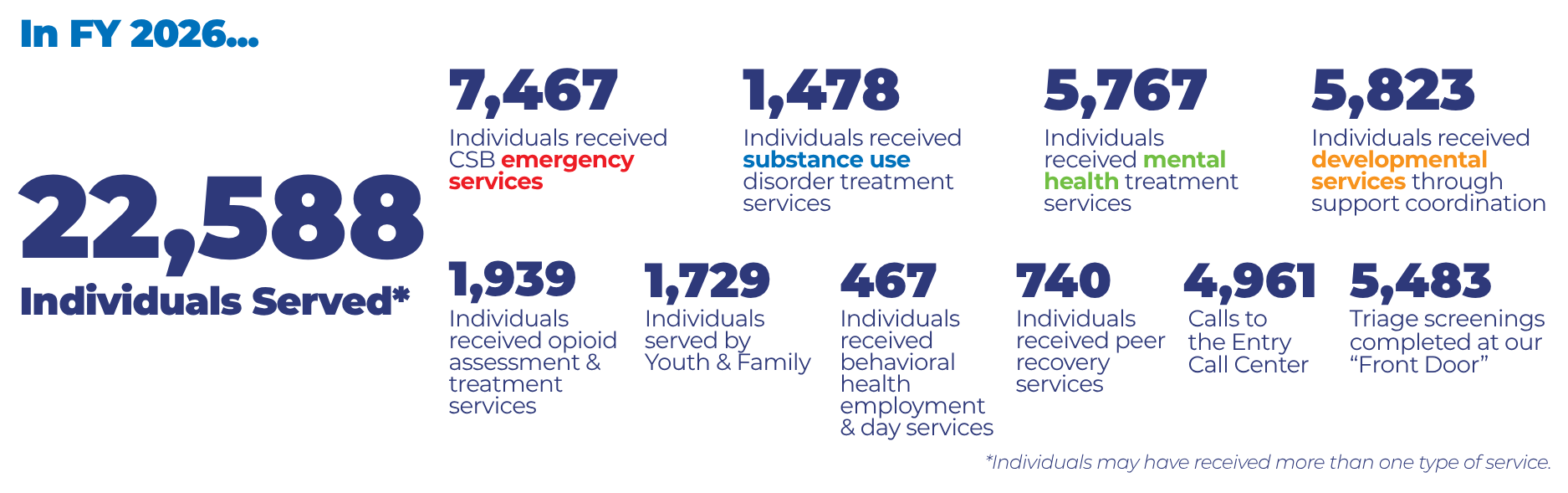
The Fairfax-Falls Church Community Services Board (CSB) provides lifesaving services to individuals experiencing mental health challenges, substance misuse and developmental disabilities. In Fiscal Year 2026, our team of more than 1,200 compassionate staff members were devoted to delivering transformative services to more than 22,500 individuals.
This annual report reflects on the achievements of the past year and showcases some of the milestones we will build upon as we continue to evolve to serve community members with behavioral health care needs and developmental disabilities.
While we celebrate where we make progress, we also remain focused on addressing the complex challenges in behavioral health and developmental disability services. In support of this, we are applying our three-year Strategic Plan launched in FY 2026. Reflective of input from nearly 1,000 stakeholders, this plan provides an intentional roadmap for focusing our work on serving our community efficiently, with agility, and in ways consistent with our values.
This annual report features the CSB’s key accomplishments and successes by the people we serve, who are at the heart of everything we do. Some highlights for FY 2026 include:
- Permanent Supportive Housing expansion fully launched and is already providing stability for individuals with serious mental illness.
- Chris’ Place opened in partnership with the Chris Atwood Foundation. This first-in-the-region program provides up to two weeks of crisis respite for individuals experiencing elevated distress related to mental health concerns or trauma.
- Diversion First celebrated a decade of cross-system collaboration that has transformed Fairfax County's approach to behavioral health and justice with a wide‑ranging continuum of services.
- The CSB partnered with the Fairfax County Health Department’s Public Health Youth Ambassador Program to launch a nine‑week Immersion Program and host the inaugural SPARK event, exposing students to behavioral health careers and a deepened understanding of both behavioral and community health.
- The Addiction Medicine Clinic launched the county’s first substance use disorder urgent care, which expanded operations to seven days per week.
The achievements of FY 2026 are truly reflective of the progress we can make when government agencies and community partners come together to prioritize meeting the needs of our community. These accomplishments are possible because of the support of Fairfax County Board of Supervisors, cities of Fairfax and Falls Church, CSB Board, and the collaborative spirit that our colleagues and partners in the region bring to solving real challenges.
Together, we remain true to our vision of building a stronger system so that everyone has the support they need to live a healthy, fulfilling life.
Jordan Scheff, CSB Executive Director
Andrew Scalise, CSB Board Chair
Key Highlights
The CSB provides a wide range of mental health and substance use treatment options to meet people where they are in their journey to wellness. Services range from outpatient to residential, with clinical work complemented by Peer Recovery Specialists who share their lived experience to connect with individuals.
Behavioral Health Outpatient Program
The Behavioral Health Outpatient Program (BHOP) provides services to adults in the areas of outpatient mental health therapy, outpatient mental health case management, intensive outpatient substance use, intensive outpatient mental health stabilization and first episode psychosis. BHOP works in collaboration with internal CSB programs to include nursing and medication management. BHOP also deploys staff to external facilities/partners, including Lincolnian and Stevenson Assisted Living and New Horizons Gateway Homes.
FY 2026 Highlights
- In FY 2026, BHOP provided expedited time to treatment, offering service orientations in under 10 days to individuals who accessed the CSB front door. This assured access to treatment at a time when individuals felt most motivated for change which enhanced success in treatment.
- BHOP worked closely with George Mason University, the Region 2 training office and Region 2 CSB partners to develop and support enhanced evidence-based practice development trainings to include Dialectic Behavior Therapy (DBT), trauma informed care, and enhanced culturally based assessments. This has led to strengthened offerings of DBT, Trauma Recovery and Empowerment Model (TREM), Cognitive Processing Therapy, and Intensive Outpatient Treatments for Substance Use and Mental Health.
- BHOP has worked this past year on a strong approach to suicide prevention by co-facilitating the CSB Collaborative Assessment and Management of Suicidality workgroup. The 18 teams in BHOP each now have an advocate, and the specialists come together monthly to discuss approaches and further develop training opportunities across the teams. As a result, serious incidents related to suicide have been on a steady decline.
- In FY 2026, BHOP served:
- 2,529 individuals through Mental Health Case Management services.
- 362 individuals through Mental Health Outpatient services.
- 278 individuals through Intensive Outpatient Substance Use Services.
- 73 individuals through Intensive Stabilization Unit services.
- 71 individuals through Turning Point First Episode and Clinically High Risk for Psychosis services.
“I wanted you to see the blessings you helped me to get, and to again say thank you”. — A BHOP Client showing the team photos of their new apartment.
Peer Recovery Services
Peer Recovery Specialists connect with individuals experiencing substance use disorder and/or mental health concerns. They share their personal experience of recovery, promoting hope, improved well-being, and increased engagement in services.
FY 2026 Highlights
- In March 2026, Chris’ Place opened, providing a regional Peer-Led Wellness Stay. Through a partnership with the Chris Atwood Foundation, this first-in-the-region program provides crisis respite for up to two weeks for individuals experiencing elevated distress related to mental health concerns or trauma. 78% of Chris’ Place guests reported improved overall wellness upon check-out.
- Recovery Services partnered with George Mason University to evaluate outcomes in selected peer recovery programs. Findings indicate the Peer Outreach Response Team has high engagement success rate with individuals from groups who often do not engage well with traditional behavioral health systems. For example, 62% of individuals served by PORT identified as Black or Hispanic, and these individuals experienced significant improvements in both recovery and social support outcomes. General recovery outcomes were statistically significant for all groups.
- The CSB launched peer practice exchange sessions for all CSB Peer Recovery Specialists staff. Similar to group supervisions, peer practice exchanges provide support for staff to maintaining high-fidelity peer recovery services.
“It was a mental vacation that feels like 14 months of therapy and healing in 14 days.” – Chris’s Place Guest
Permanent Supportive Housing
The Permanent Supportive Housing program provides stable housing and behavioral and primary health care services to people with serious mental illness.
FY 2026 Highlight
In FY 2026, Permanent Supportive Housing expansion fully launched the initiative. The initiative includes collaboration across multiple Fairfax County agencies, the Department of Behavioral Health and Developmental Services (DBHDS), and community nonprofit partners with a common goal to increase long-term, stable housing options for individuals with complex mental health needs. Since the program’s launch in early 2025 through June 2026, there were 96 referrals, with 27 individuals housed and several additional placements pending.
A Success Story: An individual who has lived in various congregate residential settings for the past 30 years, finally moved into his own Permanent Supportive Housing unit last month. Both he and his family expressed gratitude for this opportunity to live independently. In his own words, “I’m so excited for this chance. I have my own things and my own space.” This is one story of many where Permanent Supportive Housing Expansion provides individuals with dignity, independence and hope.
Nursing Services
Nursing Services provides support across all CSB clinical programs.
In FY 2026, 7,544 long-acting injections were administered. These long-acting injectable antipsychotics are psychotropic medications delivered by intramuscular injection. They provide sustained therapeutic levels for weeks to months and are used primarily for schizophrenia and sometimes for bipolar disorder. This can improve medication adherence and reduce hospitalization risk.
The CSB’s Developmental Disability (DD) Support Coordination program provides person-centered case management for individuals with developmental disabilities. Services include coordination of Medicaid Waivers, State Plan Option case management, and monitoring for individuals without a DD Medicaid Waiver to ensure ongoing connection to appropriate community supports.
FY 2026 Highlights
- 5,823 individuals served across Intake Assessment, Monitoring, and Waiver or State Plan Option case management.
- 2,378 individuals received Targeted Case Management (including those with an Active DD Waiver, State Plan Option, and those initiating a DD Waiver startup).
- DD Support Coordination launched State Plan Option case management in FY 2026, expanding access to targeted support for individuals without a DD Medicaid Waiver. Building on this rollout, the CSB plans to further expand capacity and eligibility in FY 2027 to ensure more residents can benefit from timely, person-centered coordination.
- The CSB supported a continued increase in DD Waiver distribution during FY 2026, initiating 304 new DD Medicaid Waivers that help residents access long-term, person-centered services that enhance stability and community inclusion.
- The CSB continues to maintain a Priority 1 waitlist. As the statewide effort to eliminate the Priority 1 waitlists draws to a close, the current list underscores the significant and ongoing demand for developmental disability services in this region. There are a total of 3,445 individuals receiving monitoring services. This includes 2,716 individuals on the DD waiver waitlist (1,108 Priority 1 individuals, 1,301 Priority 2 individuals, and 307 Priority 3 individuals).
The DD Support Coordination team continues to help individuals and families achieve meaningful, life changing progress and stability. Through collaboration, individualized planning, and persistent advocacy, we’ve supported people in rebuilding family relationships, reconnecting with their communities, and discovering new skills. Individuals who once avoided community settings are now able to participate in outings with loved ones, travel out of state to visit family, and engage in structured day programs and supportive living arrangements. Several individuals are also discovering new skills and opportunities, such as learning to cook independently, safely navigating the public transportation system, managing money and benefits, developing skills needed for employment or skills needed to interact and thrive in the community. These successes highlight the positive impact of the personalized supports that DD Support Coordinators put in place and the strong partnerships they build with families and providers, showing what’s possible when the right services are in place and people feel supported, empowered and understood.
Diversion First is a county initiative that provides alternatives to arrest and incarceration for people with mental illness, substance use disorders and/or developmental disabilities who come into contact with the justice system for low level offenses. The CSB partners with other county Health and Human Services System agencies, the public safety system, and the courts to provide community-based crisis response, jail-based services, specialty dockets, peer support and treatment services.
FY 2026 Highlights
- In FY 2026, we celebrated the 10th Anniversary of Diversion First, recognizing a decade of cross-system collaboration that has transformed Fairfax County's response at the intersection of behavioral health and the justice system by prioritizing treatment, recovery and community-based alternatives to arrest and incarceration. There have been more than 5,400 diversions from potential arrest since 2016.
- Diversion First was featured at the National Association of Counties' (NACo) Annual Conference. A feature video highlighted the county's cross-system initiative tremendous cross-system collaboration at the intersection of behavioral health and the justice system.
- The team strengthened workforce development by expanding specialized training opportunities that equip public safety, behavioral health and community partners with the knowledge and skills to effectively respond to individuals experiencing behavioral health crises.
- The CSB Jail-Based Team served 2,311 individuals in FY 2026.
- In FY 2026, the specialty dockets focused on expanding participant recovery support networks and involvement in pro-social activities and collaborated with the PORT team for peer supports. The dockets teams also partnered with the Chris Atwood Foundation (CAF) to expand peer services for Mental Health Docket participants, and CAF also offers groups for Mental Health Docket and Recovery Court participants. To date, over 160 participants have graduated from the intensive Specialty Dockets.
“The docket was my anchor. Even when I drifted away, it anchored me to hope. I struggled with addiction, and even when I messed up, the team didn’t let me drift away. They were always there.” — Veteran’s Treatment Docket Participant
The CSB offers a network of resources to help connect individuals to behavioral health care. There are also several supports available for individuals experiencing a mental health or substance use emergency to stabilize and find a path forward.
Emergency and Crisis Services
Emergency and Crisis Services offer assessment, intervention, stabilization and connection to ongoing care for individuals experiencing a behavioral health crisis.
FY 2026 Highlights
- 2,495 public safety calls received a response from Co-Responder Teams.
- Almost 70% of Fairfax CSB evaluations resulted in less restrictive referrals than a hospital setting.
- The CSB co-hosted the 2026 statewide conference, The Future of Crisis Services, highlighting best practices, de-escalation techniques and clinical interventions in emergency services. Wellness Circle presented Strategies for Implementing Trauma-Informed Programs at the conference. A particularly meaningful aspect of the presentation was the participation of a former Wellness Circle client, who shared their personal recovery journey following involvement in the Trauma Resilience Program. The individual described how gaining an understanding of the effects of trauma and learning practical coping strategies transformed their outlook, stating that they no longer felt hopeless or worthless. Their testimony powerfully demonstrated the life-changing impact of Wellness Circle's trauma-informed approach and reinforced the value of the Trauma Resilience Program in fostering recovery, resilience and hope.
- CSB members of the Crisis Intervention Team (CIT) received a Fairfax County Police Department Team Excellence Award in recognition of their collaborative efforts to revamp the CIT curriculum, expand training opportunities and establish the Fairfax CIT Alliance.
“Today, we brought my brother in for an emergency visit. I want to express our deepest gratitude for the extraordinary care [they] provided. I would also like to extend our appreciation to everyone we encountered during our visit. Each person treated us with kindness and courtesy during an incredibly difficult moment.”
Entry, Assessment and Referral
The Entry, Assessment and Referral unit includes both our Entry call center and our “front door” walk-in services. Together, these teams serve the community and a wide range of stakeholders across both public and private sectors who are seeking mental health and/or substance use assessments for adults, youth and families. When an individual’s needs are better met outside of the CSB, staff provide appropriate referrals and support in connecting them with services in the community.
FY 2026 Highlights
- The Entry Call Center fielded and responded to 4,961 calls. This public-facing line serves as the primary point of contact for the CSB.
- A total of 5,483 triage screenings were completed. These behavioral health questionnaires help determine the level of care an individual may need and referral to appropriate resources.
- Expanded the partnership with The Lamb Center to provide telehealth assessments to unhoused individuals directly from their location. As a result, 40 individuals were assessed and successfully connected with appropriate services.
- 96% of adults recommended for CSB Services accepted the treatment recommendation.
- 99% of youth recommended for CSB Services accepted the treatment recommendation.
“All of the staff that I interacted with today at the CSB were fantastic! Each person was kind, respectful, helpful, and caring. In particular, our intake was done by a staff member named Shelby and she was absolutely wonderful. She was a great listener and did an amazing job developing an understanding of our issues and identifying potential solutions. She was able to effectively address our immediate needs as well as our long-term needs. All in all, Shelby was outstanding and because of her and the other staff members we had a great experience today! Thanks to all of you for the important work you do!”
The Northern Virginia Regional Projects Office (NVRPO) manages and oversees regional initiatives for the five CBSs in the Virginia Department of Behavioral Health and Developmental Services Region 2. The Fairfax-Falls Church CSB is part of Region 2 and serves as the fiscal agent. NVRPO is responsible for the implementation of regional services through any Region 2 CSB and serves as the representative at the state level for the services provided in a regional program.
Regional Crisis Services
Northern Virginia Regional Crisis Stabilization Units provide short-term, community-based psychiatric treatment for individuals experiencing a behavioral health crisis who can be safely diverted from inpatient hospitalization. They offer a timely alternative to emergency department boarding, helping people receive appropriate crisis care more quickly while reducing demand on inpatient psychiatric beds.
FY 2026 Highlights
- There were 14,147 bed days used in FY 2026, an increase of 68% from 8,416 in FY 2025.
- Regional community capacity increased with the opening of the Regional Crisis Receiving Center in Woodbridge, VA, which added 32 recliners and 32 RCSU beds — 16 each of each for both adults and youth.
- The regional also added to the existing 16 beds in Chantilly and 16 beds at Wellness Circle. The region now has access to more resources that are keeping individuals out of the hospital and closer to home, near their natural supports.
"Connections Mental Crisis Unit is one of the best places to receive mental health help! I was there for about a week, and I can say everyone is by far the best! They are compassionate, kind, caring, and very helpful. Behavior specialists take their time with each patient and make sure they get everything they need. I really appreciate this place because I was able to get my thoughts in place. The providers and case managers are also amazing! I love this place."
Regional Training
The Regional Training Team offers trauma-informed, evidence-based, evidence-informed, and DBHDS training curricula for outpatient, crisis, and other identified clinician training needs across the region as part of a clinical service quality improvement initiative.
FY 2026 Highlights
- The Regional Training Team delivered training to 1,432 regional CSB staff through in-person and live virtual courses and regional conferences. This was a 12.5% increase over FY 2025.
- 76 clinicians completed DBT Fundamentals Training, a prerequisite for the internationally recognized DBT-Linehan Board of Certification.
- DBT sustainability initiative advanced with active Train-the-Trainer participation and established DBT Consultation Groups across all regional CSBs. 12 clinicians enrolled in DBT Train-the Trainer Program in FY 2026.
- 99.2% of the Regional Training and Development Conference survey respondents agreed that it met its mission “to provide a meaningful experience that leaves attendees with new ideas, renewed energy, and a deeper appreciation for the impact of their work”.
Regional Older Adult Facilities Mental Health Support Team Dementia Support Program
The Regional Older Adult Facilities Mental Health Support Team (RAFT) Dementia Support Program aims to give individuals living with dementia, their family, and their caregivers the information and tools to live with dignity, respect, and meaning.
- The RAFT Dementia Support Program celebrated their three-year program anniversary in January 2026, noting increased referrals, number of individuals served, and a high demand for training and respite care services.
- There were 304 referrals and 179 admissions to the Dementia Support Program in FY 2026.
“RAFT has been an incredible resource for my family and I. I have been connected to various resources and have been very supported, and I learn more about how to support my mother and navigate her journey. I as her caregiver don’t know how I would have been able to do this without RAFT.”
The CSB offers treatment, detoxification and recovery supports for people with substance use disorders. We also work with stakeholders across Fairfax County to address the opioid epidemic.
Addiction Medicine Clinic
The Addiction Medicine Clinic (AMC) is the county’s largest outpatient substance use disorder provider, consistently serving about 230 individuals with opioid use disorder, alcohol use disorder and co-occurring mental health disorders. It is the main source of outpatient medication for opioid use disorder within the CSB. The AMC is the service area that provides office-based addiction treatment, including outreach and engagement, aftercare for residential services, adjunct addiction medicine services for individuals in other CSB programs, and the AMC urgent care service.
FY 2026 Highlights
- AMC served 735 people in FY 2026, and we continue to see growth each year.
- AMC launched the county’s first substance use disorder urgent care, which expanded AMC operations to seven days per week at the Sharon Bulova Center.
- AMC partnered with Fairfax County Fire and Rescue on a field buprenorphine program, one of only a few in the country. This allows for first responders to offer buprenorphine after an overdose event, helping prevent a return to use and treating the acute withdrawal experienced after administration of Narcan.
An AMC Success Story: A person who we serve came to us during a time of significant instability. He was experiencing homelessness, actively using substances and struggling with strained relationships that left him feeling disconnected from those around him. Early in his recovery, he often approached situations with a sense of entitlement, making it difficult to build trust and accept support. Through consistent treatment, accountability and a willingness to embrace change, he gradually developed the skills and mindset needed to create a new path forward. Today, he has maintained more than seven years of sobriety and has transformed his life. He owns a successful business, has rebuilt meaningful relationships with family and others in his support network, and is now working toward franchising his company. His journey is a powerful example of how long-term recovery, perseverance and personal growth can lead to lasting success and inspire others that meaningful change is possible.
Detox and Residential Treatment
The Residential Treatment and Detoxification Division provides comprehensive care to adults aged 18 years and older with substance use disorders and co-occurring mental health conditions. Through evidence-based practices and individualized treatment, the division offers withdrawal management and residential services that support stabilization, recovery and long-term wellness.
FY 2026 Highlights
- 639 Individuals were served through Detoxification Center in FY 2026
- 240 Individuals were served in Crossroads and A New Beginning Residential Treatment Programs
- Detox Diversion and Outreach Services focused on connecting with individuals in the community who may need detoxification services, many of whom were experiencing homelessness or housing instability. Staff increased outreach by regularly visiting shelters, hospitals, community centers, and other locations throughout Fairfax County to build relationships, provided information about treatment, and helped individuals access care when they were ready. Diversion Services were a key referral source for the Detoxification Program, accounting for approximately 55% of all detoxification admissions through outreach, engagement, and community partnerships.
- A New Beginning developed a fully integrated Spanish-language program designed to meet the unique needs of the Spanish-speaking community. Services have been thoughtfully redesigned and tailored to meet the unique cultural and linguistic needs of the Spanish-speaking community, including individualized clinical curricula, recovery meetings, therapeutic assignments, educational resources, and culturally responsive programming delivered in Spanish. With Hispanic/Latino individuals accounting for 37% of total admissions and 55% of those admitted reporting a history of trauma, the program has had to evolve to enhance not only its service delivery but also its overall clinical approach to ensure high-quality care.
"Individual therapy really helped me work through my past and a lot of the pain I'd been carrying, and my primary counselor really helped me through it. Between that and the clinical groups, I picked up new skills for managing my emotions in a new way. Getting back on my medication made a big difference too. I relapsed and came back a few times, and every time, I felt welcomed. Never felt any judgment from the staff. Crossroads helped me get my life back on track." — A Crossroads Client
Opioid Response
Addressing the opioid epidemic is an immediate need and a longstanding priority in Fairfax County. The CSB, along with multiple county stakeholders, are partnering through Fairfax County’s Opioid and Substance Use Task Force to advance our opioid response strategy.
FY 2026 Highlights
- There was a 22% percent reduction in opioid overdose fatalities in the Fairfax Health district compared to 2024, and a cumulative 52% reduction in opioid overdose fatalities in the Fairfax Health District compared to 2023. There was a 16% reduction in non-fatal opioid overdoses in the Fairfax Health district compared to 2024.
- The Northern Virginia Adolescent Treatment Center opened in March 2026, filling a significant gap in the regional youth substance use treatment continuum. Fairfax County is the fiscal agent for this regional Opioid Abatement Authority Cooperative Partnership project with Acadia Healthcare and the five Northern Virginia CSBs.
- In February 2026, The Fairfax Prevention Coalition, the Opioid and Substance Use Task Force’s community engagement arm, launched a new Falls Church-based Youth Team comprised of youth in the Culmore neighborhood. This new team builds upon the Fairfax Prevention Coalition's existing substance use prevention work by expanding opportunities for young people to engage in leadership and community-based activities. In spring 2026, the coalition supported members’ participation in an event focused on gang and substance use prevention during which youth were trained on opioid overdose response and received naloxone.
The CSB works closely with other Fairfax County agencies and community providers through a variety of mechanisms to provide comprehensive support for the community.
Contracts and Supportive Services
The CSB's Contracted Employment and Day Support Services and Residential Support Services teams provide a range of supported employment and day support services for individuals with developmental disabilities, serious mental illness and/or substance use disorders. Working in collaboration with the Virginia Department for Aging and Rehabilitative Services, private businesses, and contracted community organizations, the CSB coordinates services that promote skill development, employment opportunities, community integration, and greater independence.
FY 2026 Highlights
- 1,347 individuals with developmental disabilities received Employment and Day Support and Self-Direct Services in FY 2026.
- 196 individual received developmental disability and mental health residential supports in FY 2026.
- The Behavioral Health Supported Employment team underwent a fidelity review for Individual Placement and Supports services in April 2026. The program was commended for high-quality work, strong agency commitment to competitive employment, and supportive and engaged leadership. The rating achieved will allow the team to begin billing for services in FY 2027.
- The Division of Contracts and Supportive Services continued to identify and implement cost-containment strategies in contracted services and Medicaid Waiver conversions, achieving substantial budget reductions while maintaining services and avoiding service eliminations.
“I wanted to take a moment to express my sincere gratitude and appreciation for Ms. Toni, my job coach. Throughout my experience working with her, she has consistently gone above and beyond in ways that have truly made a difference. What stands out most is her willingness to provide individualized support, take the time to understand my goals, and advocate for me every step of the way. Please know that her efforts have had a significant positive impact on my life, and I am extremely grateful for everything she has done.”
The CSB provides evidence-informed prevention services designed to reduce substance misuse, promote mental wellness, and strengthen protective factors among youth, families, and community members throughout Fairfax County. Our work includes community education, youth engagement, coalition development, awareness campaigns and training programs that increase community capacity to prevent substance misuse, respond to behavioral health concerns, and connect residents to resources.
FY 2026 Highlights
- The Wellness, Health Promotion & Prevention (WHPP) Team had a significant year of community engagement and prevention outreach. In FY 2026, the team participated in more than 82 community events, providing residents with access to prevention education, resources and connections to services.
- In FY 2026, the WHPP team continued to provide a wide range of evidence-informed trainings focused on suicide prevention, mental health promotion, substance misuse prevention, wellness and community resilience. The Talk They Hear You program experienced a particularly successful year, continuing to support parents, caregivers and community members by increasing awareness of the importance of communication, early prevention and supporting youth in making healthy decisions.
- Training highlights included:
- Talk They Hear You: 247 participants reached in 23 classes
- Opioid Overdose and Naloxone Education (REVIVE!) 1,060 participants trained in 64 classes. More than 17,650 individuals have been trained since the program’s inception.
- Question, Persuade, Refer (QPR) Suicide Prevention Training: 178 participants trained in 29 classes
- Adverse Childhood Experiences (ACEs) Training: 97 participants trained in 25 classes
- Activate Your Wellness: 94 participants trained in 9 classes
- Mental Health First Aid:
- 418 community members trained in 29 classes, including 9 custom trainings
- 388 Public Safety participants trained in 13 classes, including Fire and Rescue, the Sheriff’s Department, and the National Reconnaissance Office.
- Mental Health Education 101
- 158 participants trained in 11 Community-based Trainings
- 59 participants trained in 14 classes at the Adult Detention Center (ADC)
“I wanted to thank the Wellness, Health Promotion & Prevention Team for your room at the SPARK Event. I always knew that driving while impaired was dangerous but having the experience through your activities has really opened my eyes to how truly dangerous it can be and how many people you can impact.” — Public Health Youth Ambassador
The CSB continues to break down barriers to care, innovate treatment delivery, and collaborate with partners, to stregnthen the services that we provide to families across Fairfax County.
Youth and Family Services
Every child and family deserves the opportunity to thrive, and the CSB Youth & Family Services Team is committed to providing compassionate, evidence-based behavioral health services for children and adolescents ages 3–18. Through collaborative, community-based care, we empower youth, strengthen families, and foster resilience, recovery, and hope for a healthier future.
FY 2026 Highlights
- The Youth & Family Division strengthened Fairfax County's behavioral health safety net by serving more than 1,700 youth and their families.
- 1,511 Children and youth received outpatient services
- 319 youth served through intensive services
- 137 youth served through Juvenile Forensics.
- 262 through community-based teams.
- 71 through the Youth Medication-Assistance Treatment (YMAT) program.
- Youth & Family partnered with CSB's Equity and Support Coordination Divisions and the Department of Family Services to host the CSB Children's Mental Health Awareness and Acceptance Event at Clemyjontri Park. The event welcomed 231 children and 97 adults, as well as 22 community partners to celebrate the strengths of neurodivergent youth, reduce stigma, and connect families with services and supports.
- Throughout FY 2026, the Youth & Family Division implemented key operational improvements that expanded access to care and enhanced service delivery, including:
- Launching Same Day Service in partnership with CSB's Engagement, Assessment and Referral unit to provide timely assessments closer to homes and schools.
- Adopting new outpatient performance metrics that increased clinician time with clients.
- Expanding intensive therapeutic supports for parents, youth social skills, substance use, co-occurring disorders and transitional age youth.
Healthy Minds Fairfax
Healthy Minds Fairfax coordinates a full range of mental health and substance abuse services for children and youth across multiple county agencies, the school system and private treatment providers. We help youth and families in the Fairfax-Falls Church community access mental health and substance abuse services and improve the quality of those services.
FY 2026 Highlights
- More than 3,000 people visited the self-guided care navigation website.
- 513 children/youth received therapy through Healthy Minds Fairfax Short Term Behavioral Health Services.
“The experience was different in a good way. Everything was positive, and the attention was truly excellent. Sometimes, programs or help centers take a long time to get started, and you have to go through four or five meetings before therapy even begins. Here, I was assisted immediately and transferred to a therapist. I recommend them and tell people that if they need help, they should go to this program.”
Public Health Youth Ambassador Program Partnership
The CSB formed an impactful partnership with the Fairfax County Health Department’s Public Health Youth Ambassador Program (PHYAP). A cross-agency team of Youth and Family, Wellness, Health Promotion & Prevention, and administrative programs came together to launch an Immersion Program and the inaugural SPARK event. Through these pathways, the CSB equipped high school students with behavioral health education, career exploration and workforce development opportunities.
The SPARK event provided high school students with interactive learning experiences focused on behavioral health, developmental disabilities, prevention, wellness and career exploration. Students engaged directly with CSB professionals through hands-on activities, wellness exercises, impairment simulation activities and discussions designed to increase awareness of behavioral health careers and strengthen their understanding of community health. 97% of surveyed SPARK participants reported a positive experience.
“If I could describe it (SPARK) in one word, it would be inspirational…” Watch and hear their own words in this video.
FY 2026 Success Stories
An individual initially presented with severe depression, anxiety, PTSD, panic attacks, suicidal ideation, housing instability, memory difficulties affecting appointments and medication adherence, limited food access, and functional challenges. Although the individual declined therapy due to multiple stressors, the team provided supportive counseling along with referrals to a day program, food assistance, transportation, home-based care and housing resources. The individual developed coping skills through the day program, established a safety plan with reduced suicidal ideation, secured affordable housing, and successfully moved into a one-bedroom apartment. The team made additional referrals for home-based services, Meals on Wheels and furniture assistance. The individual reports feeling happy and stable in their new home and expressed appreciation for the support received from the treatment team.
A participant entered a CSB residential treatment program after years of struggling with intravenous substance use, repeated psychiatric hospitalizations and unsuccessful attempts to engage in treatment. Although he had been admitted to the program in the past, he was unable to complete the admissions process on several occasions. Rather than viewing these setbacks as failures, staff continued to welcome him back, offering encouragement and opportunities to re-engage when he was ready. During his most recent admission, he embraced treatment, was an active participant and became a positive influence among his peers, emerging as an informal leader within the therapeutic community. By successfully completing the residential program and engaging in discharge planning, he was connected to ongoing outpatient behavioral health and recovery support services that provided a strong foundation for continued recovery. He has since returned as an alumnus to provide support for current residents, offering his own experience as a source of encouragement to others still working through treatment. His journey demonstrates how persistence, hope and access to a comprehensive continuum of care can help individuals achieve meaningful and lasting change, even after multiple prior setbacks.
There was recently an individual who had a stable career and close family ties, when untreated schizophrenia gradually disrupted her life, leading to paranoia, legal involvement and homelessness. When the Forensic Discharge Planner (FDP) first met this individual in jail, she was homeless, disconnected from services and off her medication. Together they created a reentry plan focused on housing, mental health care, legal obligations and long-term stability. The FDP continued to support her after release. Because she was anxious about new providers, the FDP accompanied her to appointments, helped her build trust with CSB’s Intensive Case Management team, and supported her during court and probation meetings. With consistent support, this individual restarted her medications, gained and kept employment, complied with legal requirements and repaired family relationships. She is now actively engaged with the Intensive Case Management team.
Strategic Plan
The CSB announced the release of its FY 2026 - FY 2028 CSB Strategic Plan in September 2025.
This strategic plan will serve as a roadmap for further direction to continue providing quality services while remaining agile enough to adapt to the evolving needs of the community and meeting challenges faced along the way. It is the end product of nearly a year of thoughtful engagement and reflects input from nearly 1,000 stakeholders.
FY 2026 Expenditures
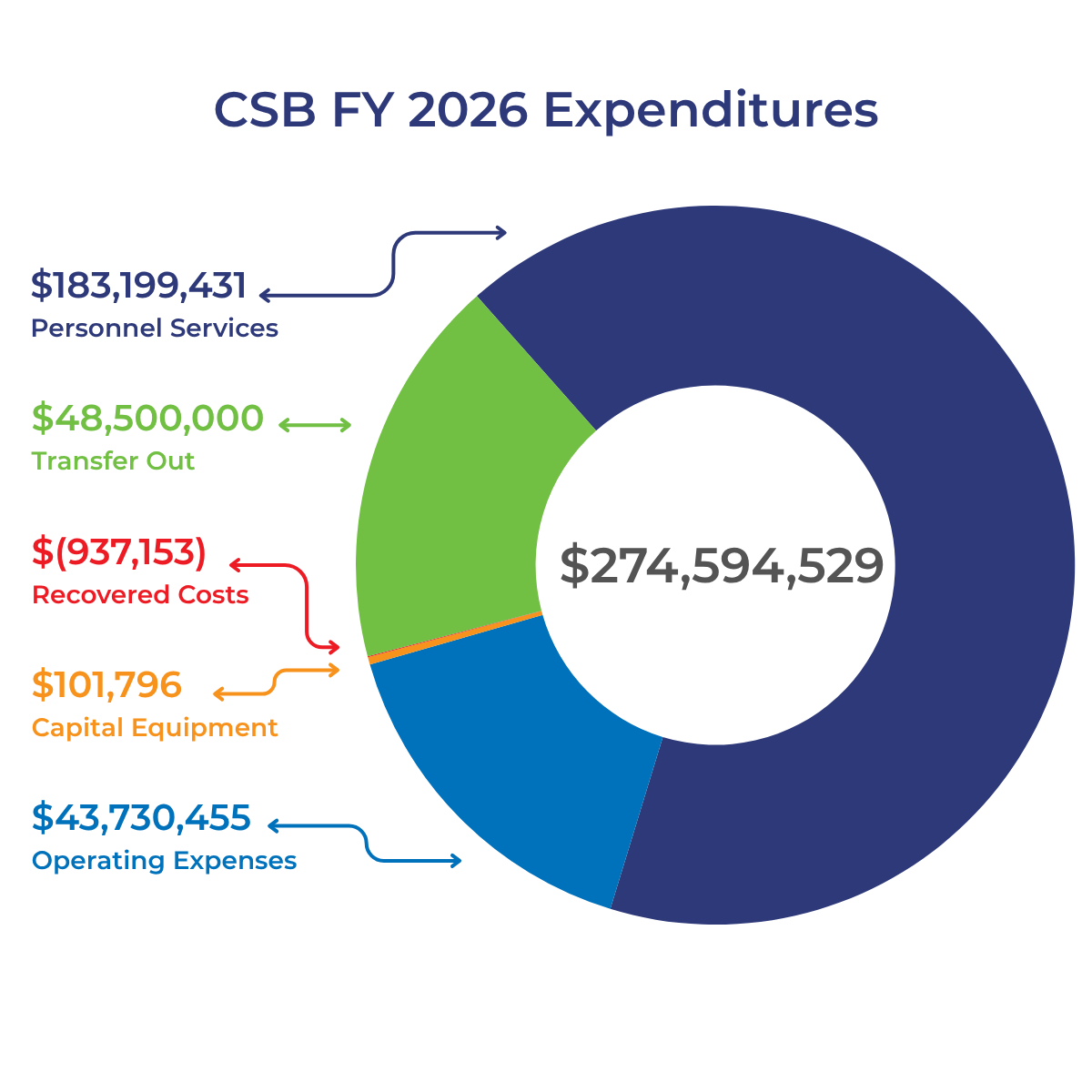
* Transfer Out includes both a one-time savings return of $7m to the County General Fund and a $41.5 million transfer to the County’s capital funds in support of construction projects, including Crossroads, the Youth Treatment Facility and the Adult Crisis Care Facility
Learn more about the CSB
Visit: CSB Board & Members | CSB vision, mission and values | CSB News
Stay connected
Sign up to receive our Health and Wellness Newsletter.
Image Descriptions
In FY 2026...
22,588 Individuals Served. Individuals may have received more than one type of service.
7,467 Individuals received CSB emergency services
1,478 Individuals received substance use disorder treatment services
5,767 Individuals received mental health treatment services
5,823 Individuals with developmental services through support coordination
1,939 Individuals received opioid assessment & treatment services
1,729 Individuals served by Youth & Family
467 Individuals received behavioral health employment & day services
740 Individuals received a peer recovery service
4,961 Calls to the Entry Call Center
5,483 Triage screenings completed at our “Front Door”
The donut chart shows CSB FY 2026 Expenditures which totaled $274,594,529.
- Personnel Services: $183,199,431 [Dark blue shading]
- Transfer Out: $48,500,000 [Green shading]
- Recovered Costs $(937,153) [Red shading that is barely visible due to its percentage of the total circle]
- Capital Equipment: $101,796 [Orange shading]
- Operating Expenses: $43,730,455 [Light blue shading]