Juvenile and Domestic Relations District Court - Court Services Unit Alert:

Over the past year, staff of JDRDC, Fairfax County Police Department (FCPD), and Fairfax County Public Schools (FCPS) expanded opportunities to divert youth from the juvenile justice system while still holding them accountable for their actions. The key components of the project included expanding the Alternative Accountability Program (AAP) and implementing a new juvenile intake process to encompass increased opportunities for diversion. These components ensure that youths' risks and needs are accurately identified and addressed while ensuring public safety.
JDRDC conducts intake assessments of all diversion eligible complains using evidence-based tools and a decision-making matrix that guides the determination of diversion in lieu of a petition. This assists with the identification of specifics program/services matching the juvenile and families' needs. Intake officers interview juveniles and families making service delivery decisions based on results from the assessments mentioned earlier. In addition, the Alternative Accountability Program (AAP) is now an option for all patrol officers in Fairfax County. AAP also serves Fairfax City, City of Herndon and the City of Vienna. AAP continues to be a primary option for School Resource Officers (SRO) and Patrol Officers to consider in lieu of filing a complaint at intake for eligible cases.
During FY 2018, JDRDC expanded services provided by Community Corrections to include pre-trial supervision for cases under JDRDC jurisdiction. These services allow offenders to remain in the community under supervision while awaiting trial. Officers perform pre-trial investigations resulting in formal court reports summarizing interviews with the defendant, the defendant’s family and community ties, financial resources, residence, history of employment, history of or current abuse of alcohol or controlled substance and criminal history. These investigations include the use of evidence-based assessment to identify the needs of the clients. The program provides support services, screening and investigative information to judicial offers to assist them in making informed decisions in determining risk to public safety. These services run parallel with Fairfax County’s Diversion First initiative. Diversion First offers alternatives to incarceration for individuals in contact with the criminal justice system for low level offenses and suffering from mental illness or developmental disabilities. The goal is to offer assessment, treatment and needed support while maintaining public safety. Without pre-trial services, many offenders spend significant amounts of time in jail before trial and or sentencing.
Over the past decade, the juvenile and criminal justice fields have developed a body of evidence-based approaches to intervention with youth and adults involved in illegal behavior. As a result, JDRDC has worked to incorporate many of these practice into intake, probation case management, and residential programs. JDRDC uses structured decision-making and risk assessment tools during the intake and case management processes, increasing the consistency and validity of case management decisions, improving system efficiency and enhancing public safety. This assists in further reductions in racial and ethnic disparity within the system. At the same time, JDRDC has worked to shift the philosophy of probation service from monitoring to one of service delivery focusing on behavior change. This shift includes extensive and continuous staff training in motivational interviewing, use of assessments, implementing evidence based interventions and cognitive processes focusing on factors specific to an individuals offending resulting in behavior change.
Through the development of a 5-year strategic plan, JDRDC identified family engagement as a priority initiative. Support for individuals, youth and families before, during and after their involvement with the juvenile justice system is important for continued success within the community. JDRDC formed a workgroup to lead the efforts within the agency. The group works to identify and develop strategies workers can use to engage and involve families at all levels within the juvenile justice system. The group conducted surveys of JDRDC staff and parents of youth currently or previously involved in probation or residential services. In addition, the group conducted focus groups with individuals and families who had experience interacting with various unties within JDRDC to gain a better understanding of what family engagement means to them and how, as clients, parents, individuals or consumers, they would like to be involved. JDRDC will implement a new family engagement curriculum during FY 2018 creating a unified philosophy in working with youth and families.
JDRDC focuses efforts on reviewing and restructuring policy and procedures around sanctions and incentives for youth on probation, disposition matrices and evaluating case processing times for juvenile court cases. During FY 2017, the Virginia Department of Juvenile Justice changed the requirements around the usage of the Detention Assessment Instrument (DAI) to assist in increasing equity for all youth. JDRDC is also reviewing and modifying policies and practices around graduated sanctions, incentives and the filing of probation violations for youth to address inequities. JDRDC’s internal workgroup continues to provide support and responses to recommendations included in previous reports. In addition, JDRDC continues to work with other Fairfax County Health and Human Service Agencies, the FCPS and the FCPD to identify ways to improve equity across the system.
The Gang Prevention and Intervention Coordinator facilitates the partnership with the Northern Virginia Gang Task Force to implement regional gang prevention initiatives, monitor the County’s internal initiatives and address human trafficking in Northern Virginia. The coordinator also works closely with law enforcement and Fairfax County Public Schools in providing gang prevention and awareness presentations to include human trafficking education.
Along with other departments in the County, JDRDC is taking steps to become a trauma‐informed agency. Collaboration between JDRDC and the CSB provides a team of professionals to address individual trauma treatment needs of youth involved in the court process. The team provides consultation, assistance with symptom screening, clinical diagnostic assessment, and referral to trauma‐specific treatment providers. The team also coordinates the efforts to establish trauma informed practices throughout the agency. JDRDC is participating in on‐going staff training and has completed an internal organizational self‐assessment to identify gaps in services for youth and gain a better understanding of how staff view trauma‐informed. JDRDC is piloting a new trauma screening instrument for youth on probation that identifies both trauma experiences and possible symptoms. This tool will allow juvenile probation officers and the trauma team to target specific behaviors that may need specialized treatment. During FY 2017, JDRDC and other agency volunteers evaluated the physical buildings housing JDRDC programming to be trauma‐informed. Administration shared results from the building evaluations and units are moving forward in creating trauma-informed spaces. JDRDC piloted training on the impact of secondary traumatic stress on staff members as a response to recommendations from the organizational assessment.
During FY 2018, JDRDC implemented a new mediation process within Domestic Relations transforming the way parties resolve custody, visitation and child support issues. This new program incorporates the benefits of the Intake Officers’ access to the clients, the resources provided within the county and the power of the court. If eligible, clients will be required to participate in mediation prior to court hearings. All mediation sessions should be completed within 4 weeks of the court order issuance date reducing court wait times and increasing the number of clients reaching agreement without judicial interference. JDRDC manages the overall mediation process including assigning cases to mediators, supervising internal and staff roster mediators, directing the flow of cases, resolving issues regarding the cases and their assignments, reviewing all court orders for compliance and serve as a liaison to the court. Many mediation sessions encourage participation in co-parenting or parallel parenting classes and family counseling. This expanded mediation program also helps reduce the stress and trauma on the children while promoting earlier resolution of the issues and encourages a collaborative approach over an adversarial approach to these critical family issues.
In FY 2017, the State Justice Institute awarded JDRDC a technical assistance grant to complete a Juvenile Probation System Review. Consultants from the Robert F. Kennedy National Resource Center for Juvenile Justice will complete the review over the next 8 months. The process includes a review and examination of policy, practice and service provisions designed to inform immediate opportunities for system enhancement, improvement and reform. The review continues efforts to meet the needs of youth and families involved with JDRDC. At the end of the review, RFK will present a report of findings and recommendations to enhance system practice, performance and access to evidence-based services to improve youth and family outcomes.
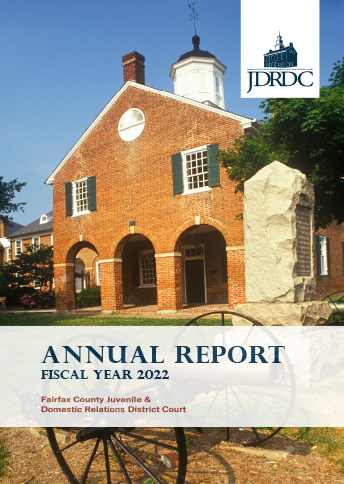
In 1800, Fairfax County moved its court to a new building at the point where Little River Turnpike (then being built) would cross the county's main north-south road. The site became known as Fairfax Courthouse.
Construction of turnpike roads linking Alexandria and Washington, D.C. to the Shenandoah Valley increased the activity that centered in Fairfax County's courthouse square when the county court met. Informal markets for farm produce and home handicrafts, trading of horses and other livestock, and transactions of all kinds brought visitors from the surrounding region. On the courthouse grounds, they mingled with others who came merely to exchange news and see friends. In the 19th century, much of the social and economic life of rural Virginia grew up around the monthly or quarterly "court days."
Throughout the Civil War, Fairfax Courthouse stood between the Union and Confederate armies, and was used first by one and then by the other as a patrol checkpoint and signal station. Action began in June 1861 when Union cavalry skirmished with Confederates occupying the grounds. A marker on the present courthouse lawn commemorates the death of Captain John Quincy Marr of the Warrenton Rifles. During the war years, county government was disrupted, although some essential functions were carried on by groups located in both Union and Confederate territory. Regrettably, not all of the court's records were removed to safety during this time, and some were damaged, destroyed, or carried away, and have never been recovered.
In the past century, Fairfax Courthouse has reflected the county's growth. The traditional courthouse square gave way to the addition of new wings to the old 1800 building. These major additions, constructed in 1929 and 1953, extended the courthouse southward to form the present building. For a time, all major county offices were housed in the new courthouse. However, the county's growth soon required expansion of services and utilization of other buildings.
In 1969, a multistory county office building was built immediately southwest of the courthouse, to provide space for the Board of Supervisors and many expanded county offices. Continued expansion of the court's business and need for more space resulted in construction of the Judicial Center, Jennings Building, which has housed the Circuit Court and the General District Court since its completion in 1982. Since 1957, when the Juvenile and Domestic Relations District Court was established as a separate entity, the Fairfax Courthouse has been its home but for the period from 1965 to 1971.
Excerpts from: The Fairfax County Courthouse-1800, published by the Board of Supervisors in 1977, and The Fairfax County Courthouse, by Ross Netherton and Ruby Waldeck, published in 1977.
Public parking is available in Garage B on Page Ave, between West Street and Judicial Drive, for a charge of $2.50 per hour with a $12.50 daily maximum. ACCESSIBLE PARKING, with proper DMV permit, is available on the complex’s SURFACE LOTS. Overflow accessible parking is available in Garage B, floors 1-4. There is an elevated walkway from the 4th floor.
Maximum height in the parking garage is 7' 2". Very tall and/or commercial vehicles that exceed 7' 2" will need to make other parking arrangements. Follow the public Parking signs on the streets around the court.
Arrive at least 30 minutes early to allow time to find a parking space and walk to the courthouse.
Parking in lots marked with "Decal Only Parking" signs or other reserved lots Monday-Friday between 8 am & 4 pm will result in a monetary fine and possible towing.
Anyone entering the courthouse is subject to security screening. Additional information regarding screening and allowed/prohibited items is available from the Sheriff's Office.
The court rarely closes unless the weather is extremely hazardous or if emergencies arise that impact normal court operation. When that occurs, local radio and television stations will be notified and requested to announce the closing. Important announcements are also posted on the County of Fairfax Web Page.
You may contact 703-246-SNOW (7669) for detailed closing information.
We follow the closings for the Fairfax County Courthouse, Fairfax County Juvenile & Domestic Relations District Court, or Fairfax County Government, not the Public Schools.
The Courthouse Cafeteria is located on the lowest level of the courthouse.
The JDRDC complies with the non-discrimination requirements contained in various federal laws. It is the policy of JDRDC Services to comply with all aspects of the goals and objectives of the Fairfax County Diversity Plan and One Fairfax Initiative. This policy statement affirms our intention to ensure non-discrimination in all employment and client service delivery. The practices for all clients, employees, and applicants is fair and respectful treatment regardless of race, color, creed, religion, age, disability, national origin, sexual orientation, veteran status, political affiliation, marital status, genetic information, or union, affiliation, and to comply with the Americans with Disabilities Act. Special accommodations when necessary and reasonably available.