
This page is best viewed on a desktop or laptop. Mobile users may experience issues while navigating this page.
Please continue scrolling below the dashboard for an introductory message from Commonwealth's Attorney Steve Descano.

This page is best viewed on a desktop or laptop. Mobile users may experience issues while navigating this page.
Please continue scrolling below the dashboard for an introductory message from Commonwealth's Attorney Steve Descano.
AN INTRODUCTORY MESSAGE FROM COMMONWEALTH'S ATTORNEY STEVE DESCANO
Why is data critical to our operation?
Before even taking office, I began working to launch a sophisticated data operation that would allow my team to track progress toward our vision for building a more effective and just legal system. I also aimed to use data to make good on my promise to increase transparency.
As we build our data operation, my team will be using data to inform our decision-making in service of our community’s values and needs – and we hope you, the community, will use it to keep apprised of our progress.
Why is cash bail and pre-trial detention data critical to our operation?
One of the first reforms I rolled out after swearing my oath of office was to direct all prosecutors on my team to stop requesting cash bail. My bond policy requires our prosecutors to make pre-trial detention recommendations based on whether a defendant represents a danger to the community and, therefore, removes a defendant’s wealth as a factor in determining whether they are held.
This dashboard provides some initial insights regarding the impact of this policy.
But, before you immerse yourself in the data, it’s important to take a step back and consider how these decisions are made and our team’s role in making them.
How, exactly, do cash bail and pre-trial detention work? What is the prosecutor’s role in all of this?
Initial prosecutorial involvement
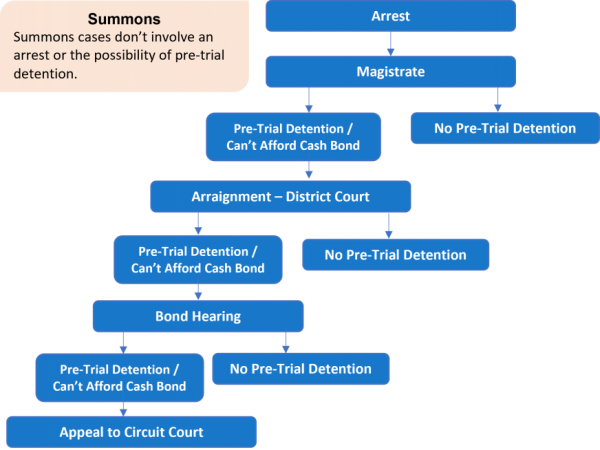
When someone is arrested, a judicial officer (a magistrate or judge) determines whether that person is held in pre-trial detention, released back into the community during the pre-trial period, or given a “cash bail,” which is an amount of money that person must pay if they wish to be released during the pre-trial period. If someone is released pre-trial, they are released “on bond” and the rules the released person must adhere to are their “bond conditions.”
There are multiple stages after an arrest during which a judicial officer makes a pre-trial detention decision. At all those stages, all detention determinations are made solely by the magistrate or judge. At the initial two stages – the magistrate’s assessment at the point of arrest and the arraignment – the judicial officer makes a decision without any recommendations from prosecutors or defense attorney. It is only after the first two stages, at what is called a Bond Review Hearing, that the prosecutor and defense attorney have an opportunity to argue their views on pretrial detention to the judge, who still makes the ultimate decision.
The twin goals of my office in these proceedings are to promote community safety and accountability. By focusing on these two goals, we aim to recommend pre-trial detention only for those defendants who represent a danger to the community should they be released or those who are such a flight risk that the only way to ensure accountability is pre-trial detention.
Community safety
Long-term community safety is served by detaining those who represent a danger pre-trial and releasing those that don’t represent a danger. Delineating between those two categories requires balancing the immediate benefits of keeping certain individuals away from the community with the well-documented long-term consequences stemming from pre-trial detention (e.g., loss of jobs, housing, family cohesion, etc.) that can lead to increased long-term recidivism. Only when the former outweighs the latter will prosecutors recommend pre-trial detention for reasons of dangerousness.
Cash bail does not support community safety
Granting cash bail for a person who represents a danger to the community gives that person a mechanism to leave jail and go back to that community. Conditioning release on cash bail for individuals who do not represent a danger to the community acts as an unnecessary barrier to them returning to their community and may lead to the loss of a job, housing, or other negative collateral consequences—increasing the odds that they will engage in crime in the future. It is therefore more consistent with public safety goals to simply make pre-trial release determinations based on a person’s dangerousness to the community and, where applicable, the available supervision and bond condition options available to those on pretrial release.
The use of cash bail changes the driving force for pre-trial detention outcomes from dangerousness to wealth. The more cash bail is used, the more common it will be for wealthy people who represent a danger to the community to be released pre-trial and those without wealth who do not represent a danger to the community to be detained pre-trial. This creates a two-tiered system of justice that undermines the principles of equal justice and fairness. Cash bail is often used as a “middle ground” to avoid making difficult decisions about whether individuals represent a significant danger to the community should they be released. It allows for simultaneous arguments that individuals given a cash bail were detained pre-trial (“they weren’t just released—they had to pay”) and also not detained pre-trial (“they weren’t detained—they just had to pay to be released”). Because our office focuses on community safety and is aware of the negative consequences of both detaining someone pre-trial due to poverty and allowing a dangerous person to pay their way out of pre-trial detention, our policy prohibits prosecutors from requesting cash bail be imposed.
Accountability
As I mentioned prior, ensuring accountability is also a goal of the team. Conducting a “flight risk” analysis that is distinct from the “dangerousness” analysis ensures that we seek pre-trial detention for those who represent a flight risk that cannot be appropriately mitigated. But this is generally unnecessary because the bond conditions available in our system are typically adequate to address any flight risk.
Making recommendations
Fairfax prosecutors consider a range of factors in determining whether a defendant poses a significant danger and/or flight risk to the community such that pre-trial detention should be recommended. Our prosecutors do not reflexively recommend detention for whole categories of crime because this would lead to releasing some individuals who, in fact, might pose a safety threat or insurmountable flight risk and detaining others unnecessarily. Instead, ACAs perform an individualized and holistic review by taking into consideration the circumstances surrounding an alleged crime, the criminal record of a defendant, and a risk assessment performed by Pre-Trial Services that helps to determine the likelihood an individual might re-offend, among other factors.
Our bond policy guides prosecutors in their decision making via different presumptions based on the type of charges faced by defendants. For those accused of non-violent crimes, our prosecutors start their analysis with a strong presumption of pre-trial release and will recommend pre-trial release unless that presumption is rebutted by the aforementioned factors. For those accused of crimes of violence, crimes of a sexual nature, or crimes where the victim is a child, prosecutors do not start their analysis with a presumption of pre-trial release. Simply put, recommending release for someone who is accused of a shooting requires substantial evidence that the individual does not pose a danger to the community. Requesting that someone accused of shoplifting be detained requires substantial evidence that they, in fact, pose a danger.
Cases presented at a Bond Review Hearing are a small minority of all cases handled by the Fairfax Office of the Commonwealth's Attorney (OCA)
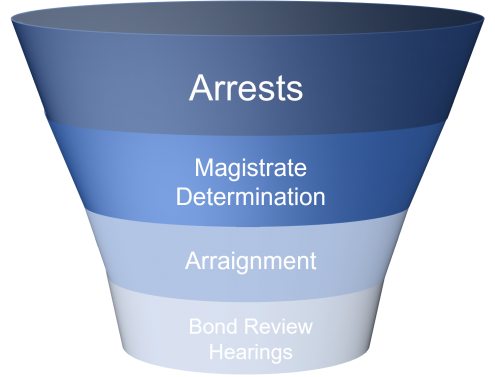
It is important to note that cases in this dashboard represent only a small minority of cases handled by our office. Although we have the highest caseload of any Commonwealth’s Attorney’s Office in Virginia and are one of the few in Virginia that staffs all felony and all misdemeanor cases, this dashboard only shows cases that have a Bond Review Hearing. Recall that a Bond Review Hearing takes place only after a magistrate has made their detention determination and a judge has made their detention decision as part of an arraignment hearing, neither of which involve a prosecutor or defense attorney.
The first Bond Review Hearing takes place at the District Court level. Depending on the nature of the charged offense, the hearing will either take place in General District Court or Juvenile and Domestic Relations District Court. This Bond Review Hearing is the first opportunity for the Commonwealth’s Attorney’s Office and defense counsel to argue their position on a defendant’s release. The District Court Judge rules after hearing argument. The District Court’s ruling can be appealed to Circuit Court. In Circuit Court, again the Commonwealth’s Attorney’s Office and defense counsel argue their position on the defendant’s release and the Circuit Court judge rules after hearing the argument. At either Bond Review Hearing, the presiding judge can hold the defendant in pre-trial detention, release them back into the community during the pre-trial period, or assign a cash bail that must be paid before they can be released.
Continued integration of data
I hope you benefit from this initial peak into our operation with regards to one of our priority reforms. In the coming months we will share more data as we continue to build our data operation and use the data we collect to continuously improve our decision-making.
Onward,

Steve Descano, Fairfax Commonwealth’s Attorney