

Fairfax County, Virginia
Fairfax County Virginia

FFX Global Navigation

    • Contact Us
  • Residents
    • Animals & Pets
      • Adoptions
      • Animal Control & Regulations
      • Guide to Dogs
      • Lost & Found Pets
      • Shelter Support & Supplies
      • Wildlife
      • More
      Courts & Legal
      • Case Information
      • Circuit Court Docket
      • Jury Duty
      • Land Records
      • Magistrate
      • Public Law Library
      • Self-Help Resources
      • Traffic Court
      • Vital Records
      • More
      Environment & Energy
      • Invasive Species
      • Litter
      • Recycle, Trash & Compost
      • Sustain Fairfax
      • Trees
      • Watersheds
      • More
      Health & Human Services
      • Basic Needs & Assistance
      • Disability Services
      • Diseases & Conditions
      • Domestic & Sexual Violence
      • Health Clinics
      • Mental Health
      • Opioids
      • More
      Individuals & Families
      • Children & Youth
      • Federal Workforce
      • Immigrants
      • Military & Veterans
      • New Residents
      • Older Adults
      • Parents
      • People with Disabilities
      • Volunteers
      • More
      Land Use & Planning
      • Comprehensive Plan
      • County Capital Projects
      • Land Records
      • Parks Planning
      • Planning Projects
      • Research Tools
      • Transportation Projects
      • Urban Centers
      • More
      Library & Education
      • Adult Education
      • Early Childhood Programs
      • Library Branches
      • Library Catalog Search
      • Public Schools
      • More
      Parks & Recreation
      • Arts
      • Athletic Fields
      • Camps
      • Community Centers
      • Parktakes Classes
      • Rec Centers
      • Senior Centers
      • Teen Centers
      • Trails
      • More
      Permits & Licenses
      • Birth & Death Certificates
      • Building
      • Child Care
      • Dogs
      • Health
      • Marriage
      • Park Use
      • Solicitors
      • More
      Property & Housing
      • Affordable Housing
      • Code & Zoning
      • Neighborhoods
      • Real Estate Values
      • Recycling & Trash
      • Tenant Landlord Issues
      • Utilities
      • More
      Public Safety & Emergencies
      • 9-1-1
      • Emergency Preparedness
      • Fire & Rescue
      • Gun Violence Prevention
      • Police
      • Scams
      • Sheriff
      • Storm Center
      • More
      Roads & Commuting
      • Bike & Walk
      • Connector Bus
      • Metrobus & Metrorail
      • Park & Ride
      • Pedestrian Safety
      • Road Maintenance/VDOT
      • Street Parking
      • Toll Roads
      • Transportation Projects
      • More
      Taxes & Fees
      • Car Taxes
      • Park Fees
      • Real Estate Taxes
      • Tax Relief
      • Trash Disposal Fees
      • More
      Voting & Elections
      • Absentee Voting
      • Early Voting
      • Election Results
      • Polling Places
      • Voter Registration
      • More
      Weather & Climate
      • Air Quality
      • Climate Action Dashboard
      • Extreme Heat
      • Floods
      • Ready Fairfax
      • Resilient Fairfax
      • Snow
      • Tornadoes
      • More
  • Business
    • Business & Construction
      • Building Permits
      • Code & Zoning
      • Land Use
      • More
      Business Services
      • Business Emergency Preparedness
      • Business Taxes
      • Consumer Services
      • Employer Transportation Service
      • Green Business Partners Program
      • Home-Based Business
      • Regulation & Licensing
      • Small Business
      • Starting a Business
      • Workplace Issues
      • More
      Doing Business with Fairfax
      • Contracting and Procurement
      • Current Solicitations
      • Permits
      • Vendor Pitch Portal
      • More
  • Government
    • About
      • Codes & Standards
      • Countywide Strategic Plan
      • Facilities & Locations
      • History of Fairfax County
      • Operating Status
      • More
      Board of Supervisors
      • Auditor
      • Board Members
      • Boards, Authorities & Commissions
      • Clerk Services
      • Committees
      • Meetings & Agendas
      • More
      Budget & Finance
      • Bonds
      • Budget
      • Financial Transparency
      • Unclaimed Money
      • More
      Departments & Agencies
      Jobs & Employment
      • Full-Time Openings
      • Internships
      • Seasonal & Non-Merit
      Maps & Data
      • Countywide Data Analytics
      • Demographics
      • Geographic Information Systems
      • Interactive Data Tools
      • More
      One Fairfax
      • Digital Equity
      • Inclusive Engagement
      • Trust Policy
  • Fairfax County Virginia
  • Services
    • Find
      • Animal Services
      • Health Clinics
      • Jobs
      • Library Resources
      • Lost or Found Pet
      • Mental Health Support
      • Park Classes
      • Real Estate Values
      • Recycling & Trash
      • Volunteer Opportunities
      • More
      Pay
      • Business Taxes
      • Car Taxes
      • Dog Licenses
      • Driving & Parking Fines
      • False Alarm Fees
      • Real Estate/Property Taxes
      • SACC Payments
      • More
      Register/Apply
      • Basic Needs & Assistance
      • Building Inspections
      • Car Registration
      • Fairfax Alerts
      • Permits & Licenses
      • Tax Relief
      • Vote
      • More
      Report
      • Animal Control Issues
      • Consumer Complaints
      • Crime
      • Domestic Violence
      • Financial Crimes
      • Neighborhood Complaints
      • Road Issues to VDOT
      • Street Light Outages
      • More
  • Connect
    • Alerts, Emails & Apps
      • Email Subscriptions
      • Fairfax Alerts
      • Mobile App
      • More
      Community Engagement
      • Surveys & Projects
      Contact
      • Directory
      • Hotlines & Emergency Numbers
      • VDOT
      • VFOIA Requests
      • More
      News & Events
      • Daily Headlines
      • Emergency Information Blog
      • Events Calendar
      • NewsCenter
      • NotiCentro (Spanish)
      • Public Meetings Calendar
      • More
      Social Media
      • Comments Policy
      • Directory of Accounts
      • More
      TV, Video & Podcasts
      • Channel 16
      • Podcasts & Radio
      • YouTube
      • More
  • TRANSLATE
    • Language Selection

      To change the language of this website, click the drop-down list and select the desired language. The Fairfax County Web site is being translated through "machine translation" powered by Google Translate. Disclaimer

Newscenter

  • NewsCenter Home
  • News by Month
    • August 2026
    • July 2026
    • June 2026
    • May 2026
    • April 2026
    • March 2026
    • February 2026
    • January 2026
    • December 2025
    • November 2025
    • October 2025
    • September 2025
    • August 2025
  • Traffic
  • Weather
  • Social Media Hub
  • Events & Meetings
Fairfax County Newscenter

Alert:

Your Guide to Tick Prevention

Published on
05/19/2026
Health and Human Services
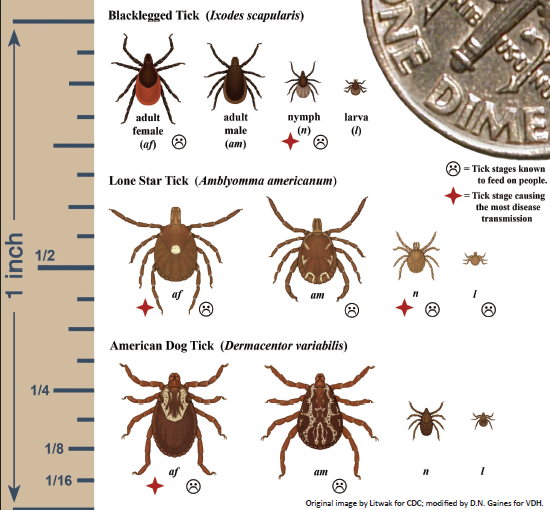
chart showing different tick species next to ruler and dime

QUICK SUMMARY

  • There are three tick species regularly found in Fairfax County that bite people.
     
  • Some tick bites can transmit pathogens or cause other health conditions — prevent tick bites to help protect yourself.
     
  • Learn how to properly remove a tick.
     
  • The Health Department offers a free tick identification service.


Ticks are active in Fairfax County almost year round, including warm winter days. This guide walks you through various considerations and actions to help prevent tick bites. 

Lyme disease is still the best known and most common disease spread by ticks in Virginia, but there are others such as Rocky Mountain spotted fever and ehrlichiosis. Factors like weather, habitat and the availability of host animals can affect the tick population from year-to-year and make it hard to predict their numbers.


8 WAYS TO PREVENT TICK BITES

Here’s what you can do to prevent tick bites and avoid getting sick from the bite of a tick.


Before You Go Outdoors:

1.) Know where to find ticks. Ticks live in grassy, brushy, or wooded areas, or even on animals. Spending time outside walking your dog, camping, gardening, fishing or hunting could bring you in close contact with ticks. Many people get ticks in their own yard or neighborhood.

2.) Use permethrin on clothing and gear. Clothing can be treated with 0.5 percent permethrin, an insecticide that repels and kills ticks. It can be purchased from the outdoors section of several retailers. Follow the label instructions.

3.) Use a repellent. Repellents can be applied to exposed skin and clothing to help repel ticks. Follow the label instructions. Use Environmental Protection Agency (EPA)-registered insect repellents that are recommended by the Centers for Disease Control and Prevention (CDC) They will contain one of the following active ingredients: DEET, picaridin, IR3535, 2-undecanone, Oil of Lemon Eucalyptus (OLE) or para-menthane-diol (PMD). EPA’s search tool can help you find the product that is right for you.

4.) Avoid contact with ticks. Know where to avoid wooded and bushy areas with tall grass and leaf litter. Walk in the center of trails to avoid overhanging plants.


After You Come Inside:

5.) Check your clothes for ticks. Ticks may be carried into the house on clothing. Any ticks that are found should be removed. Tumble dry clothes in a dryer on high heat for 10 minutes to kill ticks on dry clothing after you come indoors. If the clothes are damp, additional time may be needed. If the clothes require washing first, hot water is recommended. Cold and medium temperature water will not kill ticks.

6.) Examine gear and pets . Ticks can ride into the home on clothing and pets, then attach to a person later, so carefully examine animals, coats and backpacks.

7.) Shower soon after being outdoors. Showering within two hours of coming indoors has been shown to reduce your risk of getting Lyme disease and may be effective in reducing the risk of other tickborne diseases. Showering may help wash off unattached ticks and it is a good opportunity to do a tick check.

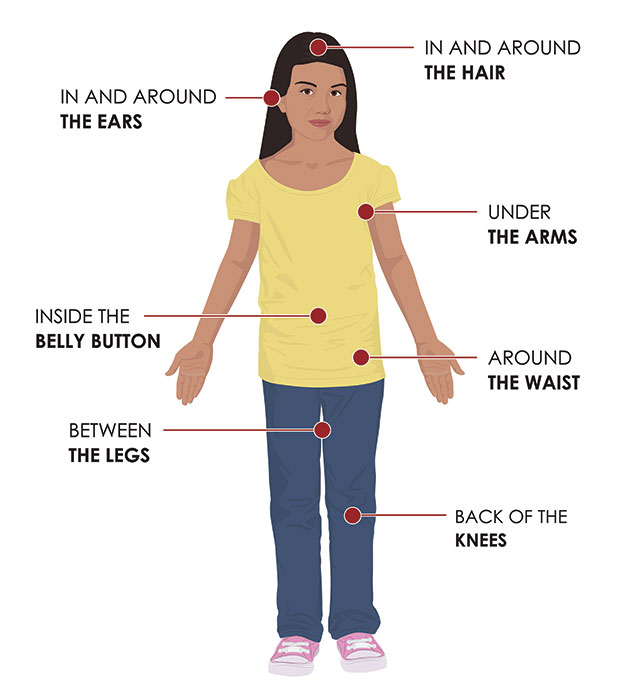
8.) Check your body for ticks after being outdoors . Conduct a full body check upon return from potentially tick-infested areas, including your own backyard. Use a hand-held or full-length mirror to view all parts of your body. Check these parts of your body and your child’s body for ticks:

  • Under the arms
  • In and around the ears
  • Inside belly button
  • Back of the knees
  • In and around the hair
  • Between the legs
  • Around the waist

human body with tick check locations labeled


HOW TO REMOVE A TICK

Checking for ticks after outdoor activities will help prevent infection. It usually takes several hours for diseases to be transmitted from a tick to you.

Here are five steps to successfully remove a tick:

  1. Use fine-tipped tweezers or shield your fingers with a tissue, paper towel, or rubber gloves, when removing the tick; otherwise infectious agents may enter through mucous membranes and breaks in the skin.
  2. Grasp the tick as close to the skin surface as possible and pull upward with steady, even pressure.
  3. DO NOT twist or jerk the tick ; this may cause the mouthparts to break off and remain in the skin.
  4. DO NOT squeeze, crush or puncture the body of the tick because its fluids may contain infectious organisms.
  5. After removing the tick, thoroughly disinfect the bite site and wash your hands with soap and water.


HOW TO REMOVE A TICK

fairfaxcounty · Tips to Battle Ticks - Fairfax County Health Department

FREE TICK IDENTIFICATION SERVICE

Our Health Department will identify your tick free of charge. This tick identification service does not test ticks for pathogens (e.g., Lyme disease bacteria) for clinical purpose. The most common tick identified is the lone star tick, but the blacklegged tick and American dog tick pop up, too.

You can submit a photo online, bring in the tick or mail the tick.

GET YOUR TICK IDENTIFIED TODAY


HOW A TICK FINDS YOU

Ticks find their hosts by detecting breath and body odors, or by sensing body heat, moisture and vibrations. Some species can even recognize a shadow.

Some ticks pick a place to wait by identifying well-used paths. Then they wait for a host, resting on the tips of grasses and shrubs. Other ticks will wait in the leaf litter on the ground for an animal or person that might walk by or stop to rest on the leaves.

Ticks can’t fly or jump, but many tick species wait in a position known as “questing.” While questing, ticks hold onto leaves and grass by their third and fourth pair of legs. They hold the first pair of legs outstretched, waiting to climb on to the host. When a host brushes the spot where a tick is waiting, it quickly climbs aboard. Some ticks will attach quickly and others will wander, looking for places like the ear, or other areas where the skin is thinner.


2 WAYS TO PREVENT TICKS IN YOUR YARD

If you have a yard at your home or townhouse, then follow these steps to prevent ticks in your yard. 

1.) Practice tick-safe landscaping. Ticks that transmit Lyme disease need higher humidity levels to survive; they die quickly in drier environments. Increasing exposure to sun and air by removing leaf litter, mowing the lawn and clearing tall grass and brush around houses and at the edges of lawns will reduce the numbers of ticks that transmit Lyme disease.

2.) Discourage deer. Ticks often attach themselves to deer. Those deer then wander into your yard and the ticks may end up on your property. Constructing physical barriers and removing food, such as spilled bird seed, from your yard will discourage deer from entering your yard. In addition, removing plants that attract deer and constructing physical barriers may help discourage tick-infested deer from coming near homes.

3 TYPES OF TICKS

There are three tick species regularly found in Fairfax County that can transmit disease to humans:

  1. Blacklegged or Deer Tick (Ixodes scapularis)
  2. Lone Star Tick (Amblyomma americanum)
  3. American Dog Tick (Dermacentor variabilis)

chart showing different tick species next to ruler and dime


TICK-BORNE DISEASE SYMPTOMS

Lyme disease is the most reported tick-borne disease in our area, but it's not the only disease transmitted by ticks. It’s important to know the symptoms of tick-borne diseases like Lyme disease so you can seek early treatment when necessary. Symptoms can include, but are not limited to:

  • Rash (Lyme disease sometimes, but not always, causes a bull’s-eye rash.)
  • Fever
  • Headache
  • Achy muscles and joints
  • Fatigue

If you are concerned that you may have contracted a tick-borne illness, consult your physician as soon as possible.


LYME DISEASE RASHES

View this collection of images from the Centers for Disease Control and Prevention.
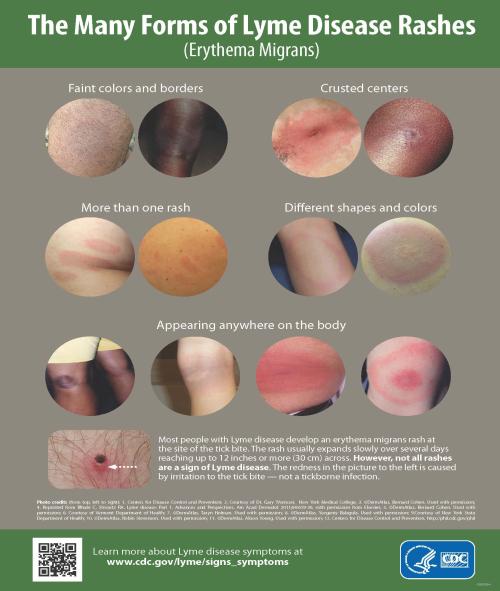
images that show several types of lyme disease rashes on different skin tones


ALPHA-GAL SYNDROME

Alpha-gal syndrome (AGS) is a potentially life-threatening allergic condition that has been associated with tick bites. Evidence suggests that AGS is primarily associated with the bite of a lone star tick in the United States, but other types of ticks have not been ruled out since AGS has been connected with other tick species in other countries. Not everyone who is bitten by a tick develops AGS.

AGS is also called alpha-gal allergy, red meat allergy, or tick bite meat allergy. AGS is not an infection, but a reaction to products containing alpha-gal. Alpha-gal is a sugar molecule found in most mammals.

Symptoms of an AGS reaction can include the following:

  • Hives or itchy rash
  • Nausea or vomiting
  • Heartburn or indigestion
  • Diarrhea
  • Cough, shortness of breath, or difficulty breathing
  • Drop in blood pressure
  • Swelling of the lips, throat, tongue, or eye lids
  • Dizziness or faintness
  • Severe stomach pain

Symptoms commonly appear within a few hours of eating meat from mammals or dairy products or after exposure to products containing alpha-gal sugar. Alpha gal is not found in poultry, eggs or seafood.

If you think you may have AGS or have medical questions, contact your healthcare provider. AGS can be a severe and potentially life-threatening condition. Seek immediate emergency care if you are having a severe allergic reaction.


TICK FREE SUMMER: HOW TO CHECK FOR TICKS


TICK CHECK 1-2 (LYME DISEASE PREVENTION RAP)


Stay Connected

Subscribe to NewsCenter
Weather
Traffic
Daily Headlines
Social Hub

newscenter logo - three circles - red, blue and graySIGN UP FOR DAILY EMAIL HEADLINES


Search NewsCenter

Recent Articles

Stock Up on Essentials During Virginia’s Sales Tax Holiday, Aug. 7-9
August 6, 2026
 
New Toolkit Available for Proposed Accessory Living Units Updates
August 5, 2026
 
Your Guide to Primary Election Day 2026
August 3, 2026
 Where and When to Vote on Election DayPolling places are open from 6 a.m. to 7 p.m. on Tuesday, Aug. 4.

Recent Interactions

    Ask Fairfax

    Terms & Conditions
    Live chat available Search our site
    • Translate
    • Awards
    • Site Feedback
    • PRIVACY POLICY & COPYRIGHT
    Main Address

    12000 Government Center Pkwy
    Fairfax, VA 22035

    Phone

    703-324-7329

    TTY 711

    Site Tools
    • Website Accessibility
    • Translate
    • Download Mobile App
    Support
    • ADA Accessibility
    • FOIA Requests
    • Website Administrator
    Additional Resources
    • Fairfax County Public Schools
    • Economic Development Authority
    • Visit Fairfax
    • Council of Governments
    • Commonwealth of Virginia
    • USA.gov
    • Calendar
    • Channel 16
    • Mail
    • Security
    • WIFI
    • Facebook
    • Twitter
    • Instagram
    • YouTube
    • Mobile

    The Official Site of Fairfax County