

Alert:
| Title | Body | Field Image | Authored on |
|---|---|---|---|
| Pohick Interceptor Rehabilitation Project To Temporarily Impact Cross County Trail |
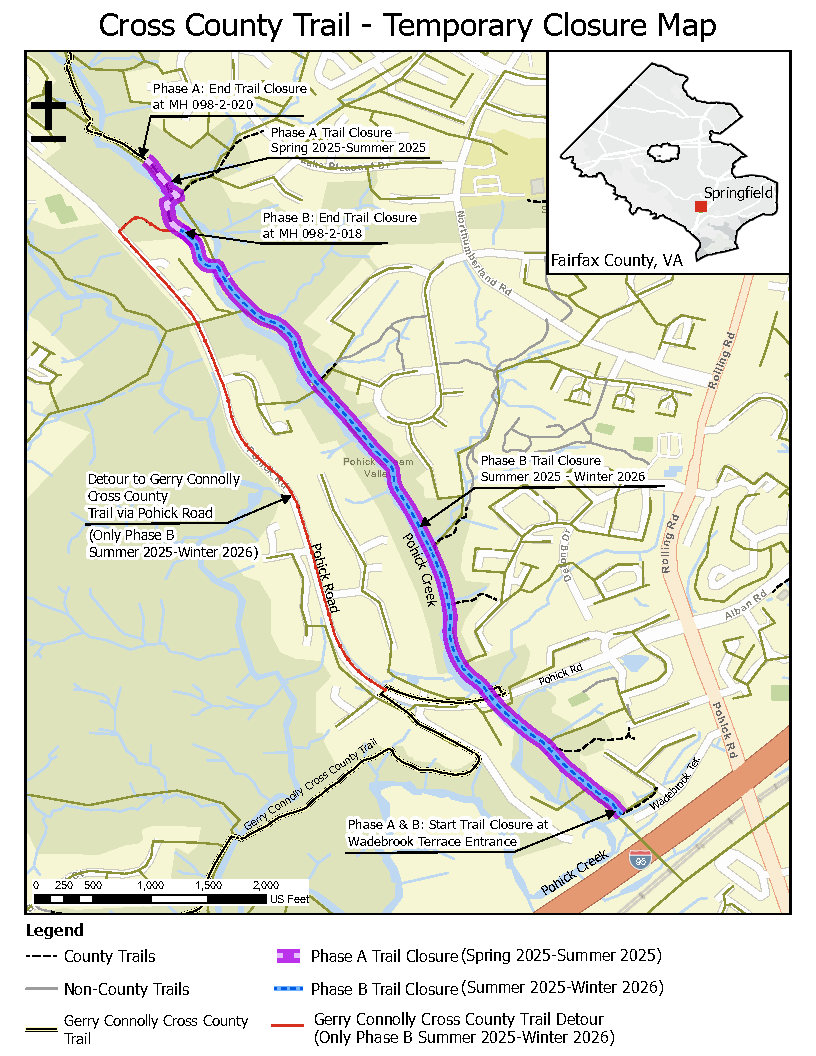
During the construction phase, there will be an initial three-month closure of the Cross County Trail within the project area. Once work at the northern end of the project area is complete, a detour along Pohick Road will be in effect for approximately 12 to 15 months, while the remaining rehabilitation is completed. Depending on weather conditions, construction is expected to conclude in winter 2026. Trail closure and project signs will be posted in Pohick Stream Valley Park to guide residents. The rehabilitation work, utilizing a trenchless Cured-in-Place Pipe (CIPP) method, is a cost-effective and minimally invasive approach that extends the service life of the infrastructure by approximately 50 years. In addition to proactively maintaining the sewer system, this project will reduce the risk of emergency repairs, protect public health and minimize environmental impacts. For alternate park locations and trails to explore during this temporary closure, residents are encouraged to use the Park Authority’s Park Amenity Locator and Trail Buddy tools. Project updates and additional information can be found online by visiting the Pohick Interceptor Rehabilitation project webpage. |

|
{{ f00UTCThursday06_Z000000bThursday000012060000ZThursdaypm2506pm31UTC }} |
| Fairfax County Park Authority To Begin Tennis and Pickleball Court Enhancements at Wakefield Park |
The project will be completed in two phases. Phase 1 will include converting Tennis Court 11 into four dedicated pickleball courts, renovating Tennis Courts 7 and 8, restoring Courts 9 and 10 to tennis-only use, and repairing Tennis Courts 1 and 2. The basketball courts will also undergo repairs, with completion expected by late June. Weather permitting, Phase 1 is anticipated to be completed by mid-July 2025. Phase 2 will follow shortly after, replacing half of the walled practice court with two additional dedicated pickleball courts, while preserving the tennis practice wall and courts closest to Courts 9 and 10. This phase will require additional site work, including modifying an existing trail and relocating picnic tables. Phase 2 is expected to be completed by fall 2025, pending necessary permits and weather conditions. During construction, Tennis Courts 3, 4, 5 and 6, as well as Pickleball Courts 12 and 13, will remain open for public use. Directional signage will guide visitors to alternative pickleball court access, ensuring safe entry. However, visitors are reminded to avoid designated construction areas. Residents should also expect occasional construction traffic entering and exiting near Court 11 via the park access road. Construction hours will be 7 a.m. to 5 p.m. on weekdays and 9 a.m. to 5 p.m. on weekends. Residents are encouraged to use the Park Amenity Locator to identify alternative courts to use during construction. Once completed, Wakefield Park will feature 10 dedicated tennis courts and eight dedicated pickleball courts, reducing competition for dual-use courts and better accommodating the county’s growing demand for racket sports. The final design was informed by public feedback from the July 9, 2024, meeting. The $300,000 project is funded through the FY 2024 Third Quarter Budget Consideration Item, sponsored by Chairman Jeff McKay and Braddock District Supervisor James Walkinshaw. FCPA remains committed to expanding accessible playing surfaces for racket sports. With this project, Fairfax County will offer 90 pickleball courts and 193 tennis courts across its parks. For more details, visit the Wakefield Tennis and Pickleball Redevelopment Project page on PublicInput or contact the Public Information Office at Parkmail@fairfaxcounty.gov. |

|
{{ f00UTCThursday06_Z000000bThursday000012060000ZThursdaypm2506pm31UTC }} |
| Park Authority Classes Offer Something for Everyone |
Whether it’s learning essential life skills (like swimming), connecting with nature, tapping into your inner artist or enhancing strength and cardiovascular health, the Park Authority offers a wide range of ways to be healthy, learn new things and connect with friends and neighbors. Classes can be found for all ages and abilities. Find a class for the entire family that fits your schedule. Explore offerings in the following categories:
Save $8 when you register by Feb. 21. Flip through the Parktakes magazine to see class offerings and more. Make this spring one to remember. Questions about classes and registration may be directed to PTOnline@fairfaxcounty.gov. |

|
{{ f00UTCThursday20_Z000000bThursday000012200000ZThursdaypm2520pm28UTC }} |
| Park Authority Seeks Community Input To Preserve Peake Cemetery History |
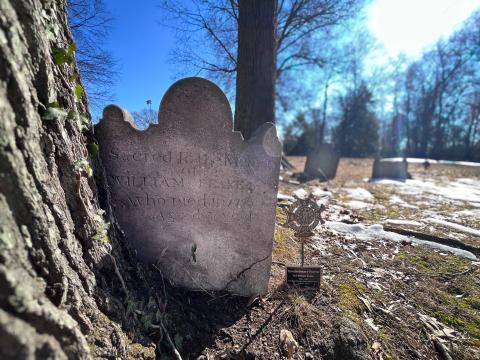
The restoration of the Peake Family Cemetery, expected to begin by spring 2025, will be overseen by archaeologists with specialized training in cemetery care and will include little to no ground disturbance with the only exception being the resetting of headstones. Work on the site will include gravestone cleaning, setting and repair, addressing landscape issues and conducting a ground-penetrating radar survey of the site to identify potential unmarked burials. In addition to site restoration, the Park Authority is planning to update the existing interpretive signs at the cemetery and is requesting assistance from the surrounding community and historical organizations. The archaeology team seeks historic records, photographs, and/or family histories, which may help in identifying unmarked graves and contribute to the interpretive history of the site. Potential burials could include members of the Ford, Javins, Brown, Bigsby and Fisher families. Historic records, photos and histories may be submitted online at the Peake Family Cemetery project website. All materials received will be reviewed by the archaeology team. The researched histories and the results of the ground-penetrating radar survey of the site will inform the narrative and design of interpretive signs later in the year. For additional project background and information, including a recorded project overview, visit the Peake Family Cemetery project website. The Peake Family Cemetery is located adjacent to Martin Luther King Jr. Park and the Gum Springs Community Center at 8115 Fordson Road in Alexandria. For additional information, please contact the Public Information Office at Parkmail@fairfaxcounty.gov. |
|
{{ f00UTCThursday20_Z000000bThursday000012200000ZThursdaypm2520pm28UTC }} |
| Experience the Magic of the Wetlands at Huntley Meadows Park |
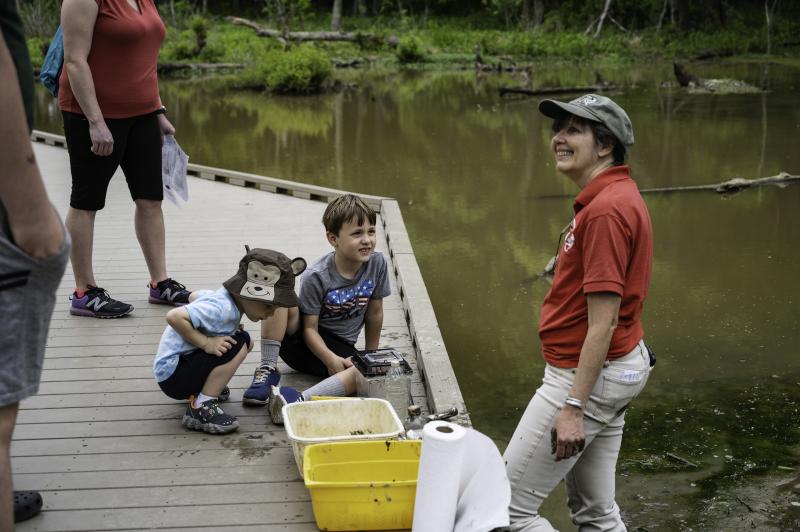
There is no better way to celebrate Wetlands Awareness Day than by visiting the Fairfax County Park Authority’s premier wetland sanctuary at Huntley Meadows Park on Sunday, May 5, from 12-4 p.m. Come explore the wonders of the park including a nationally significant historic house, majestic forests, wildflower-speckled meadows and a vast wetland bursting with all forms of life. There is no cost for admission. Some of the best wildlife watching in the Washington metropolitan area is here. Bring your friends and family to stroll the forested paths and immersive boardwalk trails. Appreciate the plants and animals that live in the park and find out why they play an important role at the park. This exciting event will feature live raptors, reptiles and amphibians. Enjoy an up-close view of our creatures and interactive displays and activities. On-site parking is limited. Shuttle rides are available from nearby Groveton Elementary School, 6900 Harrison Ln., Alexandria. Shuttles run every 30 minutes with the last shuttle ride to Huntley Meadows Park at 3:30 p.m. The last return shuttle ride to Groveton Elementary School is at 4:15 p.m. The event will be held rain or shine. To register for this free event, visit Wetlands Awareness Day. Huntley Meadows Park is located at 3701 Lockheed Blvd., Alexandria. For more information visit Huntley Meadows. |
|
{{ f00UTCThursday25_Z000000bThursday000012250000ZThursdaypm2425pm30UTC }} |
| Sun Shines on Patriot Park North for Historic Opening Day |
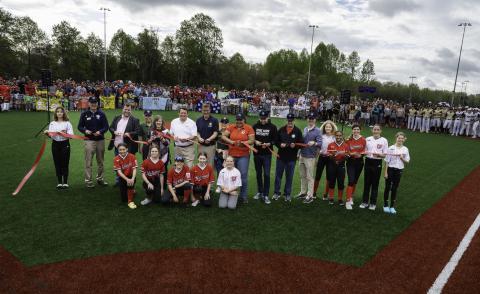
“Patriot Park North provides a winning combination of community use and economic benefit that really knocks it out of the park,” said FCPA Executive Director Jai Cole. “This project is a wonderful example of what we can do together with the community and a host of partners in creating and executing a shared vision for amazing park facilities like this. This is a project we can all truly be proud of.” Originally, the park was home to three grass diamond fields. In 2014, the FCPA acquired adjacent land, which expanded the site to 67 acres and opened the possibility for the redevelopment of the property to accommodate expanded use and create a prime destination for baseball and softball tournament play throughout the mid-Atlantic region. The redevelopment of the park included the installation of six synthetic turf diamond fields (two 60-foot and four 90-foot diamonds), batting cages, warm-up areas, lighting, a 360-degree press box and deck, live streaming capability, concession stands, stormwater management, trails, playground, parking lot and other site amenities. The $22.7 million facility was funded through developer proffers and voter-approved 2016 and 2020 Park Bonds. The FCPA anticipates significant returns on investment, with 26 committed tournaments already in process. The economic impact for the county is estimated between $162,000 to more than $1 million per tournament, depending on attendance and the duration of the event. The total estimated impact for all 26 tournaments is approximately $18.3 million in 2023. Patriot Park North is located at 5425 Willow Springs School Road, in Fairfax. For additional information, visit the Patriot Park North website or call 703-324-5308. Watch a video of the Patriot Park opening and ribbon-cutting. |
|
{{ f00UTCWednesday19_Z000000bWednesday000012190000ZWednesdaypm2319pm30UTC }} |
| Teens Learn To Lead as Camp Counselors In Training |
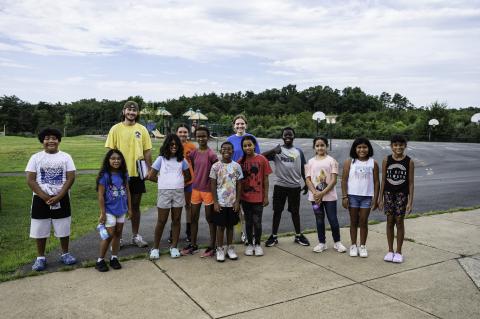
Serving alongside adult leaders, participating C.I.T.s assist counselors with programming, gain experience working as part of a team, develop new communication and leadership skills, and have fun helping elementary school-age children. Each participant receives a T-shirt and will receive an assignment for a specific Rec Center, park or school site. To participate, applicants must submit the C.I.T. application and complete an interview. Once selected to the program, there is an application fee and initial online training that must be completed before the start of the summer program. Specific instructions for summer camp and Rec-PAC C.I.T.s are included below: Summer Camp C.I.T.s: Applicants must submit their application to the camp program directors at the location they are interested in being assigned to. Camp C.I.T. training will be held virtually on Tuesday, June. 6 from 6:30 to 8 p.m. Learn more about FCPA’s camps by visiting the Camps website. Rec-PAC C.I.T.s: Applicants must note their preferred location and submit applications by Friday, June 9 and attend an in-person training event on June 17. Accepted applicants will be assigned to a site and work daily on weekdays from June 26 through Aug. 3, from 8:15 a.m. through 4 p.m. Learn more about the FCPA Rec-PAC program by visiting the Rec-PAC website. Don’t wait, submit a C.I.T. application today! |
|
{{ f00UTCThursday13_Z000000bThursday000012130000ZThursdaypm2313pm30UTC }} |
| Explore the Wonders of the Wetlands at Huntley Meadows Park |
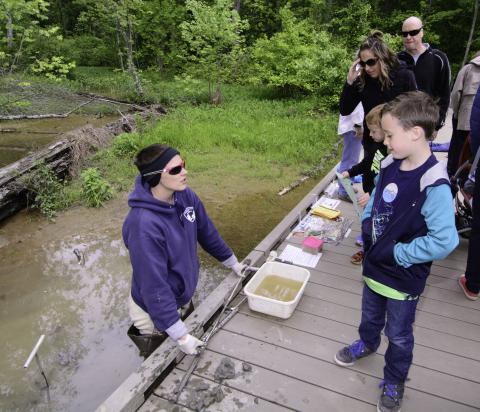
Huntley Meadows Park is home to a nationally significant historic house, majestic forests, wildflower-speckled meadows and vast wetlands bursting with life. Some of the best wildlife watching in the Washington Metropolitan Area is here. Enjoy an up-close view of live raptors, reptiles and amphibians and interactive displays and activities. Bring the whole family, and your neighbors too, to stroll the forested paths and immersive boardwalk trails throughout the park. See the plants and animals that live in the park and learn how they play vital roles in the ecosystem. Grab a discovery guide when you check in and visit different activity stations, receiving a stamp at each station to earn a prize. This free, family-friendly event will be held rain or shine. Come discover the importance and value of our local wetlands. Register for Wetlands Awareness Day Huntley Meadows Park is located at 3701 Lockheed Blvd., Alexandria, Virginia. For more information, please call 703-768-2525 or visit Huntley Meadows Park. |
|
{{ f00UTCThursday13_Z000000bThursday000012130000ZThursdaypm2313pm30UTC }} |
| Poetry in the Parks Comes to Ellanor C. Lawrence Park |
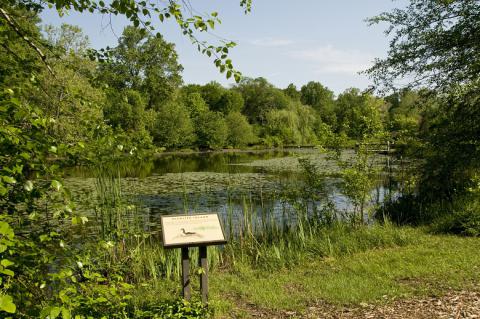
Enjoy poetry from the Fairfax Poet Laureate featuring local Arab American poets Zeina Azzam, Rayan Afif and Danielle Badra. Poetry in the Parks is a partnership between ArtsFairfax and the Fairfax County Park Authority, highlighting the relationship between nature and poetry. Experience the serenity of the Ellanor C. Lawrence wooded amphitheater, while experiencing the natural surroundings. The event will be held on April 15 from 3 to 4 p.m. Admission is free, but please register for the program. Register for Fairfax Poet Laureate Ellanor C. Lawrence Park is located at 5040 Walney Road, Chantilly, Virginia. For more information, please call 703-631-0013 or visit Ellanor C. Lawrence Park. |
|
{{ f00UTCThursday13_Z000000bThursday000012130000ZThursdaypm2313pm30UTC }} |
| Marcos Suarez | Meet Marcos!Name: Marcos Suarez
I am also a park professional with almost 10 years of experience with the Fairfax County Park Authority. I began my career with the county as an athletic field maintenance worker, holding positions such as Area 2 Park and Recreation Specialist I and Turf Crew Assistant Manager before being selected as a Parks and Recreation Specialist IV. I am a former member of the Virginia Turfgrass Council and a graduate with a landscape design and horticulturist degree from Northern Virginia Community College. I continue to increase my knowledge and expertise through the county’s Leadership and Management Training Program. I joined the county with over ten years of experience as a Landscape Design and Grounds Maintenance Manager. I have worked so many years in the service-oriented field. I love taking care of others, communicating with others and helping solve problems. Also, I love working with a group of people that are on the same path to accomplish something meaningful. As an area manager, I get to help others, manage park expectations, talk to many people and try to impact other people’s lives. The Park Authority gave me the opportunity to start and exceed in my career as a public servant. I love the environment and the fact that we are so diverse in so many ways. I am thankful that we have a team that helps each other and that is always willing to mentor you so that you could exceed in anything that you set your mind to. I think the best thing about the Park Authority is that you get to work outside, enjoy all the parks and trails, and become one with nature and with our environment. |
{{ f00UTCFriday15_Z000000bFriday000012150000ZFridaypm2215pm31UTC }} |
.jpg)
.jpg) Spring into action with Fairfax County Park Authority classes. Learn a skill, pick up a new hobby, dive into a favorite pastime and get active with a range of fitness and recreation opportunities in and around your local parks.
Spring into action with Fairfax County Park Authority classes. Learn a skill, pick up a new hobby, dive into a favorite pastime and get active with a range of fitness and recreation opportunities in and around your local parks.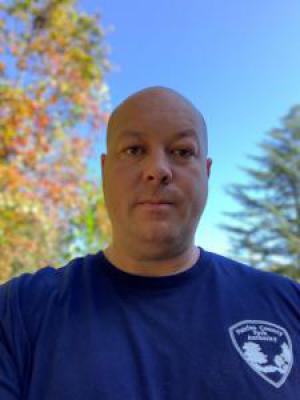 I was born and raised in Venezuela and moved to the United States (Burke, Virginia) at the age of 16. While I was in school, I played baseball and basketball at the varsity level. In school, extracurricular activities helped me a lot to learn a new language and to exceed in my future. I graduated from Lake Braddock Secondary School in 2003. After graduating high school, I worked full time and went to Northern Virginia Community College part time for many years. I am a devoted husband and father of two children, I enjoy engaging with my community as my son’s little league baseball and basketball coach, spending time at many of our county’s parks with my family, and additional outdoor activities with friends such as hunting and fishing.