

DPWES is committed to keeping Fairfax County a healthy, vibrant place to live, work and visit. We work every day to promote a healthy environment through responsible operations, smart policies, and community partnerships. We reduce energy use and carbon emissions, generate and use renewable energy, build green, sustainable facilities, reduce and divert waste, protect clean water, support healthy landscapes, and preserve local ecosystems. We engage with the community to help them take actions for a healthy, sustainable environment.
This sustainability hub consists of four major sectors. Each Sector is described below and linked to a more detailed sector page. The information on each sector page provides an overview of the sector, focus areas, a description of county government actions highlighting sustainable operations, and opportunities for the community to get involved through programs, education, and available services.
Below is the 2025 Sustainability Progress Dashboard, which provides a snapshot of DPWES progress toward Fairfax County’s 2030 sustainability goals. The dashboard highlights key performance indicators for each sector. These metrics track DPWES-specific progress and are not intended to represent countywide outcomes. More detail on each sector’s targets and metrics can be found on the individual sector pages.
DPWES SUSTAINABILITY SECTORS
Energy
Energy powers essential public works services like wastewater treatment and solid waste disposal and recycling. DPWES is doing its part to become more energy efficient to maintain reliable, nationally recognized operations.
- Energy Use and Related Greenhouse Gas Emissions Reduction
- Renewable Energy
We welcome you to explore the sector pages shown above including the many programs and services that help to achieve the progress shown in the 2025 Sustainability Progress dashboard.
DPWES SUSTAINABILITY DASHBOARD
The 2025 Sustainability Dashboard shows focus area metrics, targets and progress for each of the four sectors. Progress demonstrates DPWES’ leadership and commitment toward achieving the sustainability targets in support of county goals. The star for each metric shows the 2030 target. Energy and Waste sector targets are measured against the county established base year of 2018. For example, the 2025 Energy Use Reduction area of focus, shows a reduction of 19.8% below its 2018 base year. The 2030 goal is a 25% reduction.
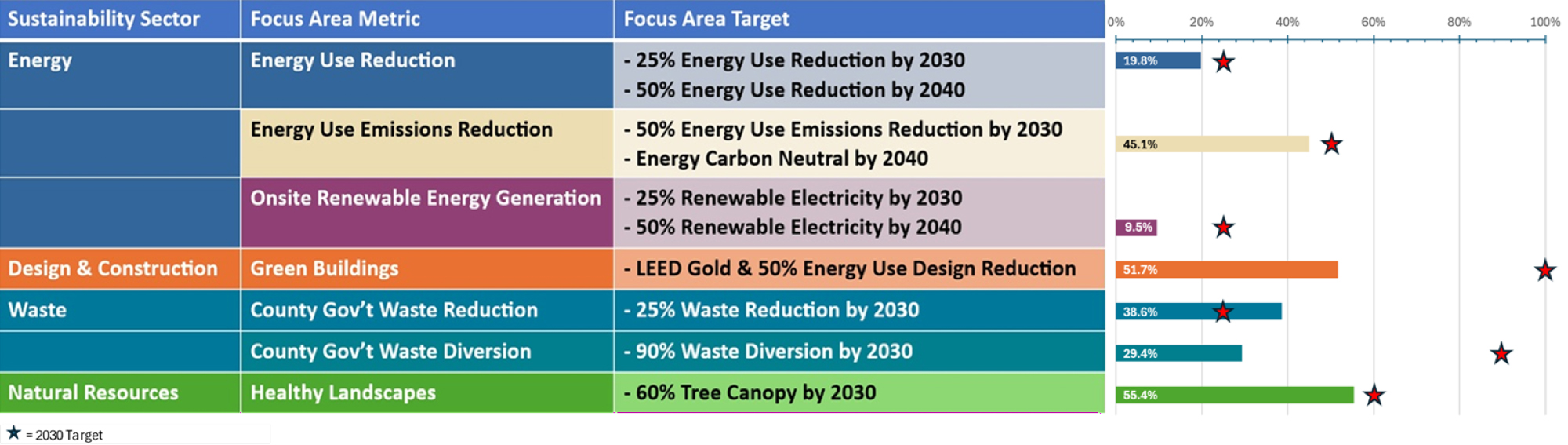
DPWES’ major sustainability metrics and targets as shown in the 2025 Sustainability Progress dashboard are described below:
Sustainability Metrics
- The Energy Use Reduction metric includes reductions in DPWES’ buildings and operations grid electricity, natural gas, propane and #2 fuel oil for heating.
- The Energy Use Emissions Reduction metric includes DPWES’ buildings and operational carbon dioxide (CO2), methane (CH4) and nitrous oxide (NOX) emissions that are associated with energy use as defined above. Emissions reductions are measured and reported as “carbon dioxide equivalent,” or CO2e to capture the different global warming potentials (GWP) of the three greenhouse gases (GHGs). GHG sources include grid electricity, natural gas, propane, and #2 fuel oil for heating. The county’s energy carbon neutrality commitment is understood as a balance of carbon emissions: that is, removing as much CO2e from the atmosphere as is emitted in a defined period (i.e., annually). Achieving energy carbon neutrality is expected to require, first, reducing carbon emissions to the greatest extent possible, then making up the remaining difference through carbon offsets. Offsets are required because so long as there is continued use of some existing fossil-fuel infrastructure, reaching zero emissions is not possible. DPWES operations currently use fossil fuels, either directly or indirectly, to meet cooling, heating, lighting, process and transportation needs.
- The Onsite Renewable Energy Generation metric includes DPWES landfill gas capture (LFG) and reuse and solar photovoltaic systems (solar).
- The Green Buildings design metric includes energy reduction (grid electricity and natural gas), and renewable energy generation at all new county buildings and facilities designed and constructed under the county’s Capital Improvement Program (CIP) (i.e., fire stations, libraries, community centers, etc.).
- The county government Waste Reduction and Diversion metrics includes county government tons of waste reduced and diverted (i.e., reused, composted or recycled).
- The Healthy Landscapes metric includes percent (%) tree canopy within the county.
What is Sustainability?
Sustainability in DPWES is a team-based, cross‑disciplinary effort to protect the environment, support social equity, and strengthen the local economy so communities are healthy, diverse, and resilient. It focuses on:
- Cutting greenhouse gas emissions and energy use
- Increasing onsite renewable energy
- Reducing and diverting waste
- Designing green buildings and infrastructure
- Protecting clean water, healthy landscapes, and ecosystems
- Engaging and involving the community
These areas of focus and supporting programs and practices are in support of county adopted policies and goals as shown in:
- 2021 Operational Energy Strategy (OES)
- 2022 Communitywide Energy and Climate Action Implementation Plan (CECAP)
- 2022 Resilient Fairfax Plan (RF)
- Tree canopy and water quality goals and targets.