This page is a resource and overview of Transportation Demand Management (TDM) requirements for developers working to build their TDM Programs. Details regarding Fairfax County and Tysons-specific goals, requirements, TDM funds, and reports follow below.
General information on TDM can be found on our site for TDM in Fairfax County, with links to resources for commuters and employers.
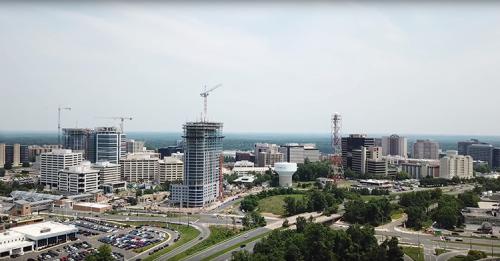
Photo Courtesy of Tysons Partnership
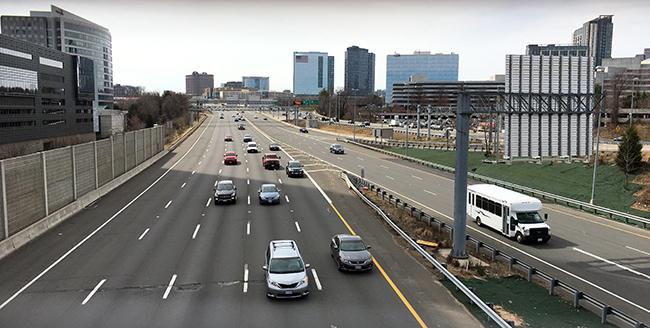
The Tysons area is a rapidly urbanizing community with growing transportation needs. Because of this, it is important that Transportation Demand Management in this area is held to a higher standard, especially with resources such as the Metro’s Silver Line serving the area and providing connectivity to the greater Washington, D.C., area.
Below are the Trip Reduction Goals for developments in Tysons. As Gross Square Feet (GSF) increases in the area, the reduction goals for developments are also increased. TDM Programs and plans are created to meet these reduction goals.
Tysons Corner Trip Reduction Goals
Total Gross Square Footage in Tysons
Distance from Metro Station
0 to 1/8 Mile
1/8 to 1/4 Mile
1/4 to 1/2 Mile
Beyond 1/2 Mile
Trip Reduction Goal
Up to 65,000,000
55%
45%
40%
35%
65,000,000
60%
50%
45%
40%
84,000,000
65%
55%
50%
45%
90,000,000
68%
58%
53%
48%
96,000,000
70%
60%
55%
50%
105,000,000
73%
63%
58%
53%
113,000,000+
75%
65%
60%
55%
Each TDM program is required to submit a Transportation Demand Management Plan (TDM Plan), which will outline the strategies that can be implemented at that site as well as an overview of existing infrastructure relevant to TDM.
The Annual Report provides a snapshot of current TDM conditions for a site. Every year this report is to be submitted with information on traffic counts and/or surveys, status of the buildings on the site, TDM budget, trip reduction goal progress, what work has been done to satisfy each TDM proffer and/or Guideline, and anticipated changes in the TDM program for the upcoming year.
To help reach these goals, every TDM program in Tysons is required to set up three different funds (Incentive Fund, Remedy Fund, and Penalty Fund) each with its own purpose.
The Incentive Fund is used to encourage and incentivize the use of multi-modal transit. This can be achieved through means such as pre-loaded SmarTrip cards, or giveaways.
The Remedy Fund is drawn upon in the case there is an immediate need for TDM funding in addition to the regular budget to reach reduction goals. However, the Remedy Fund is not a sunk cost, but rather an incentive to meet TDM goals; if the set goals are being met, developers will have money returned to them from this fund after completion of the Applicant Control Period.
Finally, the Penalty Fund is in place if the TDM program does not reach its reduction goals and can be drawn upon by the County to implement additional TDM strategies for the site. This fund is also returned to the applicant after completion of the Applicant Control Period.
Below is a table outlining the contribution rates for the various funds required for Tysons TDM programs and TDM reporting requirements:
TDMComponents
Tysons
IncentiveFund
Office
$0.02/sqft
Residential
$0.02/sqft
RemedyFund
Office
$0.40/sqft
Residential
$0.30/sqft
PenaltyFund
Office
$0.10/sqft
Residential
$0.05/sqft
Non-ComplianceFee
$100/Day
TripCounts
AnnuallyduringApplicant Control Period; Every 5 years afterwards
Surveys
Every 3 years, unless otherwiseapprovedby FCDOT
AnnualReport
AnnuallybyMay1st
EndofApplicantControlPeriod
Post build-out and 85% occupancy, after 3
consecutive counts show goal has been met
Although urban density in the rest of Fairfax County is not as high as in Tysons, it is still important to implement TDM measures that reduce the number of trips being generated by new developments. Transit Oriented Development (TOD) locations are located within ½ of a mile of a metro station and generally have more intense TDM programs than other areas of the county.
Below are the Trip Reduction Goals for developments in Non-Tysons TOD locations. TDM Programs and plans are created to meet these reduction goals.
Non-Tysons Trip Reduction Goals
Development Type
Non-Tysons TOD Locations
0 to 1/4 Mile from Station
1/4 to 1/2 Mile from Station
Trip Reduction Goal
Office
40%-50%
35%-45%
Residential
40%-50%
35%-45%
Each TDM program is required to submit a Transportation Demand Management Plan (TDM Plan), which will outline the strategies that can be implemented at that site as well as an overview of existing infrastructure relevant to TDM.
The Annual Report provides a snapshot of current TDM conditions for a site. Every year this report is to be submitted with information on traffic counts, status of the buildings on the site, TDM budget, trip reduction goal progress, what work has been done to satisfy each TDM proffer, and anticipated changes in the TDM program for the upcoming year.
To help reach these goals, every Non-Tysons TOD TDM program must set up two different funds (Incentive Fund and Remedy Fund) each with its own purpose:
The Incentive Fund is used to encourage and incentivize the use of multi-modal transit. This can be achieved through means such as pre-loaded SmarTrip cards, or giveaways.
The Remedy Fund is drawn upon in the case there is an immediate need for TDM funding in addition to the regular budget to reach reduction goals. However, the Remedy Fund is not a sunk cost, but rather an incentive to meet TDM goals; if the set goals are being met, developers will have money returned to them from this fund after completion of the Applicant Control Period.
Below is a table outlining the contribution rates for the various funds required for Non-Tysons TOD TDM programs and TDM reporting requirements:
TDMComponents
Non-TysonsTOD
IncentiveFund
Office
$0.02/sqft
Residential
$0.02/sqft
RemedyFund
Office
$0.20/sqft
Residential
$0.10/sqft
Non-ComplianceFee
$100/Day
TripCounts
AnnuallyduringApplicant Control Period; Every 5 years afterwards
Surveys
Every 3 years, unless otherwiseapproved by FCDOT
AnnualReport
AnnuallybyApril1st
EndofApplicantControlPeriod
Post build-out and 85% occupancy, after 3
consecutive counts show goal has been met
Although TDM is generally focused on the densest parts of Fairfax County, TDM programs are an important tool to limit traffic and provide benefits to the residents and tenants across the county. Non-Transit Oriented Development (TOD) locations tend to have a lower reduction goals but are still expected to provide a TDM program.
Below are the Trip Reduction Goals for developments in Non-TOD locations. TDM Programs and plans are created to meet these reduction goals.
Non-TOD Trip Reduction Goals
Development Type
Non-TODLocations
TripReductionGoal
Office
30-40%
Residential
20-30%
Each TDM program is required to submit a Transportation Demand Management Plan (TDM Plan), which will outline the strategies that can be implemented at that site as well as an overview of existing infrastructure relevant to TDM.
The Annual Report provides a snapshot of current TDM conditions for a site. Every year this report is to be submitted with information on traffic counts, status of the buildings on the site, TDM budget, trip reduction goal progress, what work has been done to satisfy each TDM proffer, and anticipated changes in the TDM program for the upcoming year.
To help reach these goals, every Non-TOD TDM program must set up an Incentive Fund which is used to encourage and incentivize the use of multi-modal transit. This can be achieved through means such as pre-loaded SmarTrip cards, or giveaways.
Below is a table outlining the contribution rates for the various funds required for Non-Tysons TOD TDM programs and TDM reporting requirements:
TDMComponents
Non-TysonsTOD
IncentiveFund
Office
$0.01/sqft
Residential
$0.01/sqft
Non-ComplianceFee
$100/Day
TripCounts
Biannually duringApplicant Control Period; Every 5 years afterwards


 This page is a resource and overview of Transportation Demand Management (TDM) requirements for developers working to build their TDM Programs. Details regarding Fairfax County and Tysons-specific goals, requirements, TDM funds, and reports follow below.