Fairfax County, Virginia
Fairfax County Virginia

FFX Global Navigation

    • Department Homepage
    • About the Health Department
      • About Us
      • Frequently Asked Questions
      • Career Opportunities
      • Contact Us
    • Department Divisions
      • Emergency Preparedness & Response
      • Environmental Health
      • Laboratory Services
      • School Health
    • Health Department Services
    • Health Department Programs
      • Disease Carrying Insects - Fight the Bite
      • Homeless Healthcare Program
      • Public Health Youth Ambassadors
      • Stable Families, Thriving Futures
      • Strengthening Antimicrobial Stewardship
    • Clinic Locations
    • Diseases & Conditions
    • Health Alerts & Advisories
    • News & Events
    • Permits & Health Codes
  • Residents
    • Animals & Pets
      • Adoptions
      • Animal Control & Regulations
      • Guide to Dogs
      • Lost & Found Pets
      • Shelter Support & Supplies
      • Wildlife
      • More
      Courts & Legal
      • Case Information
      • Circuit Court Docket
      • Jury Duty
      • Land Records
      • Magistrate
      • Public Law Library
      • Self-Help Resources
      • Traffic Court
      • Vital Records
      • More
      Environment & Energy
      • Invasive Species
      • Litter
      • Recycle, Trash & Compost
      • Sustain Fairfax
      • Trees
      • Watersheds
      • More
      Health & Human Services
      • Basic Needs & Assistance
      • Disability Services
      • Diseases & Conditions
      • Domestic & Sexual Violence
      • Health Clinics
      • Mental Health
      • Opioids
      • More
      Individuals & Families
      • Children & Youth
      • Federal Workforce
      • Immigrants
      • Military & Veterans
      • New Residents
      • Older Adults
      • Parents
      • People with Disabilities
      • Volunteers
      • More
      Land Use & Planning
      • Comprehensive Plan
      • County Capital Projects
      • Land Records
      • Parks Planning
      • Planning Projects
      • Research Tools
      • Transportation Projects
      • Urban Centers
      • More
      Library & Education
      • Adult Education
      • Early Childhood Programs
      • Library Branches
      • Library Catalog Search
      • Public Schools
      • More
      Parks & Recreation
      • Arts
      • Athletic Fields
      • Camps
      • Community Centers
      • Parktakes Classes
      • Rec Centers
      • Senior Centers
      • Teen Centers
      • Trails
      • More
      Permits & Licenses
      • Birth & Death Certificates
      • Building
      • Child Care
      • Dogs
      • Health
      • Marriage
      • Park Use
      • Solicitors
      • More
      Property & Housing
      • Affordable Housing
      • Code & Zoning
      • Neighborhoods
      • Real Estate Values
      • Recycling & Trash
      • Tenant Landlord Issues
      • Utilities
      • More
      Public Safety & Emergencies
      • 9-1-1
      • Emergency Preparedness
      • Fire & Rescue
      • Gun Violence Prevention
      • Police
      • Scams
      • Sheriff
      • Storm Center
      • More
      Roads & Commuting
      • Bike & Walk
      • Connector Bus
      • Metrobus & Metrorail
      • Park & Ride
      • Pedestrian Safety
      • Road Maintenance/VDOT
      • Street Parking
      • Toll Roads
      • Transportation Projects
      • More
      Taxes & Fees
      • Car Taxes
      • Park Fees
      • Real Estate Taxes
      • Tax Relief
      • Trash Disposal Fees
      • More
      Voting & Elections
      • Absentee Voting
      • Early Voting
      • Election Results
      • Polling Places
      • Voter Registration
      • More
      Weather & Climate
      • Air Quality
      • Climate Action Dashboard
      • Extreme Heat
      • Floods
      • Ready Fairfax
      • Resilient Fairfax
      • Snow
      • Tornadoes
      • More
  • Business
    • Business & Construction
      • Building Permits
      • Code & Zoning
      • Land Use
      • More
      Business Services
      • Business Emergency Preparedness
      • Business Taxes
      • Consumer Services
      • Employer Transportation Service
      • Green Business Partners Program
      • Home-Based Business
      • Regulation & Licensing
      • Small Business
      • Starting a Business
      • Workplace Issues
      • More
      Doing Business with Fairfax
      • Contracting and Procurement
      • Current Solicitations
      • Permits
      • Vendor Pitch Portal
      • More
  • Government
    • About
      • Codes & Standards
      • Countywide Strategic Plan
      • Facilities & Locations
      • History of Fairfax County
      • Operating Status
      • More
      Board of Supervisors
      • Auditor
      • Board Members
      • Boards, Authorities & Commissions
      • Clerk Services
      • Committees
      • Meetings & Agendas
      • More
      Budget & Finance
      • Bonds
      • Budget
      • Financial Transparency
      • Unclaimed Money
      • More
      Departments & Agencies
      Jobs & Employment
      • Full-Time Openings
      • Internships
      • Seasonal & Non-Merit
      Maps & Data
      • Countywide Data Analytics
      • Demographics
      • Geographic Information Systems
      • Interactive Data Tools
      • More
      One Fairfax
      • Digital Equity
      • Inclusive Engagement
      • Trust Policy
  • Fairfax County Virginia
  • Services
    • Find
      • Animal Services
      • Health Clinics
      • Jobs
      • Library Resources
      • Lost or Found Pet
      • Mental Health Support
      • Park Classes
      • Real Estate Values
      • Recycling & Trash
      • Volunteer Opportunities
      • More
      Pay
      • Business Taxes
      • Car Taxes
      • Dog Licenses
      • Driving & Parking Fines
      • False Alarm Fees
      • Real Estate/Property Taxes
      • SACC Payments
      • More
      Register/Apply
      • Basic Needs & Assistance
      • Building Inspections
      • Car Registration
      • Fairfax Alerts
      • Permits & Licenses
      • Tax Relief
      • Vote
      • More
      Report
      • Animal Control Issues
      • Consumer Complaints
      • Crime
      • Domestic Violence
      • Financial Crimes
      • Neighborhood Complaints
      • Road Issues to VDOT
      • Street Light Outages
      • More
  • Connect
    • Alerts, Emails & Apps
      • Email Subscriptions
      • Fairfax Alerts
      • Mobile App
      • More
      Community Engagement
      • Surveys & Projects
      Contact
      • Directory
      • Hotlines & Emergency Numbers
      • VDOT
      • VFOIA Requests
      • More
      News & Events
      • Daily Headlines
      • Emergency Information Blog
      • Events Calendar
      • NewsCenter
      • NotiCentro (Spanish)
      • Public Meetings Calendar
      • More
      Social Media
      • Comments Policy
      • Directory of Accounts
      • More
      TV, Video & Podcasts
      • Channel 16
      • Podcasts & Radio
      • YouTube
      • More
  • TRANSLATE
    • Language Selection

      To change the language of this website, click the drop-down list and select the desired language. The Fairfax County Web site is being translated through "machine translation" powered by Google Translate. Disclaimer

Health Department

  1. Home
  2. Health
  3. Mpox

Health Department Alert:

CONTACT INFORMATION: Our administration office at 10777 Main Street in Fairfax is open during regular business hours 8 a.m. - 4:30 p.m., Monday - Friday. Clinic services are not offered at this location.
703-246-2411 TTY 711
health@fairfaxcounty.gov
10777 Main Street
Fairfax, VA 22030
Gloria Addo-Ayensu, M.D., M.P.H.
Director of Health

Department Resources

  • Department Homepage
  • About the Health Department
    • About Us
    • Frequently Asked Questions
    • Career Opportunities
    • Contact Us
  • Department Divisions
    • Emergency Preparedness & Response
    • Environmental Health
    • Laboratory Services
    • School Health
  • Health Department Services
  • Health Department Programs
    • Disease Carrying Insects - Fight the Bite
    • Homeless Healthcare Program
    • Public Health Youth Ambassadors
    • Stable Families, Thriving Futures
    • Strengthening Antimicrobial Stewardship
  • Clinic Locations
  • Diseases & Conditions
  • Health Alerts & Advisories
  • News & Events
  • Permits & Health Codes
  • facebook
  • twitter
  • instagram
  • youtube

Mpox

Mpox is a rare disease in the U.S. It is caused by the mpox virus, which belongs to the same group of viruses as smallpox. Mpox can make you sick including a rash or sores (pox), often with an earlier flu-like illness. 

Information about the current status of mpox monitoring, including case numbers, is available from the Virginia Department of Health. Additional information is also available from the Centers for Disease Control and Prevention (CDC). 

!If you are sick and have symptoms consistent with mpox, seek medical care from your healthcare provider. Call ahead and let them know you are concerned about possible mpox infection so they can take precautions to ensure that others are not exposed.

If you do not have a health care provider, please call 703-246-7100 for guidance.

The mpox virus spreads mostly through close, intimate contact (e.g., skin-to-skin) with someone who has mpox.  

This includes:

  • Touching their rash or scabs
  • Contact with their saliva or mucus (snot)
  • Contact with areas around the anus, rectum, or vagina

This kind of contact often happens during:

  • Oral, anal, or vaginal sex or touching another person’s genitals or anus
  • Kissing, hugging, or giving a massage
  • Being very close, face-to-face, for a long time

The risk is considered low for getting mpox by touching objects, fabrics, and surfaces that have been used by someone with mpox. Items touched by someone with mpox should be cleaned and disinfected.  

People with mpox can spread it from when symptoms start until the rash heals and new skin forms. Some people can spread mpox 1–4 days before symptoms appear. There is no evidence that people that never develop symptoms spread the virus.

Other ways the mpox virus can spread include:

  • A pregnant person can spread the virus to their fetus through the placenta.
  • People can get mpox from infected animals, either by being scratched or bitten by the animal or by preparing or eating meat or using products from an infected animal.

Mpox does not spread from person to person through:

  • Casual conversation with someone who is infected
  • Walking by someone who is infected 

Mpox symptoms usually start within 3 weeks of exposure to the virus.

The illness often begins with a flu-like illness and includes some or all these symptoms:

  • Fever
  • Headache
  • Muscle aches
  • Backache
  • Swollen lymph nodes
  • Chills
  • Exhaustion
  • Respiratory symptoms (e.g. sore throat, nasal congestion, or cough)
  • Rash  
    • Usually develops 1-4 days after flu-like symptoms (i.e., fever and/or respiratory symptoms)
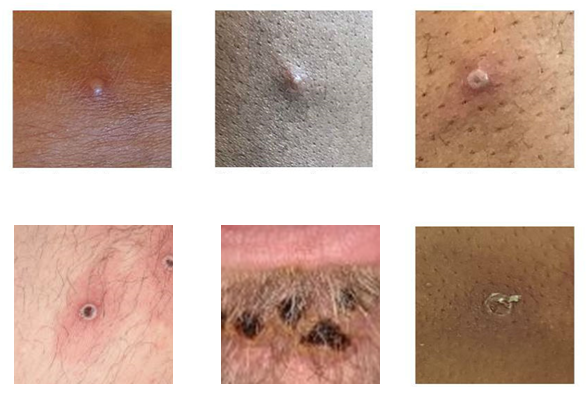
    • Can look like pimples or blisters and may be painful or itchy. See pictures of rashes below from people with mpox.
    • Might develop on just one part of the body or can appear on many parts of the body, including on or near genitals, hands, feet, chest, face, or mouth
    • The rash will go through several stages, including scabs, before healing typically within 2 to 4 weeks

Some people are at higher risk of developing severe illness, including individuals with weakened immune systems or a history of eczema, people who are pregnant or breastfeeding, and children under 8 years of age. 

If you have symptoms, separate yourself from other people and pets, cover your lesions, and contact your healthcare provider, even if you don’t think you had contact with someone who has mpox.

Mpox Rash Photos

Monkeypox Rash Photos

Photo credit: UK Health Security Agency, Source: CDC.

If you have symptoms, you should separate yourself from other people and pets, cover your lesions, and contact your health care provider. 

Important: Before you go into a healthcare facility to see your provider or for testing, cover your rash and scabs and follow any additional instructions they give you.

Mpox testing is available through your healthcare provider. Call your provider to schedule an appointment and ask about mpox testing. They may collect a specimen in their office and send it to a lab, or they may refer you to a lab where the specimen will be both collected and tested.

If you do not have a healthcare provider, some urgent care centers can see patients who have symptoms consistent with mpox and can provide testing. Call the urgent care center before you go and let them know you are concerned about mpox.

If you do not have a healthcare provider and are unable to be seen at an urgent care facility, the health department may be able to assist. Call 703-246-2433 for help with accessing mpox testing. 

If you have symptoms, separate yourself from other people and pets, cover your lesions, and contact your healthcare provider, even if you don’t think you had contact with someone who has mpox.

If you have been diagnosed with mpox or think you have mpox and are waiting to be tested or to receive your test results, it’s important to take the following steps so you do not give mpox to someone else. 

Isolate

If you are waiting to be tested or to receive your test results, you are advised to stay home (isolate) until you receive your test results. While at home you should stay away from others and not share objects (e.g., clothing, bedding, towels).

If you have mpox, you are advised to stay at home (isolate) until your mpox rash has healed and a new layer of skin has formed (usually 2 to 4 weeks). Staying away from other people and not sharing things you have touched with others will help prevent the spread of mpox. Mpox can also spread to animals, so staying away from pets, livestock and other animals is important. 

Self-care

As with many viral illnesses, treatment mainly involves supportive care and relief of symptoms. Learn how to take care of yourself and manage your symptoms. 

Inform your contacts

If you have been diagnosed with mpox, it is important to notify your close contacts as soon as possible so they know they may have been exposed. This allows them to watch for signs and symptoms, get tested, isolate if they develop symptoms, and consider getting vaccinated.  

If you test positive for mpox, the Health Department will contact you to help prevent further spread of the disease. During this conversation, a public health investigator will work with you to create a plan for notifying your close contacts. If you wish, they can confidentially notify your contacts on your behalf. 

There are several steps you can take to reduce your risk of getting mpox.

1. If eligible, get vaccinated against mpox! See details below.

2. Talk with your partners about safer sex. Tips on how to do this can be found here.

3. When you are around people with signs and symptoms of mpox (including skin or genital lesions):

  • Avoid close contact
  • Do not share any of the following items:
  • Tableware or other eating utensils
  • Clothing
  • Bedding
  • Towels
  • Personal grooming devices
  • Materials used in healthcare settings

4. If travelling abroad, learn about your exposure risk and safety:

  • Know where mpox is currently spreading
  • Know how to prevent mpox while travelling 

About the Mpox Vaccine

JYNNEOS is a two-dose vaccine used for the prevention of mpox.  The second dose is given 28 days after the first dose.  It is important to get both doses of vaccine for the best protection against mpox.

Vaccination is not treatment for mpox. If you think you are sick with mpox, testing is the only way to determine if you are infected. See your healthcare provider immediately to be tested. 

The mpox vaccine is recommended for individuals who have been exposed or are at high risk of exposure to the mpox virus.  

VDH updated its vaccine eligibility in February 2023. Vaccination against mpox is recommended if:

  • You had known or suspected exposure to someone with monkeypox
  • You had a sex partner in the past 2 weeks who was diagnosed with monkeypox
  • You are a gay, bisexual, or other man who has sex with men, or are transgender or nonbinary and in the past 6 months have had any of the following:
    • A new diagnosis of one or more sexually transmitted diseases (e.g., chlamydia, gonorrhea, or syphilis)
    • More than one sex partner
    • Sex at a commercial sex venue (like a sex club or bathhouse)
    • Sex related to a large commercial event or in a geographic area (city or county for example) where monkeypox virus transmission is occurring
  • You have a sex partner with any of the above risks
  • You anticipate experiencing any of the above scenarios
  • If you are traveling to a country with a clade I monkeypox outbreak and anticipate any of the following activities during travel:
    • Sex with a new partner
    • Sex at a commercial sex venue (e.g., a sex club or bathhouse)
    • Sex in exchange for money, goods, drugs, or other trade
    • Sex in association with a large public event (e.g., a rave, party, or festival)
  • You are at risk for occupational exposure to orthopoxviruses (e.g., certain people who work in a laboratory or a healthcare facility).

People also can be vaccinated after exposure to mpox virus to help prevent illness. Vaccination may be given up to two weeks following exposure to mpox before symptoms begin. This is called “post-exposure prophylaxis.” 

You can get the vaccine in two different ways:

  • Subcutaneous vaccination- this means you will get the vaccine in the fatty tissue of your upper arm.  You might consider asking for a subcutaneous vaccination if:
    • You get keloid scars (thick, raised scars), or
    • You are younger than 18 years of age
  • Intradermal vaccination- this means you will get the vaccine between the layers of the skin in your forearm.  If you don’t want the vaccine given in your forearm, you can ask to get it in the skin of your upper back or shoulder instead.

People aged 18 years and older can talk with their provider about which type of vaccine (intradermal or subcutaneous) they prefer to get.

It is helpful to wear loose-fitting clothing and to make sure that the vaccine site is easy to access.  Your provider might ask you to wait 15 minutes to observe you for reactions.

For more information about what to expect when receiving the JYNNEOS vaccine, visit the CDC’s website. 

The mpox vaccine is available in healthcare settings throughout Fairfax and northern Virginia. Talk to your provider or pharmacy to see if they offer mpox vaccination.

As of June 2026, the Fairfax County Health Department no longer offers mpox vaccination as part of regular vaccination services. 

It is important to get both doses of vaccine for the best protection against mpox. Even if it has been longer than 28 days since you received the first dose, it is not too late to get the second dose. You do not have to restart the vaccination series.

You should still continue to take precautions after vaccination.

The JYNNEOS vaccine is given in two-doses with 28 days between doses. You are considered protected 14 days after your second dose (about 6 weeks after your first dose). You should continue to take precautions against mpox between doses.

Mpox infections after vaccination are possible, although they may be milder and less likely to result in hospitalization. You can reduce your risk of infection by continuing to take preventative measures after being vaccinated. CDC offers more information about mpox infections after vaccination.

For more information about mpox vaccines and other prevention measures, please visit the CDC Prevention website.

Information for Healthcare Providers

The Virginia Department of Health provides information about mpox for healthcare professionals, including those working in acute care hospitals, physicians’ offices, urgent care centers, and outpatient clinics. The recommendations and guidance may also be applicable to other settings where health care is delivered, such as school/work health clinics.

If evaluating a patient suspected to have mpox, call your local health department and implement appropriate infection prevention precautions.

Additional information for clinicians is available from the CDC.

See Health Department Health Alerts and Advisories.


Additional Resources

Mpox (CDC)

Mpox (VDH)

Mpox (WHO)

Recent Interactions

    Ask Fairfax

    Terms & Conditions
    Live chat available Search our site
    • facebook
    • twitter
    • instagram
    • youtube
    • Translate
    • Awards
    • Site Feedback
    • PRIVACY POLICY & COPYRIGHT
    Main Address

    12000 Government Center Pkwy
    Fairfax, VA 22035

    Phone

    703-324-7329

    TTY 711

    Site Tools
    • Website Accessibility
    • Translate
    • Download Mobile App
    Support
    • ADA Accessibility
    • FOIA Requests
    • Website Administrator
    Additional Resources
    • Fairfax County Public Schools
    • Economic Development Authority
    • Visit Fairfax
    • Council of Governments
    • Commonwealth of Virginia
    • USA.gov
    • Calendar
    • Channel 16
    • Mail
    • Security
    • WIFI
    • Facebook
    • Twitter
    • Instagram
    • YouTube
    • Mobile

    The Official Site of Fairfax County