

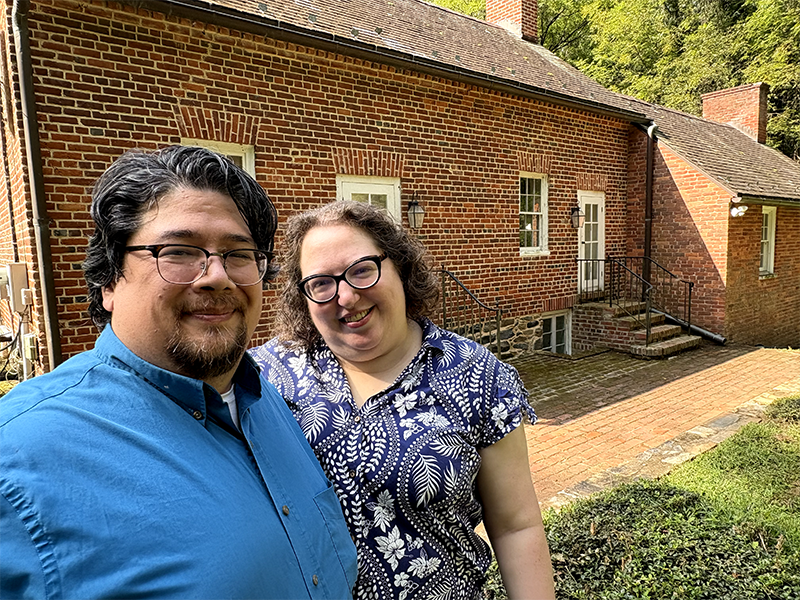
The Board of Supervisors approved leasing the Lahey Lost Valley House to resident curators Michael Nakagaki and Sonja Lupescu at their Aug. 25, 2026, meeting.
This marks the seventh historic home that’s been leased under Fairfax County’s Resident Curator program, as well as the third in the Hunter Mill District.
“This is a great county program,” said Supervisor Walter Alcorn when making the motion to approve the lease. “I know there are several other [homes] around the county. I’m so glad we’re doing this to keep historic structures alive and well and used.”
The 18th-century home will be leased to Nakagaki and Lupescu for nearly 30 years. Under the county program to preserve underutilized historic homes, the duo will live at Lahey house rent-free in exchange for renovating it at their expense.
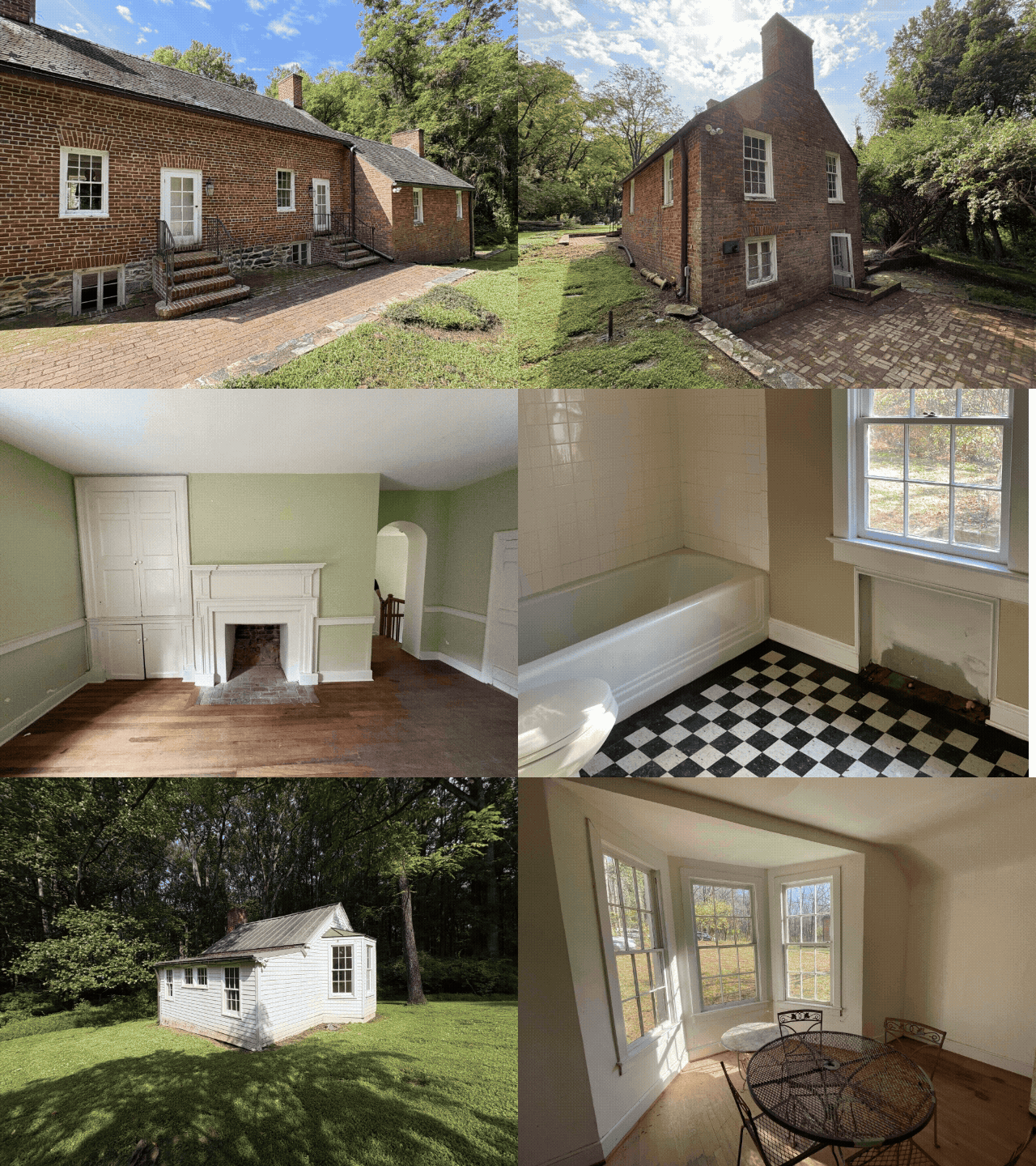
Located at 9750 Brookmeadow Drive in Vienna, the house is a 2,000 square-foot, brick home with a 1940s kitchen addition. It includes eight rooms, six fireplaces, a slate roof, hand-carved moldings and a free-standing building that was an artist’s studio. It sits on 22-secluded acres above a small stream valley.
The renovation plan approved by the Fairfax County Park Authority will cost an estimated $292,000, and the couple have five years to complete these repairs and upgrades under the program’s terms.
Using historically accurate materials, the repairs include restoration of architectural features, such as masonry and woodwork, and rehabilitation of interior finishes throughout the residence. Lupescu said they plan to showcase the home’s history across time in different rooms.
The property includes a wooden-frame kitchen addition that was built around 1914. The property’s last owners Richard and Carlotta Lahey moved it 50-feet away, turning it into a freestanding artist’s studio. The Lahey’s replaced this kitchen with a two-story brick addition that included a new kitchen with a fireplace, pantry, and furnace room, as well as a stone patio.
Lahey House’s History and Significance
As one of the oldest surviving homes in Fairfax County that’s also on the Inventory of Historic Sites, Lahey house is a significant example of a brick hall and parlor house that dates to circa 1760.
The home is notable for its association with the Gunnell family who were leaders in Fairfax County throughout the 18th and 19th centuries. The house is located on land that was granted to William Gunnell in 1730. In 1741, he gave the land to two of his sons to divide, and Henry Gunnell and his wife Catherine built the house and working plantation by 1760. Better known as “Major,” Henry Gunnell was active in the community, including as Truro Parish vestryman from 1756 to 1765 and Justice of the Circuit and District Court of Fairfax County between 1757 and 1764. He is also recorded as serving as a member of the Fairfax Committee of Safety in 1774 and sheriff in 1772. The Gunnell family continued to own the property until the 1930s
Renowned artists Richard and Carlotta Lahey bought the property in 1940. Richard studied with Robert Henri a leading figure of the Ashcan School, and his paintings are in museum collections across the country, including the Whitney Museum of American Art, Brooklyn Museum, Metropolitan Museum of Art and Library of Congress. He also served as President of the Corcoran School of Arts and Design. Carlotta taught sculpture at Goucher College and was a staff artist with National Geographic in the 1940s, while living in Vienna. In 1960, the couple worked on battle map murals at the Honolulu Memorial erected by the American Battle Monuments Commission.
In the 1990s, Carlotta Lahey bequeathed the house to the Fairfax County Park Authority, including its furnishings, art, antiques and 22 acres of land. She requested that the land be largely undisturbed to be a nature preserve in “the midst of the unbelievable growth” in Fairfax County. The Park Authority took possession of the property in 1999, following Lahey’s death.
Resident Curators Lupescu & Nakagaki
Lupescu and Nakagaki were selected as the curators following the Fairfax County Park Authority’s review of their application. This will be the couple’s first historic restoration project.
Lupsecu, who was formerly employed with USAID, stated in their application that her experience includes working on archaeological sites in Jamestown and Yorktown where she “gained familiarity with the processes of excavation, cataloging, and preservation of historical artifacts.” Nakagaki, who works for FEMA, is also an experienced woodworker, building custom furniture and restoring antique furniture.
Lupescu and Nakagaki will document their restoration work on their website for the project, and this site will also help people with accessibility or mobility issues to virtually visit the home since it's got many stairs that not everyone may be able to navigate.
Resident Curator Properties in Hunter Mill District
Lahey House joins two other Resident Curator properties in the Hunter Mill District.
Located near the Spring Hill Metro Station, the Ash Grove House was leased to Shiela Consaul last year. Thomas Fairfax built the original portion of this federal-style home in 1790 that the family inhabited until 1847.
In 2024, nonprofit Service Source cut the ribbon for their restoration of the Ellmore Farmhouse at Frying Pan Farm Park. The group spent nearly $715,000 to restore and convert this 1891 farmhouse into a site to serve people who have disabilities in Northern Virginia. Park visitors are also able to visit The Blossom Daily Café that’s operated out of the farmhouse, as well as the Bloom Gift Shop that features hand-made arts and crafts by ServiceSource participants.
Resident Curator Program
The Resident Curator Program offers long-term lease agreements to tenants in beautiful public park settings. Curators live rent free in exchange for rehabilitating underutilized historic properties owned by the Fairfax County Park Authority. Curators may be individuals, nonprofits or for-profit entities.