

Article by Gwen Jones, Department of Family Services
(Posted 2026 February)

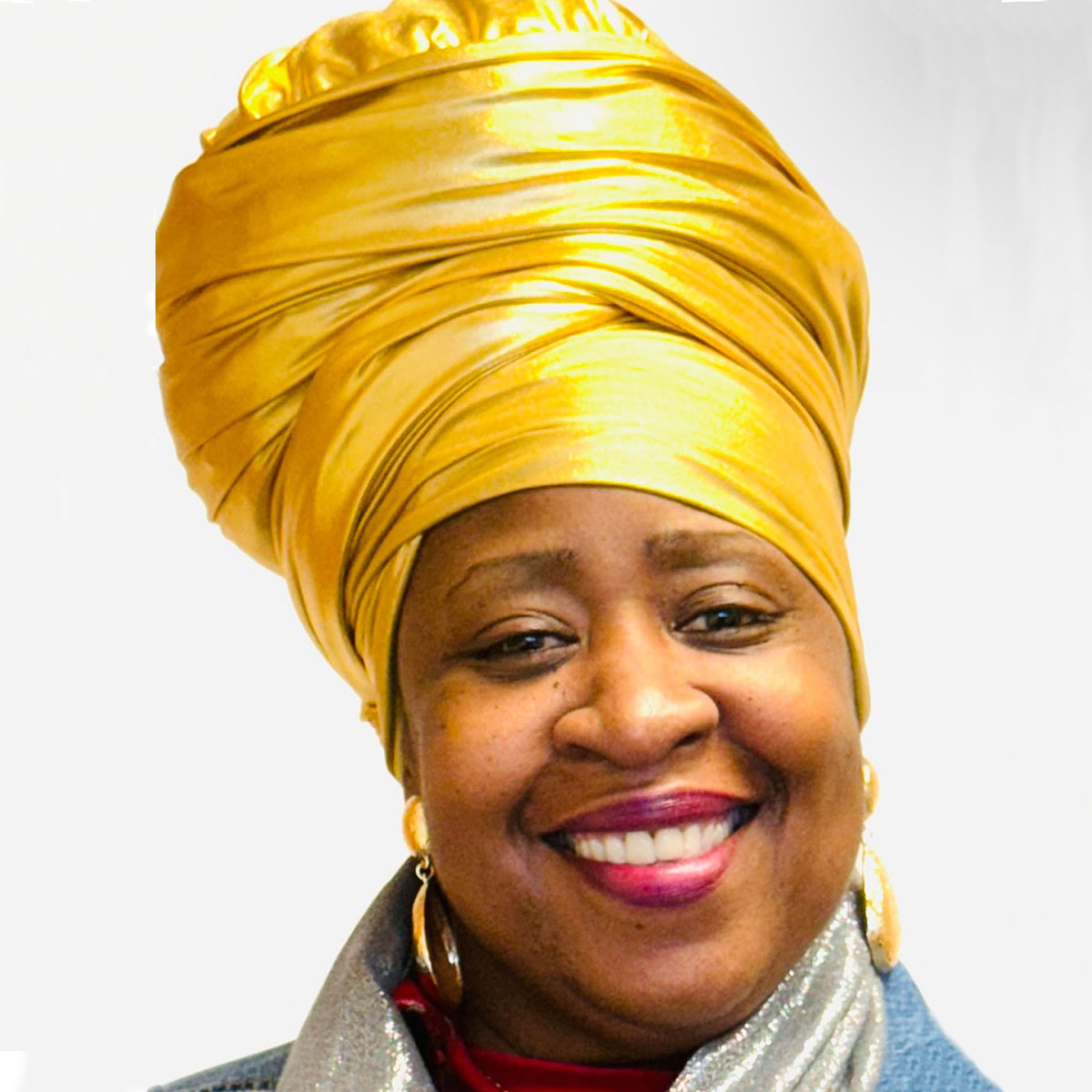
For decades people have been exploring their family history through genealogical research, but when mail-in DNA ancestry test kits were introduced over 20 years ago, everything changed. Test results often upended what people thought they knew about themselves and their family history. For Linneall Naylor, getting the results of her DNA test 10 years ago was life-changing, revealing surprising ancestry, previously unknown family connections, and deep roots in Virginia, especially in Fairfax County. Her results put her on a path of research and discovery, igniting a passion to uncover her family history and share the stories of her ancestors.
Linneall Naylor grew up in Southeast Washington D.C. She describes her parents, Clarence and Linda, as progressive African Americans who rarely talked about family history. Although he was raised Catholic, Clarence later converted to Islam and, influenced by Malcolm X, changed his name.
Although her parents didn’t discuss family history, Linneall’s paternal grandmother shared some information, including that she had grown up in Fairfax. When the miniseries “Roots” aired in 1977, her grandmother told her that they were related to the Haley family. Growing up, her grandmother’s appearance made Linneall wonder about her ancestry. “My grandmother was very fair skinned with freckles and red hair. I was always curious,” she says.
Linneall felt a calling to pursue a career in education. She attended the University of the District of Columbia, earning a degree in early childhood education. She believes her education not only prepared her for her career but also helped her be a better mother. Not long after moving from D.C. to Virginia in 1990, she began her career with Fairfax County Public Schools. Early in her career, she accepted positions that aligned with the ages of her two daughters, moving from the early childhood classroom to the School Age Child Care Program. Now that her daughters are adults, Linneall works in special education at Riverside Elementary School, a job that she truly enjoys.
Prior to taking a DNA test 10 years ago, Linneall had done little to learn about her family history. That changed when she got her test results. “It opened up a whole new door of me wanting to find my roots and while I found my roots, I found my ancestors,” she says. The test results revealed Linneall’s White ancestry, which surprised her. “I was like, wait a minute, what’s going on because the only thing I knew was that I was Black,” she recalls.
Linneall began researching her family history and discovered that her ancestors, both Black and White, had deep roots in Virginia. She traced her African American ancestors’ history to 1799. She was able to go further back in time with her White ancestry, tracing it back to Europe in the 1400s. Linneall’s primary tools for research were Ancestry.com, the Virginia Room, and the Bull Run Library in Manassas.
While her goal has always been to find her African American ancestry, Linneall soon figured out that she had to begin searching for her White ancestors to find her enslaved Black ancestors. Using 1870 census records, she found the names of her enslaved Black ancestors in the household listings of her White ancestors. “Sometimes I end up in a rabbit hole. Each time I go back I find another ancestor that was on a plantation in Fairfax County. It’s a lot to chase down,” she says. She found that both sides of her family descended from people who were enslaved on plantations in Fairfax, including Ravensworth, owned by the Fitzhugh family, and Mount Vineyard, owned by the Ratcliffe family. Linneall’s White ancestry includes Fitzhughs and Ratcliffes.
Through her ancestry research, Linneall first learned about the Jermantown Cemetery, located at 11085 Fairfax Boulevard in the City of Fairfax. Established in 1868, the cemetery served as a burial ground for enslaved and freed African Americans. While 100 burials are recorded in graves that are marked and unmarked, there may be more. She discovered that some of her ancestors were the original trustees of the cemetery and were buried there.
In 2021, Linneall became Vice President of the Jermantown Cemetery Preservation Society, a nonprofit dedicated to the restoration and maintenance of the cemetery. She now serves as President. Currently, they are working to raise funds to erect a fence around the cemetery to remind passersby that the land serves as a final resting place for many and should be treated with reverence and respect.
Although the Virginia Room has been a vital resource for her research, Linneall was disappointed that they had little information about Jermantown Cemetery or the African American community that lived in the City of Fairfax. To remedy that, she collaborated with Jenee Lindner, Rita Colbert, Etta Willson, and Rondia Prescott to write a book, which they titled “Black Communities of Fairfax: A History.”
During the year it took to write their book, the five authors met often to share ideas, give feedback, and collaborate. The book includes a list of everyone buried in Jermantown Cemetery and tells some of their stories. Rita Colbert’s father was a prolific photographer in the City of Fairfax, so they used photos from her personal archive in the book so readers could see the people and places they wrote about.
To promote their book, Linneall and Etta Willson began giving public presentations. Attendees were often inspired by what they heard and sought Linneall’s advice about how to begin their own research. “There’s always someone in the crowd that’s unsure about how to go about finding their ancestry so it’s a ministry to me. It’s a calling.” Linneall continues, “There was a time when I didn’t know who I was connected to. A lot of people now in this day and time, they have all these DNA tests and resources. They want to know the stories.”
While Linneall encourages people to get a DNA test to learn about their ancestry, she cautions that the results may be shocking. Her advice is, “Get a glass a wine and open the results. Go into it with an open heart, open mind and open eyes.”
Some of the information Linneall found during her research resonated deeply with her. She discovered that some of her ancestors were educators like her, including her third time great grandparents, who helped establish a school in Fairfax County, and the first Black principal in Fairfax County. She has also been amazed by all the people she is related to, including coworkers, old neighbors, and former classmates. “We are all six degrees of separation in Virginia,” she observes.
Linneall has also discovered that she is related to historical figures. On her maternal side, she is related to Richard Loving, who along with his wife Mildred, appealed their convictions for violating Virginia's Racial Integrity Act which banned interracial marriage. Their case, Loving v. Virginia, made its way to the U.S. Supreme Court and in June 1967, the judges issued a unanimous decision in the Lovings' favor, which overturned their convictions and struck down Virginia's Racial Integrity Act. This decision ended all race-based legal restrictions on marriage in the U.S.
Ultimately, Linneall’s goal is to recognize and honor her ancestors. “I’m a physical representation of who they were. I’m also telling their truths and their stories about how they lived, how they survived. I’m here because of them. I try to make sure I tell the story true and tell it exact and tell it with respect,” she says. She is also an advocate for them – ordinary people who worked hard to improve the lives of the generation that came after them. “I want to put the positives out about how we have overcome since slavery. I want to talk about the community that we’ve built and recognize the sacrifices that were made by our ancestors to get us here,” she says.
“Black Communities of Fairfax: A History” is available to purchase at Amazon.com. You can also borrow the book from Fairfax County Public Library. View it in the library catalog using this link: bit.ly/44NXiF7. To learn more about Jermantown Cemetery, visit jermantowncemetery.org.
This article is part of the Golden Gazette monthly newsletter which covers a variety of topics and community news concerning older adults and caregivers in Fairfax County. Are you new to the Golden Gazette? Don’t miss out on future newsletters! Subscribe to get the electronic or free printed version mailed to you. Have a suggestion for a topic? Share it in an email or call 703-324-GOLD (4653).