

Department of Family Services Alert:

Sharon Masterson’s Love of Learning Led to a Globe-Trotting Life

Lifelong learning can take many paths and doesn’t always start in the classroom. For Sharon Masterson, her interest in learning about other countries and cultures began during a family trip to Florida. It continued when, against the advice of friends, she had the courage to follow her instincts and join the U.S. Army. This choice allowed her to travel, see the world, and learn about people and cultures she never would have known if she had stayed in her hometown. Now retired, Sharon is still curious and eager to learn, and her travels keep that curiosity alive. Read more.
Come Celebrate 50 Years of Aging Well!
For five decades, the Fairfax Area Agency on Aging (AAA), has been a trusted place for residents in Fairfax County and the cities of Fairfax and Falls Church, to find resources, get support, and learn about programs that support older Americans. In honor of the 50th anniversary, Fairfax AAA is hosting a free community celebration and you’re invited! Read more.
Family Caregiver Support: Resources for Medicare Open Enrollment

Medicare Open Enrollment, October 15 to December 7 each year, is a critical period for family caregivers of older adults. Review your loved one’s current Medicare coverage, compare the options, and make any changes to fit their medical and financial needs for the coming year. If your loved one’s health has changed, they have new prescriptions, their preferred doctors or hospitals have shifted, or their budget has become tighter now is the time to make important changes. Read more.
Need a Ride?

If you no longer drive, it can be difficult to run errands and get to your medical appointments. Asking friends, neighbors or family members for a ride may be an option for some, but not all. Rideshare services are widely available, but the cost and tech savvy required to use them may put them out of reach of some older adults. The good news is there are organizations offering free or reduced-cost rides to the places you need to go. Read more.
Preserve Your Family History and Stories

October is Family History Month, a reminder that it takes work to ensure later generations know your family’s stories and can identify family members in photos. There aren’t rules for documenting your family history. You may choose to research your historical ancestors or document just the generations you remember, such as great-grandparents, grandparents, and parents. Learn how to get started. Read more.
Stay Warm This Winter: Fuel Assistance Opens October 13
(By Stevie Connor, Department of Family Services)
The start of fall is the time to get cozy and prepare to enjoy the changing leaves and holiday traditions! But it’s only enjoyable if you have a warm home where you can stay safe from the cold. Cold weather can strain heating systems and increase costs, which can be difficult for anyone on a limited income. The Fuel Assistance program helps pay heating costs for eligible households. Some people will be pre-approved and others will need to apply. Applications will be accepted from October 13 until November 13 this year.
The Crisis Assistance program is another option for households in need of heating assistance this winter. Crisis Assistance helps those who are in an emergency “no heat” situation, such as broken equipment or receiving a disconnection notice. Crisis Assistance applications will be open November 2 until March 15.
To apply for Fuel or Crisis Assistance, or other food and medical benefits, visit CommonHelp or call 855-635-4370.
October is Residents’ Rights Month!
(By Katie Patterson, Long-Term Care Ombudsman)
Residents’ Rights Month is celebrated every October to honor residents in long-term care (LTC) facilities, such as nursing and assisted living facilities, and for consumers receiving LTC services in the community. Residents’ Rights Month is an opportunity to focus on and celebrate the dignity and rights of every individual receiving long-term services and support. Residents’ rights are guaranteed by federal and state laws and are critical components of quality care and of life for all residents. This year's Residents' Rights Month theme is Join Us at the Table, highlighting the importance of food, mealtimes, and community in residents’ daily lives. Food is essential to residents’ health, but its significance extends beyond that. Food is comfort, culture, identity, and connection – a daily experience that shapes dignity and quality of life. To learn more information about Resident’s Rights, and to participate in activities related to Residents’ Rights Month, visit National Consumer Voice for Quality Long-Term Care’s website.
As a mandated program under the Older Americans Act, the Northern Virginia Long-Term Care Ombudsman Program (NVLTCOP) is often called on to assist residents and consumers to advocate for their rights to ensure quality of care and quality of life. For more information about residents’ rights, or other nursing facility and assisted living concerns, please call the NVLTCOP at 703-324-5861, TTY 711, or email NVLTCOP@fairfaxcounty.gov.
Mature Living: Emergency Preparedness
(By Fran Guastadisegni, Channel 16)
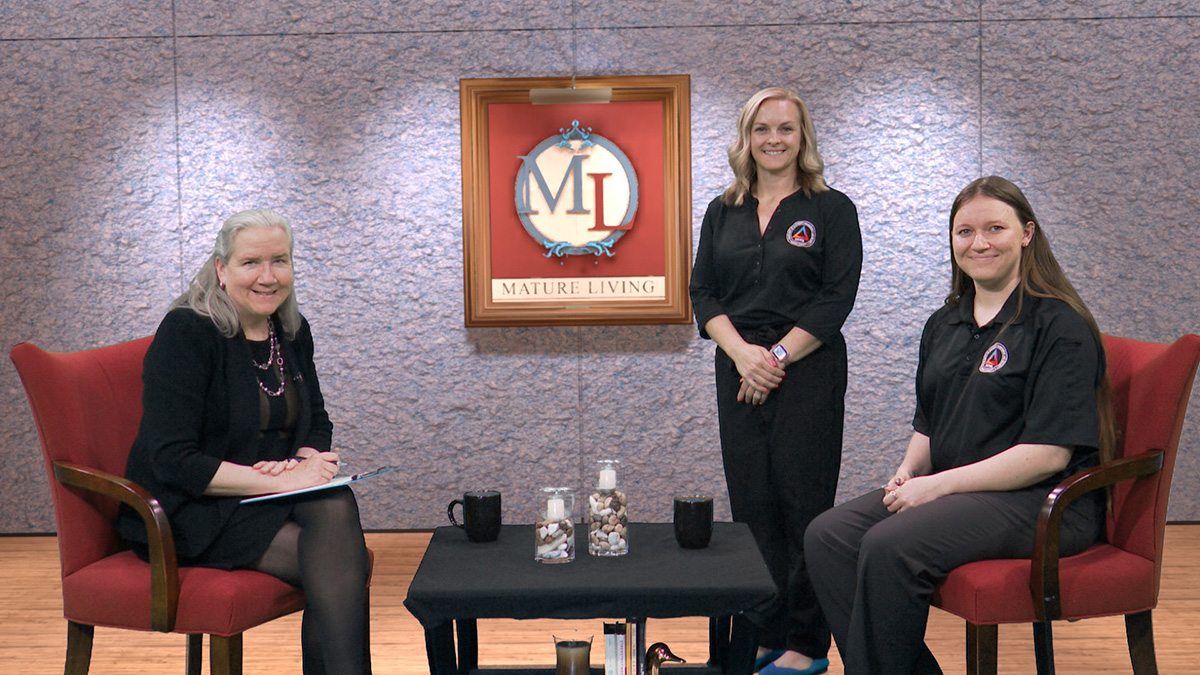
We all know it’s important to be prepared for emergencies – but where do we start, and what should we prepare for? Courtney Arroyo, Assistant Coordinator of Communications and Community Engagement, and Crystal Goodwin, Access and Functional Needs Specialist – both with the Fairfax County Department of Emergency Management and Security (DEMS), break down the most likely emergencies we might face and how to plan for them. They highlight key online resources and share practical steps you can take to keep yourself and your loved ones safe. Peggy Plunkett, a volunteer with the Fairfax County Community Emergency Response Team, DEMS and the Medical Reserve Corps, shares her real-world experience with emergency preparedness and why being ready matters so much to her.
Mature Living can be seen on Channel 16 on the following days and times:
Mature Living replays on Channel 16 may be pre-empted by Board of Supervisors, Board of Zoning Appeals, or Planning Commission meetings. Mature Living can also be seen On-Demand anytime.
You can find information on services for older adults at Older Adults Services or call 703-324-7948, TTY 711, Monday-Friday.
Celebrating Value and Talent: National Disability Employment Awareness Month
(By Tyrena Lewis, Disability Rights and Resources)
Fairfax County Department of Family Services welcomes October with its annual Employment Mentoring Day event in celebration of National Disability Employment Awareness Month (NDEAM). NDEAM was first recognized by Congress in 1945 to celebrate the accomplishments of workers with disabilities and to promote fairness in job opportunities for everyone.
This year’s theme, “Celebrating Value and Talent,” continues the spirit of last year’s celebration in honor of America’s 250th birthday. It recognizes how people with disabilities bring meaningful skills to workplaces and to our economy.
According to the U.S. Department of Labor, Bureau of Labor Statistics, 75.0% of the working-age population (ages 16 to 64) without disabilities were employed in July 2026, while the employment-population ratio for persons with a disability was 38.3%. These statistics encourage conversation about how we might improve job prospects for people with disabilities.
Employment Mentoring Day is hosted by the Disability Rights and Resources (DRR) unit, in partnership with Fairfax County Public Schools. This year’s event is taking place in the South County region and will focus on promoting career development for high school students with disabilities through career exploration as they learn first-hand about new employment opportunities, develop connections with Fairfax County employees, and increase confidence as student job seekers.
Learn more about the work of Disability Rights and Resources.
Upcoming Free Classes
(Hosted by Inova ElderLink)
Caregiving Over the Holidays
Virtual Caregiver’s Roundtable
Tuesday, Oct. 13, 7-8 p.m.
Caregiving during the holidays can cause an already full schedule to overflow. To quote AARP, "It feels good to care for loved ones and enjoy time together, celebrating with family traditions. But for many the holidays also bring added stress – an already busy caregiver finds there’s even more to do during the holidays. Something’s gotta give!" Join us to share ideas and tips for navigating through the holiday season with more joy and less stress. Register online or call the Inova ElderLink Intake Line, 703-324-5374.
A Matter of Balance
In-Person Workshop at Inova Prosperity (2740 Prosperity Avenue, Fairfax)
Wednesdays, Oct. 7 - Dec. 2, 10 a.m.-12 p.m.; No class Wednesday, Oct. 14
Many older adults experience concerns about falling and restrict their activities. This eight-week evidence-based workshop is designed to reduce the fear of falling and increase activity levels among older adults. Participants learn fall prevention strategies through discussion and activities, as well as gentle exercise to strengthen balance, flexibility, and coordination. For more information, call Kathy Akindemowo at 703-324-9814, TTY 711. Register online.
Chronic Disease Self-Management Program
Virtual Six-Week Interactive Group Workshop
Mondays, Oct. 26 - Nov. 30, 1-3 p.m.
Don't let ongoing health problems stop you from living the life you enjoy. This six-week workshop series is for individuals who are interested in learning how to live better by effectively managing their ongoing health conditions. For more information, please call Kathy Akindemowo 703-324-9814, TTY 711, or email Katherine.Akindemowo2@fairfaxcounty.gov. Register online.
Exploring the Dimensions of Aging
Virtual Embodied Labs Training Sessions
In these 75 minute facilitated sessions, you will use the Embodied Labs training platform to “see” what it’s like to be an older adult facing real-life challenges. Offered by Inova ElderLink and the Fairfax Area Agency on Aging three session topics are currently available, including two new facilitated sessions for 2026: The Clay Lab (End-of-Life Conversations) and The Beatriz Lab (Alzheimer’s Disease). After the training, attendees receive a license to keep using the Embodied Labs platform to learn more. Register online
Fairfax Area Commission on Aging
(By Linda Hernandez-Giblin, Fairfax Area Agency on Aging)
The Fairfax Area Commission on Aging (COA) is an advisory board mandated by the Older Americans Act. Commissioners for the COA are appointed by the Fairfax County Board of Supervisors and the City Councils of the City of Fairfax and the City of Falls Church.
At the September 16 COA meeting, the COA discussed the implementation of the SHAPE the Future of Aging Plan and Initiative Development Committees. In addition, the COA heard an update on Department of Family Services programs. At the October 21 meeting, the COA will continue to work on the SHAPE the Future of Aging Plan and Initiative Development Committees. The SHAPE Committee meetings will be ongoing through the duration of the Plan.
COA Meeting - Wednesday, Oct. 21, 1 p.m.
In Person: Pennino Building, 12011 Government Center Pkwy, Fairfax, VA 22035 – Room 505
To learn more about the meeting, obtain meeting materials, or for ADA accommodations, visit bit.ly/FXCOA, email Linda.Hernandez-Giblin@FairfaxCounty.gov or call 703-324-5859.
2026 Medicare Educational Workshops
(By the Virginia Insurance Counseling and Assistance Program)
Medicare 101 Workshops are led by the Virginia Insurance Counseling and Assistance Program (VICAP). The workshops are for individuals and their care partners who will soon be eligible for Medicare or have Medicare and would like to learn more about it. In-person workshops have limited seating. Registration is required. Registration for library events begin 30 days prior to the presentation date. For more information, call VICAP at 703-324-5851.
Thursday, October 1, 2-3:30 p.m., In-Person
Reston Community Center, 2310 Colts Neck Rd, Reston
For more information, call 703-476-4500.
Monday, October 5, 2-3:30 p.m., In-Person
Thomas Jefferson Library, 7415 Arlington Blvd, Falls Church
Register online.
Wednesday, October 7, 12:30-2 p.m., In-Person
Jim Scott (Providence) Community Center, 3001 Vaden Dr, Fairfax
Register online.
Friday, October 9, 1:30-3 p.m., In-Person
Tysons-Pimmit Regional Library, 7584 Leesburg Pike, Falls Church
For more information, call 703-790-8088.
Tuesday, October 13, 2-3:30 p.m., In-Person
Lorton Library, 9520 Richmond Highway, Lorton
Register online.
Wednesday, October 14, 2-3:30 p.m., In-Person
Kings Park Library, 9000 Burke Lake Road, Burke
Register online.
Monday, October 19, 2-3:30 p.m., In-Person
Mary Riley Styles Public Library, 120 North Virginia Avenue, Falls Church
Register online.
Wednesday, October 21, Noon-1 p.m., Virtual
Family Caregiver Support Programs Medicare 101 Webinar
Register online.
Thursday, October 22, 2-3:30 p.m., In–Person
Sherwood Regional Public Library, 2501 Sherwood Hall Lane, Alexandria
Register online.
Monday, October 26, 1:30-3 p.m., In–Person
Kingstowne Regional Library
7130 Silver Lake Boulevard, Alexandria
Register online.
Wednesday, October 28, Noon-1 p.m., Virtual
Family Caregiver Support Programs Medicare 102 Webinar
Register online.
Wednesday, November 4, 5-6:30 p.m., Virtual
Reston Community Center
For more information, call Reston Community Center at 703-476-4500.
Friday, November 6, 1:30-3 p.m., In-Person
Chantilly Regional Library, 4000 Stringfellow Rd, Chantilly
Register online.
October 18 Expo and Other Ways to Recharge Your Life
(By Tanya Erway, Volunteer Solutions Recruitment Coordinator)

Mark your calendar for Sunday, October 18, for a special two-for-one event featuring the Beacon 50+ Expo and Venture into Volunteering fair.
Whether you’re looking for resources, services, activities, or new ways to get involved in the community, this fair offers something for everyone. A wide variety of organizations will be on hand to share information, answer questions, and connect attendees with valuable opportunities.
Here are a few of the more than 30 organizations that will be participating in the volunteer fair:
ECHO is an all-volunteer, nonprofit organization that helps individuals and families in need within the Burke/Springfield community by offering food, clothing, housewares, and financial assistance for housing and utilities. Volunteering roles are very flexible and include opportunities to perform work on the ECHO premises within business hours, remotely at the volunteer’s convenience, and on a seasonal or temporary basis. To explore the range of ECHO services and volunteer opportunities, visit echo-inc.org.
Rebuilding Together - Arlington/Fairfax/Falls Church makes critical home repairs, at no charge, for low-income homeowners. Their volunteers make homes safe and healthy, and help older adults age in place, mostly through half-day projects. Volunteers with technical skills (from basic to advanced) work in teams to make repairs and modifications, such as installing grab bars, stair rails, and brighter lighting, tuning up doors, and correcting moisture and ventilation problems. They support volunteers through skills training, technical resources, and on-the-job mentoring. Learn more from the “Welcome New Volunteers” video at rebuildingtogether-aff.org/volunteer. Questions? Contact them at Info@rebuildingtogether-aff.org or 703-528-1999.
Would you like to connect and share your skills with others in your community? Volunteer Solutions, located within the Fairfax County Department of Family Services, and in partnership with Neighborhood and Community services, seeks volunteers to help support older adults, adults with disabilities and family caregivers. Senior centers need volunteers to lead fitness, dance, and arts and crafts, among other fun activities. Check out the full list of engaging roles, including one-on-one social visiting, grocery shopping, and more, at bit.ly/DFS-VS. Email VolunteerSolutions@FairfaxCounty.gov, or call 703-324-5406 with questions.
Help local families save money and secure critical tax refunds by volunteering with the Volunteer Income Tax Assistance Program (VITA). The Fairfax County Department of Family Services is recruiting volunteers to act as greeters, interpreters, screeners, and tax preparers. No tax training is needed for greeters and interpreters. No prior experience is necessary. Free in-person training is available for screeners and tax preparers. Opportunities are available throughout Fairfax County. Hours are flexible, including evenings and weekends.
Volunteer training begins in early December, and volunteers are needed through mid-April. Learn more.
If you wish to advertise volunteer opportunities in future editions, email Tanya.Erway@FairfaxCounty.gov.
Small Act, Big Impact
There are many ways to help older adults in our community. One way to help is by asking your older adult neighbor if you can bring their trash and recycling bins to and from the curb on trash day. While this may seem simple, it can have a big impact.
Beacon Marks 27 Years of 50+Expos
(By Steve Gurney, The Beacon Newspapers)

The Beacon is bringing back its signature 50+Expos this fall, marking the 27th year of the free, in-person events that draw thousands of older adults and their families across the DMV region.
This year's Expos will take place at two locations:
Attendees at both events can browse dozens of exhibitor booths from local businesses, government agencies, and nonprofits covering housing options, home remodeling, home care, financial planning, insurance, healthcare, fitness, travel, and other senior resources. Parking is free at both venues.
The Springfield event will also feature “Venture into Volunteering,” a partnership between the Beacon and the Fairfax County Area Agency on Aging showcasing more than 35 agencies and nonprofits with volunteer opportunities for older adults.
At the Silver Spring Expo, attendees can catch a keynote conversation with Kojo Nnamdi, the acclaimed journalist and host of WAMU's “Young at Heart” podcast.
Both Expos will offer free health screenings, including blood pressure, glaucoma, blood glucose, and cholesterol testing. A range of vaccines will also be available, including the latest COVID-19 and RSV shots, regular and high-dose flu vaccines, and Shingrix, pneumonia, and tetanus vaccines. Attendees are encouraged to bring their Medicare and/or insurance cards.
The 2026 Expos are supported by a roster of local sponsors. Gold Sponsors include AARP Virginia and WAMU 88.5. Silver Sponsors are Giant Pharmacy and Johns Hopkins Health Plans. Bronze Sponsors include United Healthcare, CareFirst BlueCross BlueShield, Cogir West End Alexandria Senior Living, the Fairfax County Department of Family Services, The Harbor at Quantico Creek, Montgomery County Recreation, and Montgomery County Aging & Disability Services, along with Torregrossa Insurance.
Those interested in exhibiting, sponsoring, or volunteering can call 301-949-9766, email info@thebeaconnewspapers.com, or visit thebeaconnewspapers.com/50expos.
Keep Your SNAP and Medicaid Benefits
(By Stevie Connor, Department of Family Services)

A federal law enacted in July 2025 made changes to the Supplemental Nutrition Assistance Program (SNAP) and Medicaid (Medical Assistance) that affect some adults ages 19-64.
The law included several changes to the SNAP work requirement:
All participants must provide proof of expenses to lower their income in the SNAP benefit calculation. Submitting proof of expenses is not required to receive SNAP benefits but may increase your benefit if you are approved. Previously, SNAP participants could provide a statement instead of documentation.
Examples of expenses include dependent (adult or child) care, shelter (housing), utilities, and medical costs.
These changes only apply to adults with Medicaid Expansion (adults ages 19–64 with incomes up to 138% of the Federal Poverty Level).
Work requirements can be met by working, volunteering, or participating in work training or education for at least 80 hours a month, enrolling as a student at least half-time, or having an income of at least $580/month. Many exemptions apply to the new work requirement.
Retroactive Medicaid coverage will be reduced for all members, from 3 months to 1 month for Medicaid Expansion members and 2 months for all other Medicaid members.
Department of Family Services is committed to helping eligible people stay covered. Medicaid members should ensure their contact information is up to date and keep an eye out for important notifications from Virginia Medicaid. Make changes online at CommonHelp or by calling Cover Virginia at 1-855-242-8282 (TTY: 1-888-221-1590).
If you lose Medicaid benefits, there are community clinics and other services available to help you stay healthy. Learn about low-cost or free health care options in Fairfax County.
Learn more about these and other changes to SNAP and Medicaid at bit.ly/benefit-changes.
Charging Electronics Safely
(By Community Risk Reduction, Fairfax County Fire & Rescue Department)
Fire Prevention Week is October 4-10! The theme this year is “Charge Into Fire Safety™ – Safe Charging Is a Superpower.” We charge our electronic devices every day. Did you know that some charging habits are more dangerous than others? There are actions you can take to help reduce the risk of lithium-ion battery fires and to keep your family and home safe.
Lithium-ion batteries can be found in devices that we use every day, including mobile phones, laptops, tablets, e-bikes, and e-cigarettes. These batteries can store a large amount of energy in a compact space. Lithium-ion batteries charge quickly and efficiently, but are prone to overheating, catching on fire, and sometimes exploding if they are not charged, handled, stored, or disposed of safely.
The National Fire Protection Association offers these six safe charging habits:
Do you have more questions about lithium-ion batteries and safe charging? Join Fairfax County Fire and Rescue Department for an Open House at any of our 39 stations on Saturday, October 10, 10 a.m.-4 p.m.!
Most home fires can be prevented; working smoke alarms save lives! Test your smoke alarms MONTHLY. Contact Fairfax County Fire & Rescue to arrange for free smoke & carbon monoxide alarm installation. Call 703-246-3801 or email fire.smokealarms@fairfaxcounty.gov.
For more information, or to book a presentation by a Life Safety Education Specialist, please visit our webpage of Educational Resources or email us at fire.ESW@fairfaxcounty.gov.
Source: National Fire Protection Association - nfpa.org/Education-and-Research/Home-Fire-Safety
Free Caregiving at a Glance Guidebook
(By Gwen Jones, Department of Family Services)
Available in both English and Spanish, the sixth edition of the Caregiving at a Glance guidebook is for families caring for a loved one with Alzheimer’s and dementia. Created by Insight Memory Care Center, a nonprofit providing quality memory and cognitive care for families living with dementia, this guidebook includes techniques and strategies to help caregivers address topics such as troublesome behaviors, communication, eating, bathing and more. Request a free print copy.
Insight has also introduced a new series of self-paced videos based on the guidebook. Available in both English and Spanish, these short videos provide practical information, tips and strategies to help care partners better understand common challenges, build confidence, and feel more prepared throughout the dementia journey.