

Fairfax County, Virginia
Fairfax County Virginia

FFX Global Navigation

    • Soil and Water Conservation District Homepage
    • About NVSWCD
      • About the Soil and Water Conservation District
      • Board of Directors and Staff
      • Careers and Internships
      • Our Partners
      • Policy Positions and Legislative Letters
    • Addressing Conservation Problems
    • Urban Agriculture and Community Gardens
    • CAP/VCAP Cost-share
    • Flood Mitigation Assistance Program (FMAP)
    • Community Programs and Presentations
    • Volunteering with NVSWCD
    • Youth and Student Programs
    • Newsletter
  • Residents
    • Animals & Pets
      • Adoptions
      • Animal Control & Regulations
      • Guide to Dogs
      • Lost & Found Pets
      • Shelter Support & Supplies
      • Wildlife
      • More
      Courts & Legal
      • Case Information
      • Circuit Court Docket
      • Jury Duty
      • Land Records
      • Magistrate
      • Public Law Library
      • Self-Help Resources
      • Traffic Court
      • Vital Records
      • More
      Environment & Energy
      • Invasive Species
      • Litter
      • Recycle, Trash & Compost
      • Sustain Fairfax
      • Trees
      • Watersheds
      • More
      Health & Human Services
      • Basic Needs & Assistance
      • Disability Services
      • Diseases & Conditions
      • Domestic & Sexual Violence
      • Health Clinics
      • Mental Health
      • Opioids
      • More
      Individuals & Families
      • Children & Youth
      • Federal Workforce
      • Immigrants
      • Military & Veterans
      • New Residents
      • Older Adults
      • Parents
      • People with Disabilities
      • Volunteers
      • More
      Land Use & Planning
      • Comprehensive Plan
      • County Capital Projects
      • Land Records
      • Parks Planning
      • Planning Projects
      • Research Tools
      • Transportation Projects
      • Urban Centers
      • More
      Library & Education
      • Adult Education
      • Early Childhood Programs
      • Library Branches
      • Library Catalog Search
      • Public Schools
      • More
      Parks & Recreation
      • Arts
      • Athletic Fields
      • Camps
      • Community Centers
      • Parktakes Classes
      • Rec Centers
      • Senior Centers
      • Teen Centers
      • Trails
      • More
      Permits & Licenses
      • Birth & Death Certificates
      • Building
      • Child Care
      • Dogs
      • Health
      • Marriage
      • Park Use
      • Solicitors
      • More
      Property & Housing
      • Affordable Housing
      • Code & Zoning
      • Neighborhoods
      • Real Estate Values
      • Recycling & Trash
      • Tenant Landlord Issues
      • Utilities
      • More
      Public Safety & Emergencies
      • 9-1-1
      • Emergency Preparedness
      • Fire & Rescue
      • Gun Violence Prevention
      • Police
      • Scams
      • Sheriff
      • Storm Center
      • More
      Roads & Commuting
      • Bike & Walk
      • Connector Bus
      • Metrobus & Metrorail
      • Park & Ride
      • Pedestrian Safety
      • Road Maintenance/VDOT
      • Street Parking
      • Toll Roads
      • Transportation Projects
      • More
      Taxes & Fees
      • Car Taxes
      • Park Fees
      • Real Estate Taxes
      • Tax Relief
      • Trash Disposal Fees
      • More
      Voting & Elections
      • Absentee Voting
      • Early Voting
      • Election Results
      • Polling Places
      • Voter Registration
      • More
      Weather & Climate
      • Air Quality
      • Climate Action Dashboard
      • Extreme Heat
      • Floods
      • Ready Fairfax
      • Resilient Fairfax
      • Snow
      • Tornadoes
      • More
  • Business
    • Business & Construction
      • Building Permits
      • Code & Zoning
      • Land Use
      • More
      Business Services
      • Business Emergency Preparedness
      • Business Taxes
      • Consumer Services
      • Employer Transportation Service
      • Green Business Partners Program
      • Home-Based Business
      • Regulation & Licensing
      • Small Business
      • Starting a Business
      • Workplace Issues
      • More
      Doing Business with Fairfax
      • Contracting and Procurement
      • Current Solicitations
      • Permits
      • Vendor Pitch Portal
      • More
  • Government
    • About
      • Codes & Standards
      • Countywide Strategic Plan
      • Facilities & Locations
      • History of Fairfax County
      • Operating Status
      • More
      Board of Supervisors
      • Auditor
      • Board Members
      • Boards, Authorities & Commissions
      • Clerk Services
      • Committees
      • Meetings & Agendas
      • More
      Budget & Finance
      • Bonds
      • Budget
      • Financial Transparency
      • Unclaimed Money
      • More
      Departments & Agencies
      Jobs & Employment
      • Full-Time Openings
      • Internships
      • Seasonal & Non-Merit
      Maps & Data
      • Countywide Data Analytics
      • Demographics
      • Geographic Information Systems
      • Interactive Data Tools
      • More
      One Fairfax
      • Digital Equity
      • Inclusive Engagement
      • Trust Policy
  • Fairfax County Virginia
  • Services
    • Find
      • Animal Services
      • Health Clinics
      • Jobs
      • Library Resources
      • Lost or Found Pet
      • Mental Health Support
      • Park Classes
      • Real Estate Values
      • Recycling & Trash
      • Volunteer Opportunities
      • More
      Pay
      • Business Taxes
      • Car Taxes
      • Dog Licenses
      • Driving & Parking Fines
      • False Alarm Fees
      • Real Estate/Property Taxes
      • SACC Payments
      • More
      Register/Apply
      • Basic Needs & Assistance
      • Building Inspections
      • Car Registration
      • Fairfax Alerts
      • Permits & Licenses
      • Tax Relief
      • Vote
      • More
      Report
      • Animal Control Issues
      • Consumer Complaints
      • Crime
      • Domestic Violence
      • Financial Crimes
      • Neighborhood Complaints
      • Road Issues to VDOT
      • Street Light Outages
      • More
  • Connect
    • Alerts, Emails & Apps
      • Email Subscriptions
      • Fairfax Alerts
      • Mobile App
      • More
      Community Engagement
      • Surveys & Projects
      Contact
      • Directory
      • Hotlines & Emergency Numbers
      • VDOT
      • VFOIA Requests
      • More
      News & Events
      • Daily Headlines
      • Emergency Information Blog
      • Events Calendar
      • NewsCenter
      • NotiCentro (Spanish)
      • Public Meetings Calendar
      • More
      Social Media
      • Comments Policy
      • Directory of Accounts
      • More
      TV, Video & Podcasts
      • Channel 16
      • Podcasts & Radio
      • YouTube
      • More
  • TRANSLATE
    • Language Selection

      To change the language of this website, click the drop-down list and select the desired language. The Fairfax County Web site is being translated through "machine translation" powered by Google Translate. Disclaimer

Northern Virginia Soil and Water Conservation District

  1. Home
  2. Northern Virginia Soil and Water Conservation District
  3. Stream Monitoring Handbook

Northern Virginia Soil and Water Conservation District Alert:

703-324-1460 TTY 711
ConservationDistrict@fairfaxcounty.gov
12055 Government Center Parkway
Suite 905, Fairfax, VA 22035
nvswcd
Willie Woode
Executive Director

Department Resources

  • Soil and Water Conservation District Homepage
  • About NVSWCD
    • About the Soil and Water Conservation District
    • Board of Directors and Staff
    • Careers and Internships
    • Our Partners
    • Policy Positions and Legislative Letters
  • Addressing Conservation Problems
  • Urban Agriculture and Community Gardens
  • CAP/VCAP Cost-share
  • Flood Mitigation Assistance Program (FMAP)
  • Community Programs and Presentations
  • Volunteering with NVSWCD
  • Youth and Student Programs
  • Newsletter
  • facebook
  • instagram

Stream Monitoring Handbook

WANT TO JOIN NVSWCD AT A STREAM MONITORING WORKSHOP?

Stream monitoring workshops are only announced through the Watershed Calendar. You can register for this email listserve here or by emailing NVSWCD.

This handbook is designed to be an overview of stream monitoring information provided for certified stream monitoring volunteers. It is NOT designed as a replacement for field training sessions. If you would like additional training or have any suggestions about other materials that would be helpful, please contact NVSWCD.

It is easy to forget some details when monitoring quarterly. Although you are a certified monitor, you may want some review of the details of sampling and identification. You are encouraged to join other monitors or invite other monitors to join you. If you ever have any questions, please do not hesitate to reach out to NVSWCD and the stream monitoring program coordinator.

This handbook is broken into four sections: safety, equipment, biological monitoring information, and common benthic macroinvertebrates.

stone fly

Stonefly

Safety

Before Monitoring:

  • If you would like some additional helpers, please contact the coordinator. Your monitoring session can be advertised to other certified monitors, or the program coordinator may be available to assist.
  • Make sure that someone knows the date, time, and location that you will be monitoring so that if you are injured, someone will know that you are missing or late in returning.
  • PLEASE DO NOT MONITOR ALONE.
  • Find out the phone number of the nearest medical center to your monitoring site and make sure you have cell phone coverage at your monitoring site. 

Rules to Monitor by:

  • Never monitor when the water is at flood stage or is flowing much swifter than normal. It is better to delay your monitoring event than to risk drowning or broken bones. A good rule of thumb is not to monitor if the water is above your knee.
  • During monitoring, keep your hands away from eyes and mouth. ALWAYS WASH YOUR HANDS THOUROUGHLY WITH SOAP AND WATER AFTER MONITORING. NEVER EAT WITHOUT WASHING YOUR HANDS FIRST. Many of our streams have elevated e. coli levels. Do not monitor your stream with open cuts.
  • If the water appears to be polluted (strong smell of sewage or chemicals, unusual colors, dead fish) please postpone your monitoring.

To protect yourself, it is advised that you:

  • Wear rubber boots or waders to keep your legs and feet dry and to minimize contact with water. Rubber boots will also offer protection from ticks. It is better to wear old sneakers than sandals because they offer protection from glass and sharp rocks in the stream.
  • Wear rubber gloves to reduce contact with water and to protect cuts from trash in the stream.

Snakes

Snakes may be a concern when monitoring in an aquatic environment, especially in slow moving water with overhanging vegetation. Most snakes in aquatic environments are not venomous. If you approach your site through thick high grass, thump the ground in front of you with a walking stick. Snakes will feel the vibrations and will move away. Snakes are deaf so loud noises will not scare them away. The only venomous snake in Fairfax County is the Copperhead.

In case of a suspected venomous snake bite:

  • Remain calm. Take a few deep breaths and keep movement to a minimum.

  • Remove all jewelry and watches if bitten on the hand or arm. Snake venom may cause the area to swell.

  • Have your monitoring partner call 911 for help if you suspect a venomous bite.

Ticks

  • If you do find a tick on your skin, remove it right away. To remove an attached tick, use tweezers to grasp the tick at the skin surface.

ALWAYS DO A TICK CHECK WHEN YOU RETURN FROM MONITORING!

netspinner

Netspinner

Equipment

Monitoring Kit Includes:

  • Net
  • Magnifier boxes
  • Ice-cube trays
  • Forceps (tweezers)
  • Paint brushes
  • Laminated bug identification cards
  • Waders or Rubber boots
  • Gloves

Additional Equipment that you may want to check out, add to your kit or purchase:

  • Table
  • Chairs
  • Magiscope (field microscope)
  • Additional Magnifiers

Taking care of the net:

In the field, be careful to not drag the net through areas with sharp vegetation. It is very easy to tear the nets accidentally. They should be carefully carried to the monitoring location. If your site is located so that you have to walk through thick vegetation, it is recommended to carry the net in a plastic bag. After monitoring, wash the net in the stream to remove any algae or macroinvertabrates. Carefully inspect the net to make sure all the macroinvertebrates are set free. Once home, be sure to set up your net to dry - they develop a unique smell if they dry in car trunks and other such places.

Gilled Snail

Gilled Snail

Biological Monitoring Information

Biological Monitoring Directions

Sampling of benthic invertebrates should be done according to the Virginia Save Our Streams (VASOS) Modified Method for rocky bottom streams. Instructions and data sheets can be found on the VASOS website here.

REMEMBER THAT THE GOAL IS TO GET 200 BUGS OR MORE! DO NOT STOP COUNTING WHEN YOU REACH 200. COUNT ALL THE BUGS THAT ARE ON YOUR NET!

mayfly

Mayfly

hellgramite

Hellgramite 

Common Benthic Macroinvertebrates:

Below are illustrations and pictures of common benthic macroinvertebrates. As you can see, some macroinvertebrates can be easily confused because they look very similar! Be sure to take care in identifying your macroinvertebrates so that you do not confuse any of them.

Descriptions have been provided under each picture to help distinguish the benthic macroinvertebrates from each other. The Virginia Save Our Streams website also has very useful training resources to assist you in identifying common invertebrate species, which can be found here.

mayfly
Mayfly

Three Tails
Gills on sides of abdomen
One set of wing pads
Legs stretched to the sides
Six legs

plecoptera
Stonefly
Two Tails
No gills on abdomen
Two sets of wing pads
Legs stretched to the sides
Six legs
 
free living caddisfly
Caddisfly

Two brushy tails, with hooks (usually)
If have gills, gills are underneath abdomen
No wing pads
Legs held in front of body
Six legs
Other notes: Lots of variation. Some will be in cases, some will be fat and fleshy, some thin. Most common one is pictured above. It is a free-living caddisfly (no case) and will have three hardened plates.

midge fly
 
Midge fly
No gills
No wing pads
Proleg held under body
One proleg
Long, thin body - does not thicken at end
Head clearly visible - no projections from head
Tend to "convulse" when moving

 
black fly
Black Fly

No tails - have a suction pad instead
No gills
No wing pads
Proleg held under body
One proleg
Body thickens into a rounded abdomen
Head has mouth brush
Tend to attach to surface

crane fly
Crane Fly
No tails - fingerlike projections instead
No gills
No wing pads
No legs
Thick, caterpillar-like body
Body often semi-transparent
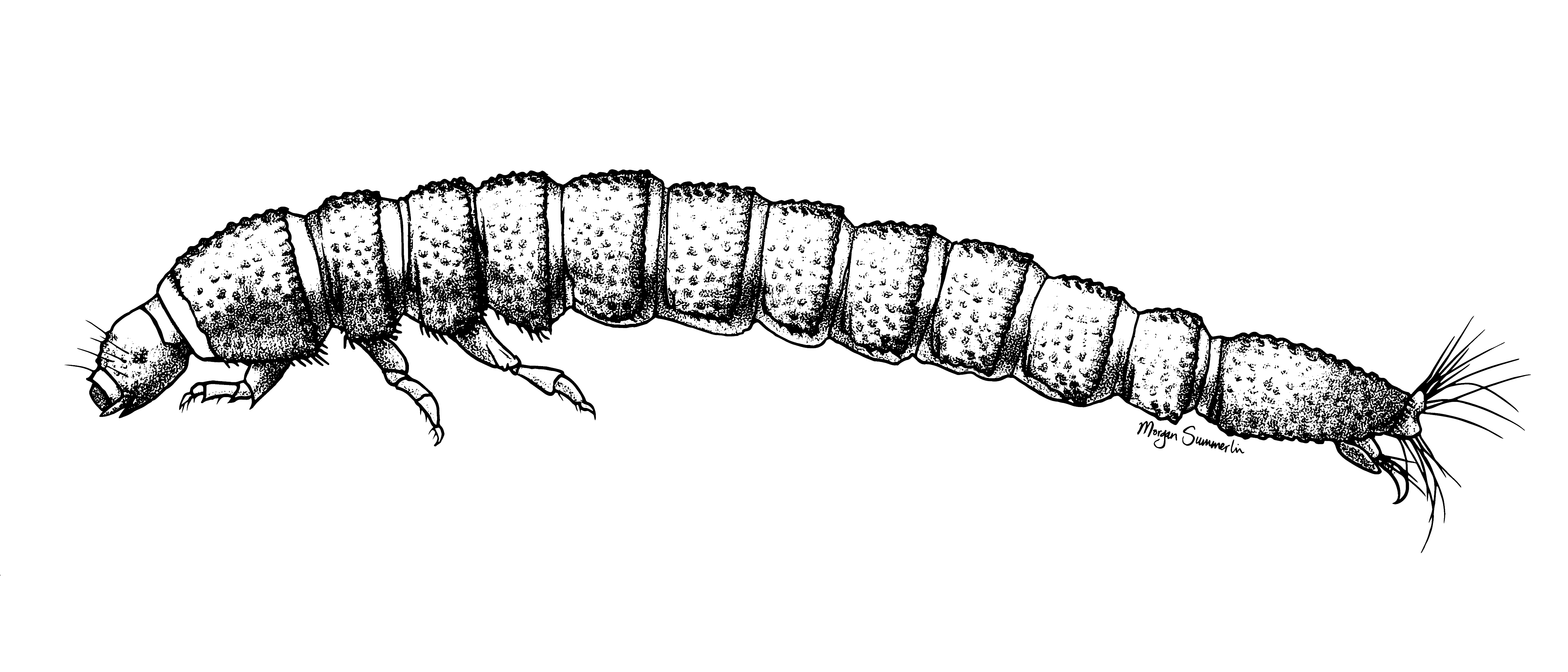
 
beetle larvae
Beetle Larvae

No tails - but gills often pulse in and out
Gills are sometimes found on end
No wing pads
Legs held in front of body usually
 

This project was initiated by the Northern Virginia Soil and Water Conservation District (NVSWCD). This information was designed for students, citizen volunteers, and others interested in benthic macroinvertebrates and/or biomonitoring to provide assistance in identification of specimens and to provide information on the habitat and general ecology of common benthic macroinvertebrates.

All drawn images are from Aquatic Entomology: the Fishermen's and Ecologist’s Illustrated Guide to Insects and Their Relatives (McCafferty 1981). The picture of the stonefly is from the Pekin High School River Watch program.

Recent Interactions

    Ask Fairfax

    Terms & Conditions
    Live chat available Search our site
    • facebook
    • instagram
    • Translate
    • Awards
    • Site Feedback
    • PRIVACY POLICY & COPYRIGHT
    Main Address

    12000 Government Center Pkwy
    Fairfax, VA 22035

    Phone

    703-324-7329

    TTY 711

    Site Tools
    • Website Accessibility
    • Translate
    • Download Mobile App
    Support
    • ADA Accessibility
    • FOIA Requests
    • Website Administrator
    Additional Resources
    • Fairfax County Public Schools
    • Economic Development Authority
    • Visit Fairfax
    • Council of Governments
    • Commonwealth of Virginia
    • USA.gov
    • Calendar
    • Channel 16
    • Mail
    • Security
    • WIFI
    • Facebook
    • Twitter
    • Instagram
    • YouTube
    • Mobile

    The Official Site of Fairfax County