

Written by Sophia Eames, OEEC Spring 2026 Communications Intern
What does it actually take to make a county more sustainable? Before this internship, I would have given you a textbook answer. After a season with Fairfax County’s Office of Environmental and Energy Coordination (OEEC), I can give you a real one, and it involves a lot more teamwork, creativity, and community than I ever expected.

Hi! My name is Sophia Eames and I came to OEEC as a communications intern with a social science background and a passion for sustainability. I’ll be walking away from this experience with new appreciation for web accessibility standards, EV charging guidance, and energy audits processes — and most importantly, firsthand knowledge of how climate policy comes to life at the local level.
At first, I wasn’t sure what to expect. I was a bit nervous, not really familiar with the inner workings of a local government agency. However, what I quickly discovered was how interconnected OEEC was to county life, and how diverse its programs were to support all sorts of constituent needs. From the AC Rescue program to social media outreach, the office covers and informs on an impressive range of environmental and infrastructure topics, and I’m proud to have contributed to that work.
Translating Policy into Plain Language
My first major assignment was ensuring that the office's web content was both readable and accessible — a task that sounds straightforward until you realize just how much thought it requires.
So, what does that actually mean? In 2024, the Department of Justice finalized a rule under Title II of the Americans with Disabilities Act (ADA), requiring state and local governments to make their websites and mobile apps accessible to people with disabilities. In practice, this means digital content must work for everyone, regardless of ability, device, or circumstance. This challenge pushed me to rethink how information is written and presented — removing all the jargon and translating technical concepts into clear, digestible language. But in order to simplify something, you first need to understand it.
In the process, I learned about electric vehicle types and chargers, solar panel tax credits, environmental leadership opportunities, and how the county has achieved measurable success with green building practices. The accessibility work became an unexpected deep dive into the very topics I care most about, and it reinforced just how important it is for local government to communicate clearly with all of its residents.
Energy Audits: Lessons from the Field
One of the most memorable experiences of the internship was accompanying the team on energy audits at two Metro adjacent facilities: Herndon Yard and the Wiehle Metro Station garage. Did you know that a poorly ventilated parking garage can develop its own miniature weather system, complete with clouds forming along the ceiling? I certainly didn't and I was completely shocked when I learned that at the audits. Following the engineers and analysts at Herndon Yard, I was able to understand what factors go into the installation of solar panels and industrial machinery.

The questions they asked were ones I'd never thought to consider: What material are the walls and supporting beams made from? What direction does the structure face? What's the facility's daily electricity consumption? Each answer determined whether and how renewable energy infrastructure could be incorporated. At Wiehle, on the other hand, the team was investigating a suspected energy leak. Hearing engineers debate the possible causes made me realize the economic and legal aspects of this work. What I appreciated the most though, especially coming from a person with a social science background, was that no one was dismissive of questions; everyone was collaborative, curious, and genuinely committed to solving the problem. I never once felt out of place asking something basic, and the generosity of the team made it an incredibly enriching experience.
Throughout the internship I came to understand what a strong communications strategy looks like, and how important it is to have one especially for an office that organizes regularly with federal agencies, private partners or third parties. Charge Up Fairfax and Sustain Fairfax, two of OEEC’s initiatives, are ambitious programs that require consistent, accurate and engaging communication to be effective. Charge Up Fairfax supports community organizations in navigating the transition to electric vehicles, while Sustain Fairfax encourages residents and businesses to adopt sustainable habits and practices. Keeping the materials for these programs up to date and aligned across teams required constant coordination between the communications team and program managers, and it taught me that attention to detail is not optional when the goal is public trust.
Talking Climate Action with Pre-K and Skeptics Alike
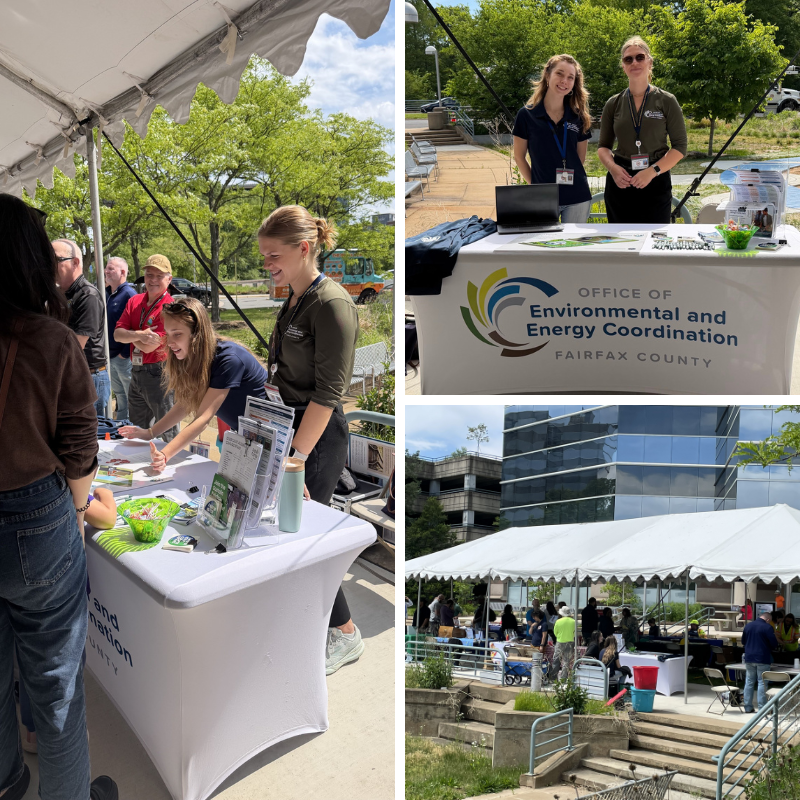
This was exemplified at the Building Safety Month Resource Fair, where I joined two colleagues at an OEEC table for a full day of community engagement. The event attracted a wide range of visitors — curious passersby, engaged residents, and, at one delightful and unexpected moment, an entire Pre-K class. No one is too young (or too old!) to learn about solar power, as it turns out. Explaining the concept of renewable energy to four-year-olds was simultaneously one of the most creative and most tiring communication challenges I've faced. I also witnessed meaningful conversations with residents who came in skeptical about electric vehicles or renewable energy, and it was genuinely powerful to see how a simple, honest conversation could shift someone's perspective. That kind of direct community engagement is something I won't forget.
Another project I thoroughly enjoyed was producing a "Day in the Life" social media video designed to give our audience a look at what it's actually like to work at OEEC. The first iteration of this series features Kevin Smith, our Division Manager for Energy Programs. As I worked through the editing process, sorting footage, deciding what to keep and what to cut, I realized how much storytelling is involved in even short-form video content. The skills I applied here weren't so different from the skills behind a well-written article or essay: know your audience, lead with something compelling, and make every word count. It was a great reminder that communications work spans far more formats than I initially expected, and that adaptability is just as important as any other technical skill.
What This Internship Taught Me That Classrooms Can’t
Being part of the OEEC communications team this spring taught me things no classroom fully could. I learned about office dynamics, the importance of teamwork, and the genuine interdependence required between agencies and people to make local government function well. I discovered that the work that sometimes looks “boring” from the outside, like updating websites, writing emails, or staffing tables, often carries real meaning when you understand its purpose and its audience. Yes, there were quieter days at my cubicle; yes, it looked like the typical “office”, but the majority of the time the room was full of laughter, collaboration and people who truly care about the environment and what they do.
I'm leaving this experience with technical knowledge I didn't have before, professional skills that will serve me in graduate school and beyond, and admiration for the talented people at OEEC who show up every day to make Fairfax County a more sustainable place to live. I have no doubt this internship has set me up well for the next chapter ahead.

Sophia Eames is a recent graduate of The George Washington University, where she studied International Affairs and Public Policy with coursework in climate regulation, global energy markets, and GIS. She served as OEEC’s Communications Intern for the Spring 2026 term and will be pursuing an M.S. in Environment and International Affairs at Georgetown’s School of Foreign Service in the fall.
Climate Matters is the blog of Fairfax County’s Office of Environmental and Energy Coordination, where we share stories, insights and information related to climate change and environmental sustainability. Posts are written by knowledgeable and passionate OEEC staff members and guest authors. To read all blog posts, visit Climate Matters.