

Fairfax County, Virginia
Fairfax County Virginia

FFX Global Navigation

    • About Us
      • About Us
      • Request a Speaker
    • Our Work
      • Climate Plans, Policies, and Initiatives
      • Buildings and Energy
      • Sustainable Transportation
      • Natural Resources
      • Waste
      • Resources for Residents
      • Resources for Businesses
      • Resources for Organizations
    • Sustain Fairfax
    • Sustain Fairfax Challenge
    • Our Programs
      • AC Rescue
      • Charge Up Fairfax
      • Energy Conservation Assistance Program
      • Fairfax Energy Compass
      • Green Business Partners Program
    • Latest News and Events
      • OEEC News and Events
      • Newsletters
      • Climate Matters Blog
    • Track Our Progress
      • Climate Action Dashboard
      • County Government Energy Data
  • Residents
    • Animals & Pets
      • Adoptions
      • Animal Control & Regulations
      • Guide to Dogs
      • Lost & Found Pets
      • Shelter Support & Supplies
      • Wildlife
      • More
      Courts & Legal
      • Case Information
      • Circuit Court Docket
      • Jury Duty
      • Land Records
      • Magistrate
      • Public Law Library
      • Self-Help Resources
      • Traffic Court
      • Vital Records
      • More
      Environment & Energy
      • Invasive Species
      • Litter
      • Recycle, Trash & Compost
      • Sustain Fairfax
      • Trees
      • Watersheds
      • More
      Health & Human Services
      • Basic Needs & Assistance
      • Disability Services
      • Diseases & Conditions
      • Domestic & Sexual Violence
      • Health Clinics
      • Mental Health
      • Opioids
      • More
      Individuals & Families
      • Children & Youth
      • Federal Workforce
      • Immigrants
      • Military & Veterans
      • New Residents
      • Older Adults
      • Parents
      • People with Disabilities
      • Volunteers
      • More
      Land Use & Planning
      • Comprehensive Plan
      • County Capital Projects
      • Land Records
      • Parks Planning
      • Planning Projects
      • Research Tools
      • Transportation Projects
      • Urban Centers
      • More
      Library & Education
      • Adult Education
      • Early Childhood Programs
      • Library Branches
      • Library Catalog Search
      • Public Schools
      • More
      Parks & Recreation
      • Arts
      • Athletic Fields
      • Camps
      • Community Centers
      • Parktakes Classes
      • Rec Centers
      • Senior Centers
      • Teen Centers
      • Trails
      • More
      Permits & Licenses
      • Birth & Death Certificates
      • Building
      • Child Care
      • Dogs
      • Health
      • Marriage
      • Park Use
      • Solicitors
      • More
      Property & Housing
      • Affordable Housing
      • Code & Zoning
      • Neighborhoods
      • Real Estate Values
      • Recycling & Trash
      • Tenant Landlord Issues
      • Utilities
      • More
      Public Safety & Emergencies
      • 9-1-1
      • Emergency Preparedness
      • Fire & Rescue
      • Gun Violence Prevention
      • Police
      • Scams
      • Sheriff
      • Storm Center
      • More
      Roads & Commuting
      • Bike & Walk
      • Connector Bus
      • Metrobus & Metrorail
      • Park & Ride
      • Pedestrian Safety
      • Road Maintenance/VDOT
      • Street Parking
      • Toll Roads
      • Transportation Projects
      • More
      Taxes & Fees
      • Car Taxes
      • Park Fees
      • Real Estate Taxes
      • Tax Relief
      • Trash Disposal Fees
      • More
      Voting & Elections
      • Absentee Voting
      • Early Voting
      • Election Results
      • Polling Places
      • Voter Registration
      • More
      Weather & Climate
      • Air Quality
      • Climate Action Dashboard
      • Extreme Heat
      • Floods
      • Ready Fairfax
      • Resilient Fairfax
      • Snow
      • Tornadoes
      • More
  • Business
    • Business & Construction
      • Building Permits
      • Code & Zoning
      • Land Use
      • More
      Business Services
      • Business Emergency Preparedness
      • Business Taxes
      • Consumer Services
      • Employer Transportation Service
      • Green Business Partners Program
      • Home-Based Business
      • Regulation & Licensing
      • Small Business
      • Starting a Business
      • Workplace Issues
      • More
      Doing Business with Fairfax
      • Contracting and Procurement
      • Current Solicitations
      • Permits
      • Vendor Pitch Portal
      • More
  • Government
    • About
      • Codes & Standards
      • Countywide Strategic Plan
      • Facilities & Locations
      • History of Fairfax County
      • Operating Status
      • More
      Board of Supervisors
      • Auditor
      • Board Members
      • Boards, Authorities & Commissions
      • Clerk Services
      • Committees
      • Meetings & Agendas
      • More
      Budget & Finance
      • Bonds
      • Budget
      • Financial Transparency
      • Unclaimed Money
      • More
      Departments & Agencies
      Jobs & Employment
      • Full-Time Openings
      • Internships
      • Seasonal & Non-Merit
      Maps & Data
      • Countywide Data Analytics
      • Demographics
      • Geographic Information Systems
      • Interactive Data Tools
      • More
      One Fairfax
      • Digital Equity
      • Inclusive Engagement
      • Trust Policy
  • Fairfax County Virginia
  • Services
    • Find
      • Animal Services
      • Health Clinics
      • Jobs
      • Library Resources
      • Lost or Found Pet
      • Mental Health Support
      • Park Classes
      • Real Estate Values
      • Recycling & Trash
      • Volunteer Opportunities
      • More
      Pay
      • Business Taxes
      • Car Taxes
      • Dog Licenses
      • Driving & Parking Fines
      • False Alarm Fees
      • Real Estate/Property Taxes
      • SACC Payments
      • More
      Register/Apply
      • Basic Needs & Assistance
      • Building Inspections
      • Car Registration
      • Fairfax Alerts
      • Permits & Licenses
      • Tax Relief
      • Vote
      • More
      Report
      • Animal Control Issues
      • Consumer Complaints
      • Crime
      • Domestic Violence
      • Financial Crimes
      • Neighborhood Complaints
      • Road Issues to VDOT
      • Street Light Outages
      • More
  • Connect
    • Alerts, Emails & Apps
      • Email Subscriptions
      • Fairfax Alerts
      • Mobile App
      • More
      Community Engagement
      • Surveys & Projects
      Contact
      • Directory
      • Hotlines & Emergency Numbers
      • VDOT
      • VFOIA Requests
      • More
      News & Events
      • Daily Headlines
      • Emergency Information Blog
      • Events Calendar
      • NewsCenter
      • NotiCentro (Spanish)
      • Public Meetings Calendar
      • More
      Social Media
      • Comments Policy
      • Directory of Accounts
      • More
      TV, Video & Podcasts
      • Channel 16
      • Podcasts & Radio
      • YouTube
      • More
  • TRANSLATE
    • Language Selection

      To change the language of this website, click the drop-down list and select the desired language. The Fairfax County Web site is being translated through "machine translation" powered by Google Translate. Disclaimer

Office of Environmental and Energy Coordination

  1. Home
  2. Office of Environmental and Energy Coordination
  3. Your Guide to Energy Labels: How to Save When You Shop

Alert:

CONTACT INFORMATION: Our office is open to visitors by appointment only. Please call or email from 8:00 a.m. - 4:30 p.m., Monday through Friday.
703-324-7136 TTY 711
oeecinfo@fairfaxcounty.gov
12000 Government Center Pkwy, Suite 533
Fairfax, VA 22035
fairfaxcountyclimate
Robert Sandoli
Director

Department Resources

  • About Us
    • About Us
    • Request a Speaker
  • Our Work
    • Climate Plans, Policies, and Initiatives
    • Buildings and Energy
    • Sustainable Transportation
    • Natural Resources
    • Waste
    • Resources for Residents
    • Resources for Businesses
    • Resources for Organizations
  • Sustain Fairfax
  • Sustain Fairfax Challenge
  • Our Programs
    • AC Rescue
    • Charge Up Fairfax
    • Energy Conservation Assistance Program
    • Fairfax Energy Compass
    • Green Business Partners Program
  • Latest News and Events
    • OEEC News and Events
    • Newsletters
    • Climate Matters Blog
  • Track Our Progress
    • Climate Action Dashboard
    • County Government Energy Data

Your Guide to Energy Labels: How to Save When You Shop

October 2, 2024

Post written by Maggie Beetstra, Community Specialist

Fairfax County celebrates Energy Efficiency Day on October 2, a national day of awareness and action around conserving energy to lower costs and improve the health of communities. In honor of Energy Efficiency Day, we want to provide this resource on how to purchase the most energy-efficient appliances and windows for your home.

Making a large purchase like getting a new appliance, television, or windows requires doing some research ahead of time. You might consider online reviews, recommendations from people you know, and price before making your choice. There is another piece of information you might want to add to the mix too: energy efficiency. More energy-efficient appliances use less electricity or natural gas to run them, while energy-efficient windows reduce energy use by heating and cooling systems. Higher energy efficiency translates to fewer carbon emissions produced if your energy comes from non-renewable sources. Plus, you'll benefit even more by saving on your energy bills.

But where can you find energy efficiency information? For many purchases, it is easier to find than you might expect. Most appliances and televisions have a bright yellow sticker on the front, while new windows often have a while label on them. These are examples of energy efficiency labels, and they include lots of relevant information to help consumers make informed purchases.

Reading the Yellow Tag

Let’s review some of the common pieces of information on these labels.

The yellow stickers on appliances and televisions contain consistent information that makes it easy for consumers to compare across products. 
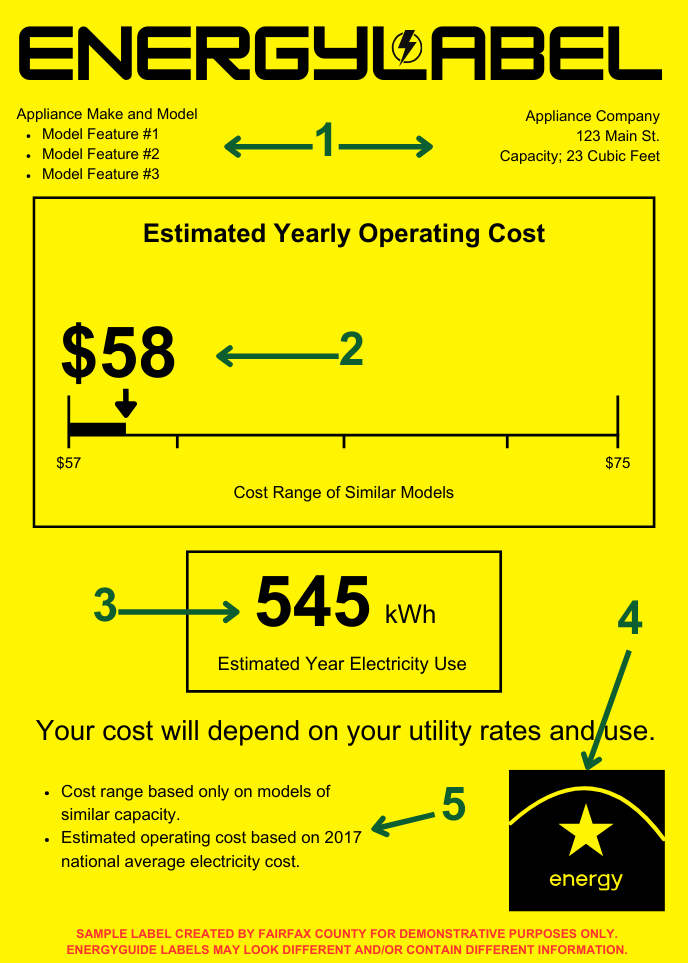
sample yellow labels found on appliances, with arrows pointing to where information is located
This is a sample label created for demonstrative purposes.​​​

Important information found on the yellow label:

  1. Information about the type of product you are purchasing and its make and model.
  2. The estimated yearly energy cost compared to other similar models. For example, if you purchase a refrigerator, the estimated yearly energy cost would be in comparison to other similar refrigerators currently on the market. 
  3. The estimated amount of electricity the appliance will use. The number is in the units of kilowatt-hours (kWh), a common unit of electricity consumption. To get a more specific estimate for your home, look at your most recent electricity bill to see what your utility provider charges per kWh in your area and then multiply by the number in this box.
  4. The ENERGY STAR® logo indicating high energy efficiency. (The sample label above is not an accurate depiction of the ENERGY STAR® logo.) You might also notice the ENERGY STAR® logo on other items in either black, white, or blue. The logo signals to consumers that the product uses less electricity than other similar products so therefore is a more energy efficient choice.
  5. Additional context for the numbers included on the tag, such as what kind of similar products were used for comparison, the year used as a baseline for electricity costs, and sometimes a link to additional information.

Reading a Window Tag

Energy efficiency labels on windows look slightly different and convey unique, but equally important, information to consumers.
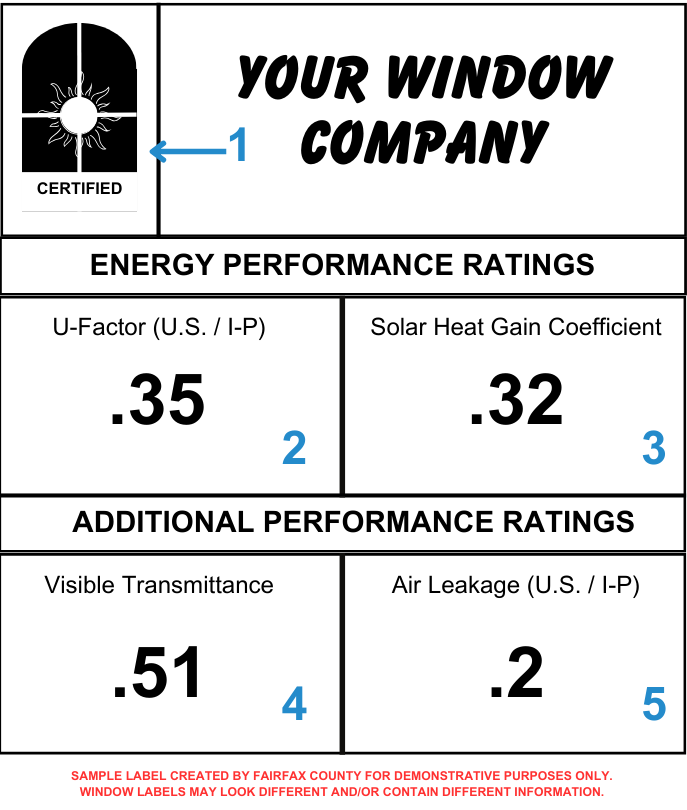
sample white label that is commonly found on windows, with arrows pointing to the information in the list
This is a sample label created for demonstrative purposes.​​​

Important information found on the window label:

  1. The National Fenestration Rating Council® label indicates that the window was independently rated using a standardized procedure. Sometimes, the ENERGY STAR® logo will also appear here when it is a more energy efficient option. (The sample label above is not an accurate depiction of the NFRC logo.) 
  2. The U-Factor measures heat transfer from the glass, frame, and other window fittings into and out of the building. When comparing across windows, a smaller U-Factor is more energy efficient. (Lower = better)
  3. The Solar Heat Gain Coefficient measures solar energy from the glass, frame, and other window fittings into and out of the building. Like the U-Factor, a smaller value is more energy efficient. (Lower = better)
  4. The Visible Transmittance measures the amount of visible light entering a building through the window. The value can range from 0-1, with 0 meaning that all visible light is blocked and 1 that no visible light is blocked. The optimal value will depend on the climate of your area and your specific lighting needs but in general, higher values reduce the need for indoor electric lighting and can provide some small warming benefits in colder months. (Higher = better)
  5. The Air Leakage value indicates how much air seeps into a building through the window when it is closed. A lower number means that the window is more energy efficient. (Lower = better)

The next time you make a big purchase, look for these labels and shop with confidence knowing that you are making an energy efficient choice.

Check out our Home Energy webpage to learn more about making smart choices about home energy use and to find federal, state, and energy provider incentives that can help Fairfax County residents offset the costs of purchasing and installing energy-efficiency upgrades and equipment.

headshot of woman with blonde hair and red shirt

Maggie Beetstra joined OEEC in summer 2024 as a community specialist staffing the county’s Environmental Quality Advisory Council (EQAC). She also assists with the implementation of the Community-Wide Energy and Climate Action Plan through the development of a residential energy program. Maggie holds degrees from Washington University in St. Louis, the University of Washington, and The Ohio State University.


Climate Matters is the blog of Fairfax County’s Office of Environmental and Energy Coordination, where we share stories, insights and information related to climate change and environmental sustainability. Posts are written by knowledgeable and passionate OEEC staff members and guest authors. To read all blog posts, visit Climate Matters.

Recent Interactions

    Ask Fairfax

    Terms & Conditions
    Live chat available Search our site
    • Translate
    • Awards
    • Site Feedback
    • PRIVACY POLICY & COPYRIGHT
    Main Address

    12000 Government Center Pkwy
    Fairfax, VA 22035

    Phone

    703-324-7329

    TTY 711

    Site Tools
    • Website Accessibility
    • Translate
    • Download Mobile App
    Support
    • ADA Accessibility
    • FOIA Requests
    • Website Administrator
    Additional Resources
    • Fairfax County Public Schools
    • Economic Development Authority
    • Visit Fairfax
    • Council of Governments
    • Commonwealth of Virginia
    • USA.gov
    • Calendar
    • Channel 16
    • Mail
    • Security
    • WIFI
    • Facebook
    • Twitter
    • Instagram
    • YouTube
    • Mobile

    The Official Site of Fairfax County