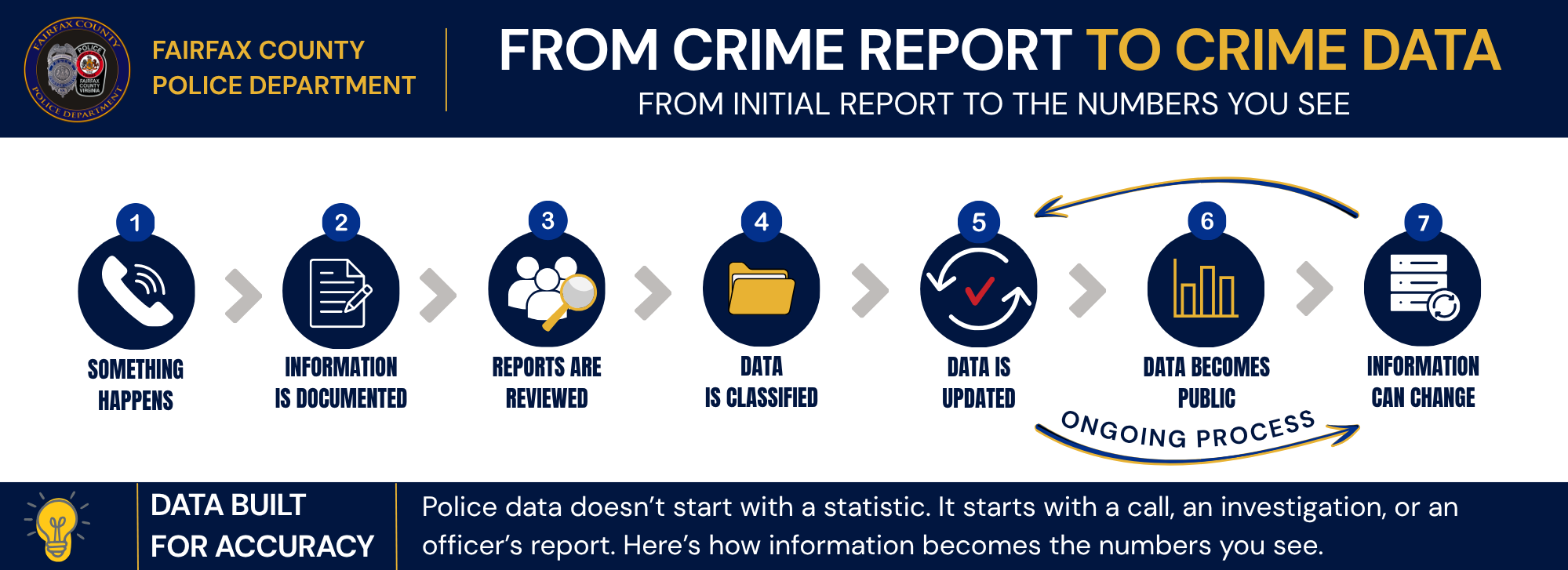
Police data is not static. Investigations continue, reports are reviewed, and information may be corrected or reclassified as new details become available. Our public data is updated to reflect the most accurate information available.
From Crime Report to Crime Data
1
Step 1: Something Happens
A call for service is received, an officer responds, or an incident is reported.
2
Step 2: Information Is Documented
Officers document what is known at the time, based on initial information, interviews, and evidence.
3
Step 3: Reports Are Reviewed
Supervisors review reports for accuracy, completeness, and proper classification. Additional information may also become available.
4
Step 4: Data Is Classified
Information from the report is categorized according to applicable reporting standards and definitions.
5
Step 5: Data Is Updated
Follow-up investigation, new evidence, corrections, or additional review may change how an incident is classified or counted.
6
Step 6: Data Becomes Public
Once processed, information contributes to the statistics and datasets FCPD shares with the public.
7
Step 7: Information Can Change
Data keeps evolving and is never final. As cases develop and circumstances change, records are reviewed again and the published numbers are updated to stay accurate.
↻ Updates loop back to step 5.
Data Change Log
Changes to how statistics are calculated, which can explain why some numbers are updated.
November 12, 2026, Arrests Dashboard: Race, Ethnicity, Residency, and Gender previously counted unique individuals, so someone arrested three times a year was counted once. Count is by each arrest now.
Fairfax County Police Open Data (FCPOD) Portal
Crime dashboards, performance metrics, and published reports, updated as records are reviewed.
This dashboard provides a near real-time view of active Fairfax County Police Department (FCPD) calls for service. The information is intended to enhance community awareness of ongoing police activity and provide greater transparency into police responses throughout Fairfax County.
Active Calls for Service
This dashboard displays active FCPD calls for service.
5 Minutes
Information refreshes every five minutes.
First Unit
Calls become visible when the first police unit arrives on scene.
Last Unit
Calls remain visible until the last assigned unit clears the incident.
Because information is updated at five-minute intervals, the dashboard may not reflect changes to police activity as they occur.
Call Types Are Preliminary
The call type displayed on this dashboard reflects the information available to the call taker or dispatcher when the call is initially entered into the system.
As additional facts become available, the nature of the incident may change. In many cases, the initial call type will not match the final incident or crime classification documented by responding officers.
While dispatchers or officers may update call information during an event, updates may not always occur before the call is closed and may not be reflected on the dashboard.
Call Status
This field is completed by the police call taker and indicates:
In Progress
The incident is happening now.
Just Occurred
The incident happened in the last several minutes.
Report Only
The incident is being called in after the fact.
Not Obtained
No data was entered.
Total Units Assigned
The number of police units displayed reflects the total number of units assigned to a call at any point during the response, rather than the number currently responding or on scene.
For example, if eight units were assigned to a call, the dashboard will continue to display eight units even if some have cleared and only two remain.
This number should not be interpreted as the number of officers currently at the scene.
Incident Locations and Map Privacy
To protect the privacy and safety of victims, witnesses, and others involved in police incidents, call markers disappear when the map is zoomed in beyond a certain level. The marker is a randomly determined distance from the actual call location. The associated GPS coordinates in the dashboard have been modified to protect the privacy of crime victims.
This safeguard helps prevent the identification of specific residences or individuals associated with police activity, particularly during sensitive incidents.
If a call marker disappears when zooming in, it does not mean the incident has ended. Zooming back out will allow the call to appear again, provided it remains active.
Helicopter and Drone Indicators
A helicopter or drone icon will appear when a police helicopter or drone is assigned to a call for service.
The icon will remain displayed until the call is closed, even if the helicopter or drone is no longer assigned to the incident.
The presence of a helicopter or drone icon does not necessarily mean the aircraft is currently operating over the incident location.
Dashboard Coverage
While this dashboard provides insight into active police activity, it does not display every FCPD call for service. Certain call types, such as search warrants, arrest warrant service, officer breaks, and other administrative or operational activities, are excluded for privacy, safety, and operational considerations.
As a result, the absence of a call from the dashboard does not necessarily mean police activity is not occurring in the area.
Daily Reset
This dashboard resets each day at midnight. Calls that remain active at midnight are removed from the dashboard and do not carry over to the next day.
Because of this daily reset, the dashboard should not be used to determine the total number of calls for service handled by FCPD during a given day.
Data Use and Limitations
The information displayed on this dashboard is preliminary dispatch data and is provided solely for community awareness of active police activity.
Information may change as additional facts become available.
Displayed call types should not be considered final incident or crime classifications.
This dashboard is not an official source of crime statistics, crime trends, or crime reporting data.
Frequently Asked Questions (FAQs) - Calls for Service Dashboard
Why do some calls for service remain active and visible on the dashboard for longer than others?
Every police call for service is unique. Some incidents can be resolved quickly, while others require additional time, resources, or follow-up activities before the call can be closed. Several factors may affect the duration of a call, including the need to preserve a crime scene, obtain medical evaluation for an involved person, complete required reports or documentation, conduct investigative activities, or provide additional assistance to a community member. The Calls for Service Dashboard displays the approximate location of the original police event, not the real-time location of officers assigned to the call. As a result, a call may continue to appear on the dashboard even when officers are completing related investigative or administrative tasks at another location, such as a hospital, police station, detention facility, or evidence processing location.
This dashboard contains data regarding Crimes Against Person and Crimes Against Property in Fairfax County. It includes information regarding demographics, geographic distribution, trends by type, and data for previous years. For definitions of each item on the dashboard, please see:
This dashboard contains data regarding Arrests made by FCPD in Fairfax County. It includes information regarding demographics, geographic distribution, and data for previous years. For definitions of each item on the dashboard, please see:
Frequently Asked Questions (FAQs) - Incident Based Reporting (IBR) Data
The Fairfax County Police Department (FCPD) and the Commonwealth of Virginia both publish crime statistics using Incident Based Reporting (IBR). The numbers won't always match due to circumstances such as:
The state's numbers keep changing. A year's data isn't final when the state publishes it. Agencies keep sending corrections and new information, so a case from last year can still be updated.
FCPD sends data to the state once a month. Each monthly submission includes new cases and updates to older ones. FCPD's own public statistics are live and show what's in our records system at the moment you view them.
Investigations change over time. A witness may recant, evidence may reveal additional offenses, or an investigation may find that no crime occurred. These changes show up right away in FCPD's data but don't reach the state until our next monthly submission.
The state covers more agencies. The state's data can include every crime in Fairfax County, no matter which agency investigated it. FCPD is the county's largest law enforcement agency, but not the only one. Our statistics include only cases reported to FCPD.
FCPD reports every incident to the state using the standard IBR offense codes. The reports are the same. What can differ is how those codes are grouped into the summary figures each of us publishes.
For example:
The state may combine several IBR codes into a single "sex offenses" category.
FCPD may group the same offenses differently, either for clarity or to meet local reporting needs.
To make this easier to follow, FCPD is working to list which IBR codes are included in each summary statistic we publish, so you can see exactly what a number covers and why it may not match the state's figure.
IBR uses different counting rules depending on the type of crime:
Crimes against persons are counted by victim. If three people are assaulted in the same incident, IBR counts three crimes, one for each victim.
Crimes against property are counted by offenses. A single burglary counts as one crime, even if many items are stolen.
Because of these rules, two datasets can show different totals depending on what each one is measuring.
A robbery crime is classified as a "Crime Against Property" and is counted by offenses, not by victim. An assault occurring during, and in furtherance of, a robbery is typically not captured as a separate offense.
The theft and the property damage, both crimes against property, are counted by offense.
No. Older crime reporting systems counted only the most serious offense in an incident, a practice known as the hierarchy rule. IBR records every separate offense and counts each one using the rule for its category.
For example, if a single event involves an assault, a theft, and property damage:
All three offenses are recorded.
The assault, a crime against a person, is counted by the number of victims.
The theft and the property damage, both crimes against property, are counted by offense.
This gives a more complete picture of what happened. It also means totals can differ depending on which offenses or categories a dataset includes.