


Fairfax County Sheriff Stacey A. Kincaid and her staff welcomed seven members of the French Embassy to the Adult Detention Center (ADC) on Sept. 22. Many of the visitors work within the French justice system and were interested in learning how Fairfax County has transformed the way its behavioral health and criminal justice systems interact.
“Knowledge that is not shared is a waste,” Sheriff Kincaid told the delegation as she described the agency’s cultural shift from relying primarily on incarceration to connecting people with treatment, services, and other community-based resources.
“Once someone is released from the ADC, they are members of our community. They are our neighbors,” Kincaid said. “We have a responsibility to ensure the people we release have the skills and resources to be successful.”
That philosophy helped lay the groundwork for Diversion First, a countywide initiative that provides alternatives to incarceration for people with mental illness, substance use disorders, or developmental disabilities who come into contact with law enforcement for low-level offenses. When appropriate, law enforcement officers can take an individual to the Sharon Bulova Center for Community Health rather than to jail.
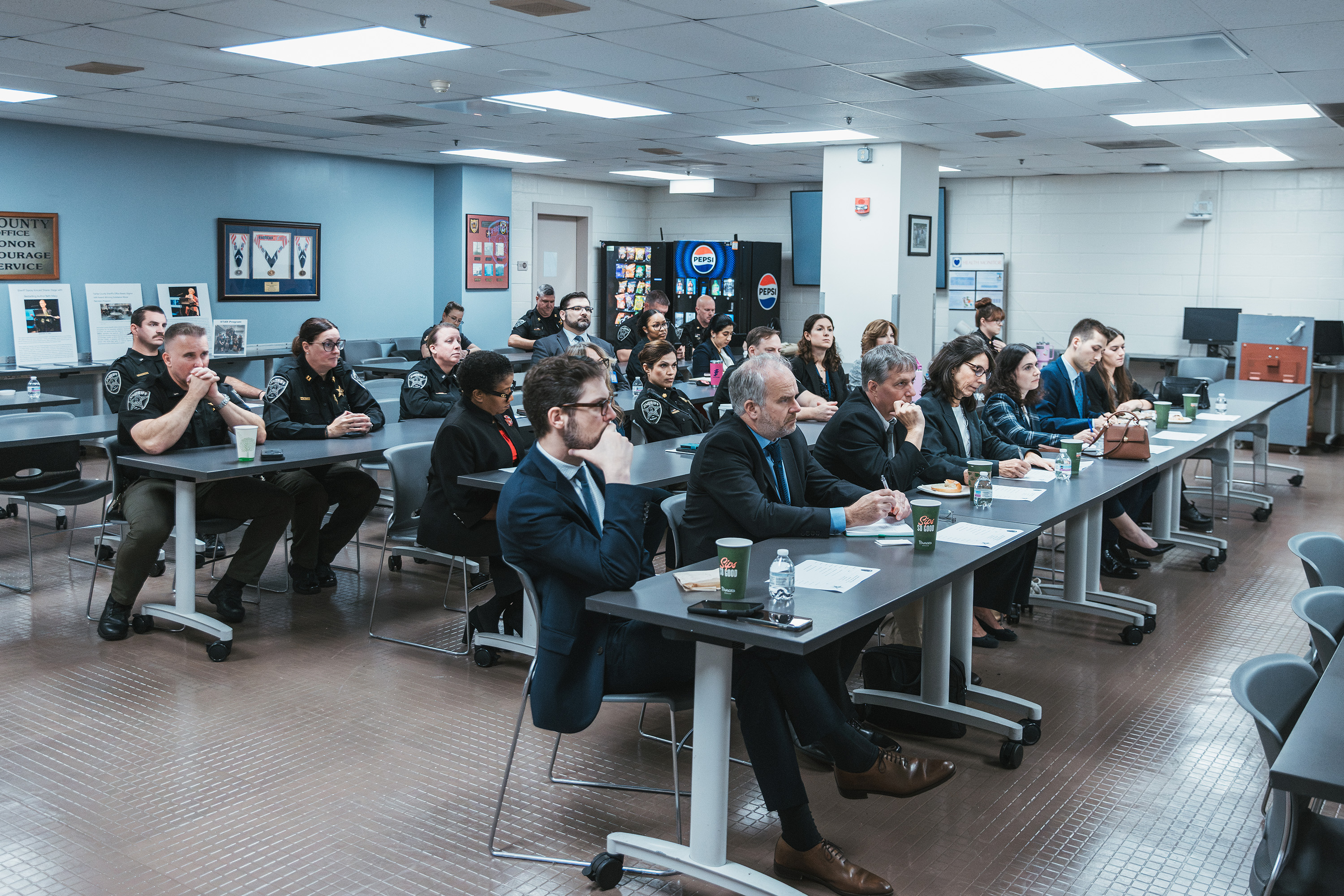 Kincaid explained that unlawful behavior may sometimes be driven by an unmet basic need rather than criminal intent. In the past, for example, someone experiencing homelessness might commit a minor offense during cold weather to secure a night indoors. The principle of Diversion First allows the county to address the underlying need and connect the person with appropriate services without introducing them unnecessarily into the criminal justice system.
Lisa Potter, director of Diversion First, shared the initiative’s history. The national Stepping Up Initiative, launched nationally in May 2015, helped establish the foundation for Diversion First, which began Jan. 1, 2016.
“County leadership believed in the initiative, and county partners wanted to be part of the change,” Potter said.
That partnership now brings together the Sheriff’s Office, Fairfax County Police Department and Fairfax-Falls Church Community Services Board at the Sharon Bulova Center for Community Health. Second Lt. Jennifer Foster described the results of their coordinated work.

“We are now sitting at more than 5,000 diversions from incarceration based on the different response teams we have and the central location we share,” Foster said. The collaborative environment allows the agencies to work toward a common goal: connecting each person with the least restrictive appropriate level of care.
After learning how Diversion First operates in the community, the delegation visited the Striving to Achieve Recovery unit, or STAR, a peer-led recovery housing program established inside the ADC in November 2018.
“It’s a program that has paid dividends,” Kincaid said. “Rather than saying we release sober addicts, when they complete this program, we say they are in recovery.”

Several STAR participants spoke with the visitors about the program’s phases, its supportive environment and the personal accountability it fosters.
“This is all voluntary,” one STAR participant said. “We don’t judge each other. We let people determine their own path and how recovery can work for them.”
Others described learning how to build healthy habits, manage their emotions, live within a community and remain accountable to themselves and one another. Peer Support Mentor Eugene summarized one of the program’s central lessons: “Not doing drugs is the easy part. Dealing with your own life and your own emotions—that’s what is hard.”
Another participant explained that the program helped him recognize how he had used alcohol as an escape and taught him to create structure in his life.
“I can’t think of my life anymore as anything other than helping,” he said. “I’ve created structure within myself that I can’t imagine not having, and I got that from this program.”
As the visit concluded, Kincaid thanked the STAR participants for sharing their experiences. Their stories demonstrated that meaningful change occurs when agencies exchange ideas, challenge past practices and work together to build a stronger, healthier community.