

Written by Allison Homer, Resilient Fairfax Program Manager
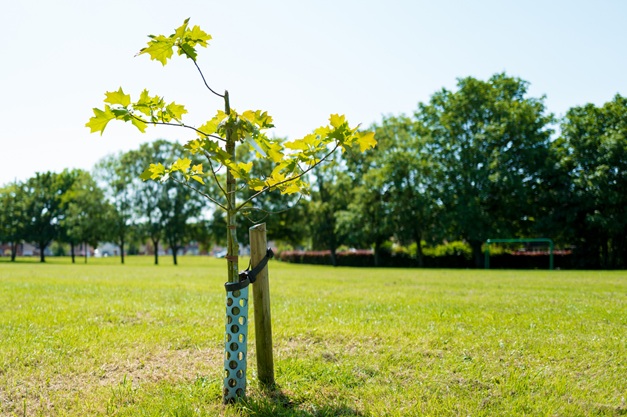
Picture this: it’s a crisp, beautiful afternoon in Fairfax County. You’re meandering through the saplings at your local garden center, pining for a new tree to plant. Fellow gardening enthusiasts chatter excitedly nearby, and scents of fresh garden soil and flowers waft around you. As you peruse the rows upon rows of baby trees, you’re eager but perhaps a little over-elm-ed by the choices.
As you ponder your options, memories of past tree failures flicker through your mind. Perhaps you’ve lost trees in a storm, or a heat wave, or a drought. Perhaps your phone has lit up with enough Fairfax Alerts declaring “Road Closures due to Downed Tree” to make you wary1. Perhaps you’ve heard that our hardiness zones are shifting northward2, so you’re not sure if your go-to trees are still appropriate for our area. As our climate gets warmer, wetter, and weirder, you know that planting trees is as important as ever. However, you also want to keep your family safe and choose a tree that has a good chance to survive and thrive.
Good news, tree lovers: We wood never leaf you stumped. There is now guidance on the Resilience of Trees in Fairfax County VA (PDF)!
READ THE RESILIENCE OF TREES DOCUMENT
Let’s walk through a few common questions.
What are Resilient Trees?
When we say “Resilient Trees,” we mean local trees that generally thrive in a range of conditions. We scored hundreds of tree species for dozens of traits each, including (but not limited to) the traits shown in the graphic below:

View an ADA accessible version of this graphic.
These traits can be sorted into 3 branches:
- Climate traits help you choose trees that are well-suited for the warmer, wetter, weirder climate we’re experiencing. This branch of traits includes 3 sub-branches:
- Adaptability and flexibility traits help you select trees that can adapt to change, including shifts in habitat, hardiness zones, and climate norms.
- Climate resilience traits help you select trees that can withstand severe weather like intense storms, flooding, or heat.
- Risk reduction traits help you select trees that protect you by absorbing flood water, cooling down the neighborhood, or serving as a wind shield during storms.
- Urban environmental traits are helpful everywhere in the county, but especially in our urbanized areas. While all trees prefer healthy environments, some trees are more tolerant of things like air pollution, diseases, winter salts, or compact soils.
- Other considerations include a range of factors that are important when selecting a tree. As always, we encourage selecting native trees and trees that are wildlife and pollinator friendly. You’ll want to make sure you’re planting the right tree in the right place, that you can handle the maintenance, and that the nuts are not poisonous to pets and kids if you have them.
Our Resilient Trees guide includes species with both positive and negative versions of these traits. For example, for the flood tolerance trait, some tree species are labeled as “flood tolerant” while others are labeled “flood vulnerable.”

Are all trees listed in the guide “Resilient Trees?”
The guide is not limited to Resilient Trees, because we also wanted to spread awareness of trees that are common but not resilient. To find Resilient Trees in the guide, keep an eye out for the trees marked with the Resilient Fairfax logo and the words “Resilient Tree!”
Are all native trees resilient?
Many native trees are resilient, but not all! As our climate changes, some trees that were previously well-suited to our area now do better further north.
What are the roots of this information?
The Resilient Trees effort is rooted in Resilient Fairfax, the county’s climate adaptation and resilience initiative that helps us adapt to a “warmer, wetter, and weirder” climate. Among the 48 Resilient Fairfax strategies is a Resilient Trees amendment to the Public Facilities Manual (PFM). (Bear with me).
The PFM is like a guidebook for land developers, helping to ensure development plans meet county standards. County staff propose updating the PFM’s tree sections to include more and better tree options. The amendment sprouted from extensive research. If you can be-leaf it, nearly 300 tree species were scored for 60-plus factors each, based on thousands of reputable sources. This information is being used to update the county’s tree lists, with an overarching goal of improving the health of our tree canopy and reducing tree failures by encouraging a diverse array of resilient trees.

To our delight, there has been great public interest in Resilient Trees data! One of the most common questions we received about the PFM amendment is “can the average resident have this information?” However, as you can imagine, many people’s eyes glaze over when looking at a PFM table. We accept the shade; the PFM can be quite boring. The “Resilience of Trees” document is our first attempt to spruce up tedious tables into something more reader-friendly!
Will Resilient Tree resources branch out from here?
Keep an eye out for more Resilient Tree resources! The current document is a temporary way to quickly provide public access to Resilient Trees information. Staff are working to create more enhanced, user-friendly resources.
In the meantime, we hope you now feel oak-ay about selecting a tree this year. We’re rooting for you!
Questions? Feel free to reach out at ResilientFairfax@fairfaxcounty.gov.
Footnotes:
- VDOT data shows downed trees are the most common reason for weather-related road closures in Fairfax County.
- Fairfax County shifted from hardiness zone 7a to 7b between 2012 and 2023, and is projected to be in hardiness zone 8 as early as 2040.

Allison Homer is the Resilient Fairfax Program Manager and a climate planner for the Fairfax County Office of Environmental and Energy Coordination. In her role, she coordinates with staff from 25+ county agencies to help the county create climate-ready communities, resilient infrastructure and buildings, and adaptive environments. She holds an environmental Master of Urban and Regional Planning (MURP) degree, a Global Master of Natural Resources (GMNR) degree, and a Graduate Certificate in Global Sustainability from Virginia Tech, in addition to a Bachelor’s degree from Wake Forest University. She is certified by the American Institute of Certified Planners (AICP) and a LEED Accredited Professional for Neighborhood Development (LEED AP ND).
Climate Matters is the blog of Fairfax County’s Office of Environmental and Energy Coordination, where we share stories, insights and information related to climate change and environmental sustainability. Posts are written by knowledgeable and passionate OEEC staff members and guest authors. To read all blog posts, visit Climate Matters.