

Article by Gwen Jones, Department of Family Services
(Posted 2026 November)

Using computers, phones, and the internet is now part of everyday life for most people. But many users have to figure technology out on their own, which is not always easy. This can leave people open to online scams, which are getting more sophisticated and harder to spot thanks to Artificial Intelligence (AI).
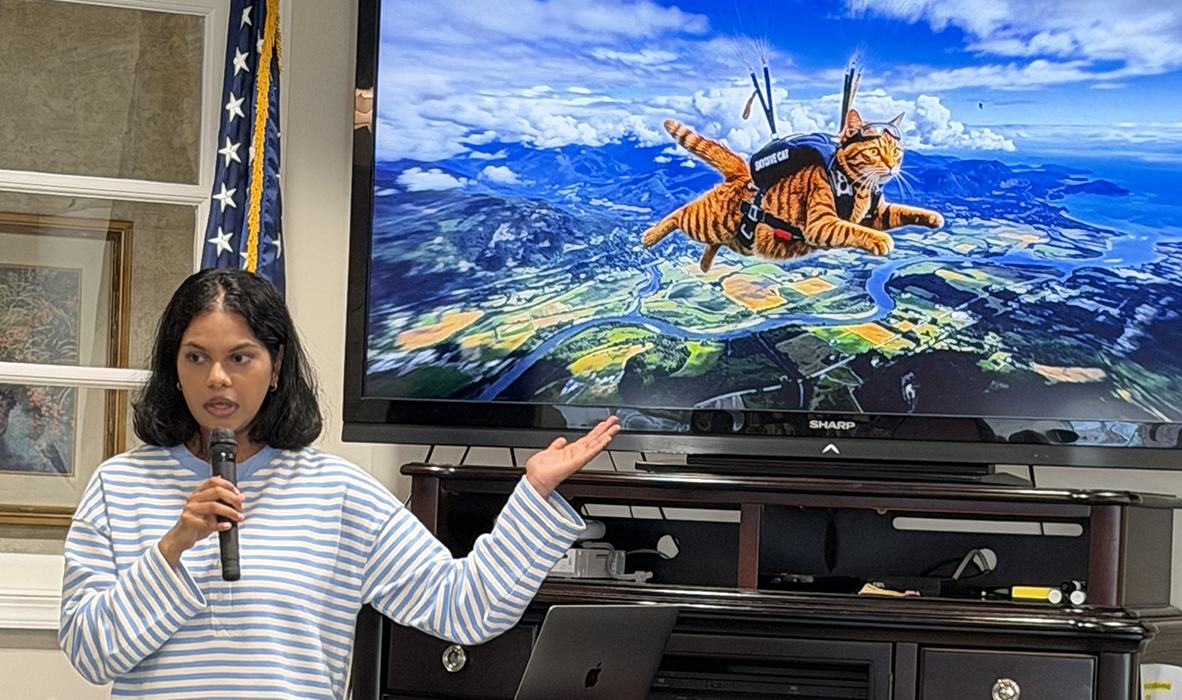
Lakshmi Katrapati is a computer science major at George Mason University. She has studied AI for years and is especially interested in how it is used to create deepfakes. A deepfake is a fake image, video, or audio made or changed by AI. It can look and sound very real, even though the events in it never happened. Because deepfakes are so realistic, scammers and others use them to mislead people and spread false information online.
Last year, Lakshmi learned that an older neighbor lost $30,000 to a scammer who used a deepfake video on Facebook. When she talked to her grandparents about it, she realized they did not know what AI or deepfakes were.
“I found that deepfakes scams were becoming more prevalent and realistic, and seniors are more susceptible to them due to lower digital literacy,” she says. “I know that a lot of senior centers already offer digital education to seniors, but I didn't find many that offered an AI literacy and deepfake awareness presentation, so I decided to give those presentations myself.”
In March 2026, Lakshmi started giving talks at senior centers and older adult living communities. Her goal is to help older adults:
- Understand AI tools like ChatGPT
- Protect themselves from deepfake and AI-related scams
- Learn how these tools can help them in daily life
She begins each session by asking if people know what AI is. About half of the audience usually has never heard of it. After she explains AI and deepfakes, she shares real examples of how scammers use them. She shows both real and fake photos and videos and gives simple tips for spotting deepfakes.
Seeing such realistic videos and finding out they’re fake can be upsetting so Lakshmi reminds her audience to fact-check what they see online. “I tell them it’s just another form of misinformation. When I was younger or even when they were younger, teachers would say, if you hear something, always fact check it,” she says.
She suggests two easy ways to check a video:
- Make sure it comes from a trusted website or source.
- Do a Google search to see if reliable news or information sites are reporting the same story.
When the spring semester ended, Lakshmi went to Ridgeland, Mississippi, for a summer internship. In her free time, she gave her talk at local senior centers. She found that older adults there knew less about AI than those in Northern Virginia, but they were just as interested in learning.
Back at GMU this fall, Lakshmi has continued her presentations and has also become a research assistant in GMU’s Data Agency and Security (DAS) Lab, led by Dr. Sanchari Das. The lab focuses on improving cybersecurity and privacy using AI.
The lab is now studying AI-Enabled Romance Scams, Online Trust & Digital Safety among older adults. They are looking for older adults to join a research discussion group (focus group). See below for details on how you can participate in the study.
Even with her busy schedule, Lakshmi plans to add more topics to her talks. “I plan to expand the curriculum to include topics on how other AI systems affect senior healthcare and finance, how AI robots are being used to serve as emotional companions for the elderly, and how AI can be effectively leveraged to empower the elderly,” she says.
Study Participants Needed!
Please Register by Thursday, Nov. 5.
Tuesday, Nov. 10, 10 a.m.-12 p.m.
Stacy C. Sherwood Community Center
3740 Blenheim Blvd., Fairfax
Staying Safe Online: Online Trust, Relationships & Digital Safety for Older Adults
- Discuss online dating, relationships, trust, and digital safety
- Share your thoughts and experiences about AI-enabled romance scams
- Learn about scam warning signs and ways to stay safer online
- Receive practical tips, resources, and online safety support
Study participants must be adults age 60 and older or caregivers of older adults who have experienced or are interested in learning about online scams.
For questions or to register, contact Fairfax Village in the City at 703-385-5738, email village@fairfaxva.gov, or complete the Participant Interest Form.
Hosted by researchers from George Mason University.
Reference number: STUDY00001084
This article is part of the Golden Gazette monthly newsletter which covers a variety of topics and community news concerning older adults and caregivers in Fairfax County. Are you new to the Golden Gazette? Don’t miss out on future newsletters! Subscribe to get the electronic or free printed version mailed to you. Have a suggestion for a topic? Share it in an email or call 703-324-GOLD (4653).