

Public Works and Environmental Services Alert:
The concept design is scheduled to be delivered in December 2026.
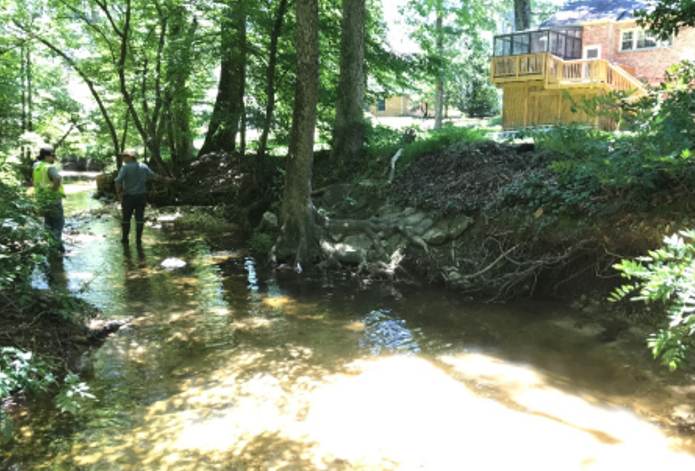
The proposed stream restoration project is identified in the Little Hunting Creek Watershed Management Plan as LH9249 and LH9229. The existing conditions of the channels within the project area exhibit the typical degraded form resulting from channel evolution in response to many decades of development and the increase of impervious surfaces within the watershed: an overly down cut and widening channel, floodplain disconnection, tree loss, property loss, unbalanced sediment transport, accelerated channel erosion and accelerated channel migration.
The stream restoration design team includes County staff from Stormwater Planning Division, Maintenance and Stormwater Planning Division, Utilities Design and Construction Division, Urban and Community Forestry Division, Park Authority, Wastewater Collection Division, Land Acquisition Division, Wetland Studies and Solutions, Inc. (design engineering consultant), residents along the project area, Civic Associations and other stakeholders within the community.
The goal of the project is to improve water quality through restoration of approximately 12,000 feet of Paul Spring Branch and the North Fork of Little Hunting Creek, tributaries, stormwater outfalls and the floodplain within the stream valley between Mason Hill Drive, Sherwood Hall Road and Collingwood Road.
The project goal will be achieved by:
Grade control structures to be installed within the stream channel will mimic bedrock outcrops and beaver dams, and may include rock sills, cross vanes, step pools, riffles, boulder riffles and large woody debris jams. These engineered grade control structures are made of boulders, clay, logs, limbs, geotextile fabric and reinforced bed material.
The stream restoration design will minimize disturbance to the existing natural resources by:
View the downloadable map. The project area is shown in red outline.
Pre-Design
The benefits of this project include the protection of property, health and safety, and improvement of water quality.
Community engagement efforts for the project will continue with in-person community meetings scheduled to review the existing conditions and proposed design submittals at the 35%, 65%, 95% and 100% design phases. County staff will also continue to be available to meet with Community Associations, small groups of residents, individual residents and other stakeholders to discuss the existing and proposed conditions and to best understand the community’s concerns and receive feedback on project implementation.
All community members are welcome and encouraged to participate in the project design review meetings. Additionally, a small group of volunteers from the community will be sought to work with County staff on a project Stream Team. Stream Team volunteers will be invited to attend more in-depth design development working meetings and field validation. Stream Team members will also serve as community liaisons to expand community participation and project outreach efforts through sharing design development insights with the community and providing feedback from the community to the County to help inform and shape the project implementation process. Project assessment and plan set deliverables will be made available in digital format when feasible and in physical copy in the Reference Section of the Sherwood Regional Library.
A pre-construction meeting for the community will be scheduled ahead of the Notice to Proceed being issued to the contractor, which will occur following the contractor prequalification and low-bid contract procurement process. Once construction is underway, County staff will provide thorough coordination and construction inspection on a daily basis, hold weekly progress meetings with the contractor and design/inspection staff, attend community construction progress meetings as needed/requested, offer a post-construction site walk for the community, and continue to provide project coordination and monitoring efforts to ensure success of the constructed project and installed native vegetation.
The project costs are funded by the County’s Stormwater Service District. The design task order with WSSI was approved for $1,345,000. Funding for the construction phase of the project will be separate from the design phase and will be dependent on future budget allocations and prioritization. The cost of construction will be determined after bids are received for construction contract authorization.
Community Meetings for the project will be scheduled for review of design submittals and at the start and completion of construction.
Paul Spring Branch at Sherwood Hall Stream Restoration Project
For more information, please email the Project Manager, Justin Pistore, at justin.pistore@fairfaxcounty.gov within the Stormwater Planning Division, Department of Public Works and Environmental Services, or call 703-324-5685, TTY 711.