

Land Development Services

CONTACT INFORMATION: Monday through Thursday, 8 a.m. - 4 p.m. and Friday, 9:15 a.m. - 4 p.m. Please note that visitors may not be added to in-person queues past 3:45 p.m.
703-222-0801 TTY 711
12055 Government Center Pkwy
Fairfax, VA 22035
Bill Hicks
Director

Living Shoreline

What is a Living Shoreline?

A living shoreline is defined in § 28.2-104.1 of the Code of Virginia as a shoreline management practice that:

  • Provides erosion control and water quality benefits.
  • Protects, restores, or enhances natural shoreline habitat.
  • Maintains coastal processes through the strategic placement of plants, stone, sand fill, and other structural and organic materials.

When practicable, a living shoreline may also enhance coastal resilience and help reduce wave energy and storm surge impacts.

Determining if Your Property Has Tidal Shoreline

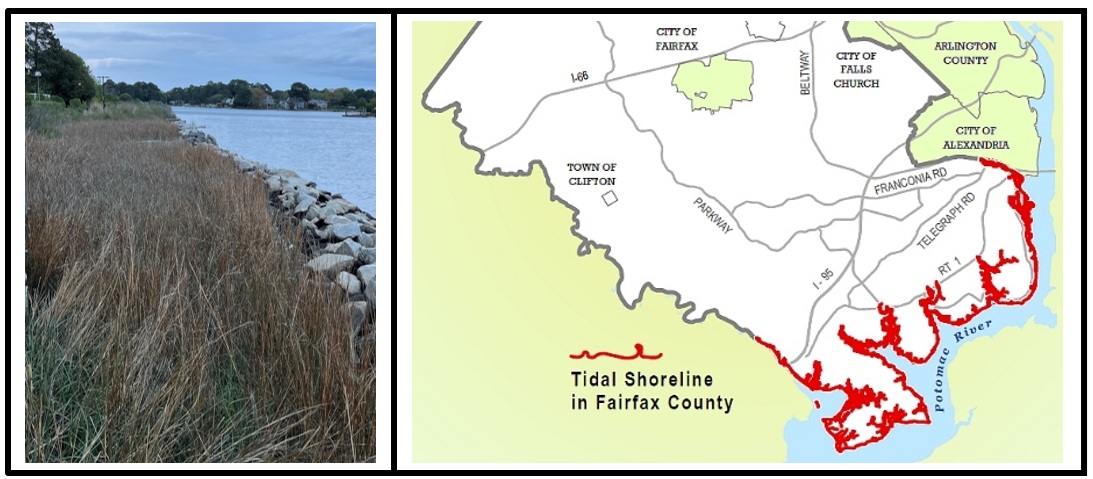
If you own or are involved with property that includes tidal shoreline, you can use the following online resources to locate and evaluate shoreline areas:

If you need additional assistance in determining whether tidal shoreline exists on your property, contact staff for the Fairfax County Wetlands Board:

Department of Planning and Development, Planning Division
12055 Government Center Parkway, Suite 730,
Fairfax, VA 22035-5504
703-324-1380, TTY 711
DPDWetlandsBoard@fairfaxcounty.gov

How does this affect you?

Maintaining or Modifying Existing Shorelines

Existing tidal shoreline structures, including bulkheads and riprap, should be maintained to prevent erosion and structural failure.

If you want to modify your shoreline, approvals and permits are required before any work begins. Unauthorized activity, including construction of a living shoreline, may result in violations and require restoration. See the below Requirements section for more information.

If a bulkhead or rip rap has failed, and tidal wetlands have developed landward of the structure, a living shoreline may be required as part of the repair.

Under the Code of Virginia § 28.2-104.1.D, a living shoreline approach must be used, unless it is determined to be unsuitable. In those cases, elements of a living shoreline must be incorporated to the maximum extent possible.

The Shoreline Decision Support Tool is available to provide recommendations for shoreline erosion control. This tool integrates the best available science on shoreline management. For additional resources, see the Technical Assistance section below.

Benefits of Living Shorelines include:

  • Reducing erosion and property loss for you and your neighbors.
  • Improving water quality for safer drinking water and recreation.
  • Storing and absorbing carbon to slow greenhouse gases and reduce the harmful effects of climate change.
  • Providing a natural barrier to waves.
  • Preserving natural coastal processes, such as marsh dunes.
  • Providing an attractive natural appearance.
  • Supporting resilient communities.
  • Streamlining the permitting process for some projects.

Requirements:

Below is an overview of the Living Shoreline approval process which:

  • Identifies required permits and plans.
  • Provides a checklist to ensure complete submissions.
  • Lists agency contacts for each step.

While the applications in Steps 1 and 2 below may be submitted concurrently, it is strongly recommended to complete Step 1 first. This helps to avoid redesign and the need to submit plan revisions later.

Submit one JPA electronically to the U.S. Army Corps of Engineers (USACE) through the Regulatory Request System (RRS), which will distribute it automatically to:

  • U.S. Army Corps of Engineers (USACE)
  • Fairfax County Wetlands Board (WB)
  • Virginia Marine Resources Commission (VMRC)

Typically, the order of review is: (1)USACE → (2)Wetlands Board → (3)VRMC. Each agency issues a permit or written response indicating whether a permit is required. (Note: USACE may advance the JPA to the Wetlands Board without issuing a written response.

After the JPA is submitted, then submit a Wetlands Permit Application through our online permitting system (PLUS).

Before submitting:

Questions? Contact Fairfax County Wetlands Board staff at 703-324-1380, TTY 711, DPDWetlandsBoard@fairfaxcounty.gov, or in-person at 12055 Government Center Parkway, Suite 730, Fairfax, VA 22035-5504.

Submit the following to Land Development Services (LDS) through our online permitting system (PLUS):

  • Floodplain Use Determination (FPUD) for encroachment in the floodplain.
  • Water Quality Impact Assessment (WQIA) for encroachment in a Resource Protection Area (RPA).
  • Grading plan* (see note below).

Before submitting:

  • Submit the FPUD request to determine whether your proposed use is allowed under county floodplain regulations.
  • Complete a Resilience Assessment as part of the WQIA. This assessment evaluates climate change and sea-level rise impacts for any project in an RPA per § 118-4-3(g)(1)-(6) of the Fairfax County Code.
  • Confirm whether a WQIA is required under § 118-3-3(a). It is typically required for any land disturbance or development in an RPA. If requesting a WQIA exemption for a living shoreline, demonstrate compliance with § 118-3-3(i) criteria.
  • Schedule a pre-application meeting before submitting your materials.

*NOTE: The type of grading plan required depends on the scope of work and total associated disturbance. Common plan types for living shoreline projects include:

  • Infill lot grading plans (INF)
  • Rough grading plans (RGP)

For details, visit the Permit Library: Site Plans or contact the Site Engineer of the Day at 703-324-2268, TTY 711, by email at sitequery@fairfaxcounty.gov, or in-person at 12055 Government Center Parkway, Suite 324, Fairfax, VA 22035-5504.

This information is the most common way to obtain the necessary approval for a Living Shoreline project and is not representative of all the conditions you may encounter. Depending on the scope of your project, perhaps it includes a retaining wall, dock, or other structure, you may need to apply for a separate building permit record in PLUS. To determine whether your project requires such a permit, visit When a Permit is Required.

Technical Assistance:

The Virginia Conservation Assistance Program (VCAP) provides financial and technical assistance to property owners who would like to install a Living Shoreline. For more information, please visit Virginia Conservation Assistance Program.

For questions about VCAP grants, contact: conservationdistrict@fairfaxcounty.gov.

Fairfax Virtual Assistant