Public Affairs Alert:
| Title | Body | Field Image | Field Publishdisplaydate | Authored on |
|---|---|---|---|---|
| Board of Supervisors Approves Public Safety Small Unmanned Aircraft Systems (UAS) Program | At its meeting today, Tuesday, May 21, the Fairfax County Board of Supervisors voted unanimously to approve a Public Safety Small Unmanned Aircraft Systems (UAS) program. The county’s UAS program will provide an enhanced level of operational capability, safety and situational awareness for the Office of Emergency Management, Fire and Rescue, Police and Sheriff by delivering relevant high-quality imagery, data and customized geospatial solutions using unmanned aircraft. Fairfax County’s UAS program is designed to assist public safety personnel with search and rescue, flooding assessments, pre- and post-disaster damage assessments, crash reconstruction, fire incident/scene management and investigations, hazardous materials responses and situational awareness for wildlife management. The county’s program will focus on responsible and accountable operations; the safety of the public and UAS flight crews; the protection of individual privacy, civil rights and civil liberties; compliance with all applicable federal, state and local laws, regulations, and policies; public information; data management; and operation and training requirements. Following today’s vote, county public safety agencies will begin an approximately 90-day process of equipment purchases, pilot certifications and flight/ground school training with a “go live” for real-world operational flights beginning in late August/early September. All pilots in the county program are required to have a remote pilot certificate with small UAS rating issued by the Federal Aviation Administration. In addition, a UAS program manager will be appointed and a UAS Steering Committee, with public representation, will be created to provide oversight to the program and ensure adherence to the county’s UAS program manual and training requirements. A UAS notification group has been created in Fairfax Alerts to provide public notifications for missions or training flights. For questions about the program, a copy of the program manual, information about the equipment used, flights that have taken place, presentations and details of public outreach efforts, visit the UAS webpage. In addition, the UAS program can be reached by both email (UAS@fairfaxcounty.gov) and phone (571-350-1234). Today’s approval of the program followed two years of work by a county UAS Work Group formed in May 2017 and a UAS Task Force that was created in fall 2018. The task force included representation from groups and organizations such as the ACLU, NAACP, George Mason University, area chambers of commerce, Audubon Society, FAA, Fairfax Federation, McLean Citizens Association, Leadership Fairfax, the Fairfax Area Disability Services Board, Communities of Trust, the commonwealth of Virginia and numerous county agencies. Further Information UAS can operate in many types of environments (natural or manmade), or other critical incidents that might be hazardous to the safety of first responders or others. UAS provides a unique, viable, safe, versatile, supplemental tool for incident commanders and first responders. For some missions UAS provide first responders with a tool that can access areas where manned aircraft cannot fly due to weather or other safety regulations. ### Note to Media: Roy Shrout, deputy coordinator, Office of Emergency Management, and chair of the UAS Work Group is available for media interviews. He can be reached at roy.shrout@fairfaxcounty.gov or 571-350-1225. |
May 21, 2019 | May 21, 2019 | |
| Judge Tina Snee Leads New Mental Health Efforts in Fairfax County Courts | The Honorable Tina Snee, a Fairfax County General District Court judge, has championed mental health initiatives through the court by helping to expand the Fairfax County Diversion First initiative into the county system and securing funding for the expansion of the county’s Supervised Release Program. She has also been instrumental in developing Fairfax County’s new Mental Health Docket over which she and Judge Susan J. Stoney will preside. The docket, which was recently approved by the Virginia Supreme Court, is scheduled to launch in July. “The issue of mental health is important to the whole judicial system,” says Snee. “Unfortunately, a large number of individuals who are part of the judicial system suffer from varying degrees of mental health/co-occurring issues. Their needs would be best addressed by behavioral health specialists. The goal of the justice system is to make sure they are in the best place to have those needs addressed, which is not always the jail. They need to be treated for competency, so they can participate in their own cases.” The Mental Health Docket was developed by Snee and Stoney to work in conjunction with the county’s Supervised Release Non-Compliance Docket as another option for those experiencing different mental health/co-occurring issues. The Supervised Release Non-Compliance Docket, which has helped 180 people since it began in August 2018, served as a pilot for a full Mental Health Docket. The Mental Health Docket will allow commonwealth and defense attorneys to require a defendant to complete different phases of treatment until they “graduate,” at which time the defendant’s charges will be resolved. “It is the goal of every judge to promote the fair administration of justice,” Snee adds. “The goal of Diversion First is for those with mental health or co-occurring issues to be treated in a just and fair method. This new docket helps with these goals.” Snee was appointed to the Fairfax County General District Court in 2015 for a six-year term, having served as a substitute judge for two years prior. Her legal career spans 26 years, focused mainly on civil litigation in the trial and appellate courts of Virginia, Maryland and the District of Columbia. Snee was recently recognized by Virginia Lawyers Weekly as one of the Influential Women of Law. This new award program honors women attorneys and judges for their excellent work on behalf of their clients, their commitment to their communities and their service to the profession. She received the award at a reception and dinner in Richmond, and her work was featured in a special supplement of Virginia Lawyers Weekly. |
May 7, 2019 | May 7, 2019 | |
| Fairfax County Files Lawsuit Against Opioid Manufacturers, Distributors and Pharmacy Benefit Managers | On Tuesday, April 30, the Fairfax County Board of Supervisors filed a lawsuit in Virginia state court against more than 50 known defendants, including opioid manufacturers, distributors and pharmacy benefit managers, or PBMs, for their role in creating the public health emergency caused by the opioid crisis. The defendants include manufacturers Purdue Pharma, Abbott Laboratories, Endo Pharmaceuticals, Mallinckrodt Pharmaceuticals, Teva Pharmaceuticals, Janssen Pharmaceuticals, Cephalon, Inc., Barr Laboratories, Inc., Actavis Pharma, Watson Laboratories, Inc., Allergan PLC and Insys Therapeutics; distributors AmerisourceBergen Drug Corp., Cardinal Health Inc. and McKesson Corp.; and PBMs Express Scripts, Inc., Caremark/CVS Health, United Health Group Inc. and OptumRx, Inc. “Opioids are the number one cause of unnatural death in Fairfax County, and our residents are demanding action in response to this epidemic,” says Fairfax County Board of Supervisors Chairman Sharon Bulova. “In addition to Fairfax County launching an Opioid Task Force, offering REVIVE training courses, creating safe drug disposal opportunities and educating our community about the dangers of drug addiction and overdose, Fairfax County seeks to hold drug companies accountable for their role in this nationwide crisis.” The lawsuit alleges that defendants are responsible for the opioid epidemic and profited enormously from their respective roles in manufacturing and moving opioid products throughout the county, while misrepresenting or understating their addictive nature. The county has alleged violations of statutory and common law public nuisance, the Virginia Consumer Protection Act, fraud, common law conspiracy, negligence and unjust enrichment. The lawsuit seeks to recover the public funds the county has expended to address the effects of the opioid crisis, including the significantly increased expenditures for the delivery of emergency medical services, law enforcement services, mental health services and substance abuse services as a result of the crisis. Fairfax County is being represented by outside legal counsel, Kaufman & Canoles, P.C., Sanford Heisler Sharp, LLP and The Cicala Law Firm PLLC. Media can contact Tony Castrilli, Fairfax County Director of Public Affairs, at 703-268-8953, or Madelaine Strauss with Sanford Heisler Sharp at 646-331-2691. |
April 30, 2019 | April 30, 2019 | |
| New Circuit Court Judge Dontaè L. Bugg Receives Official Commission May 10 | Dontaè L. Bugg will be presented his official commission as a Fairfax Circuit Court judge on Friday, May 10, at 4 p.m. at the Fairfax County Courthouse, Courtroom 5J, 4110 Chain Bridge Road, Fairfax. The public is invited to attend the investiture ceremony.
Before joining the Circuit Court, Bugg served as a substitute judge for the General District Court and Juvenile and Domestic Relations District Court from November 2016. Prior to taking the bench, the judge was the founder of Bugg Law Firm, PLLC, focusing his practice on criminal defense in federal and state courts, as well as domestic relations. A native of Newport News, Va., Bugg earned his Bachelor of Arts in criminology and criminal justice from the University of Maryland and his Juris Doctor from the T.C. Williams School of Law at the University of Richmond. For more information or reasonable ADA accommodations, contact Kim Callahan, Fairfax Circuit Court, at 703-246-4166, TTY 711. |
April 30, 2019 | April 30, 2019 | |
| Education and Career Certification Plans Move Forward at Original Mount Vernon High School | Fairfax County, Fairfax County Public Schools (FCPS) and Northern Virginia Community College (NOVA) signed a letter of intent to offer educational and career certification programs at the Original Mount Vernon High School. The redevelopment of the Original Mount Vernon High School is part of the revitalization plans embodied in Embark Richmond Highway.
“I am thrilled that the county has entered into an agreement with NOVA to partner toward incorporating a learning academy at the Original Mount Vernon High School,” said Mount Vernon District Supervisor Dan Storck. “This is a culmination of years of effort by myself, Supervisor McKay and School Board Chair and Mount Vernon District Representative Karen Corbett Sanders to bring new opportunities to the Richmond Highway Corridor, which has been substantially underserved in the areas of higher education and human development. As we work to create a community hub and human development center at this central location, our goal is to provide opportunities for innovation, business incubators, college access, recreation, child development and the arts, with NOVA and FCPS providing important education components.” The nonbinding agreement provides a framework for the public schools, college and county to:
“I’m thrilled that we have reached yet another major milestone as part of our progress at the Original Mount Vernon High School,” said Lee District Supervisor Jeff McKay. “The new agreement signed last week brings us further to turning these plans into a reality, and brings us one step closer to benefiting the folks on the Route One Corridor and keeping our promise to revitalize the area as part of our Embark vision. I look forward to continuing to work with all of our community stakeholders on this important work.” School Board Chair and Mount Vernon Representative Karen Corbett Sanders said, “The importance of having access to college level educational opportunities and career certifications for students and families in Mount Vernon and Lee has been a priority for community leaders. The inclusion of NOVA in the redevelopment had the full support of the community when it was presented to the Board of Supervisors in 2015. The letter of intent is the result of the efforts of the NOVA’s leadership, the schools and the county working together to more fully realize these opportunities for a community that does not have ready access to college and career training available in other areas of the county. We are thrilled to see this becoming a reality at the Original Mount Vernon High School location.” As potential anchor tenants in the planned re-use of the former high school located at 8333 Richmond Highway, Northern Virginia Community College and Fairfax County Public Schools bring community linkages to the knowledge and skills that can build pathways to employment and entrepreneurship opportunities. “NOVA sees the need for a higher education presence in this underserved area and looks forward to continuing to work with state and local officials to explore educational and training opportunities that fit and could make a real difference,” said Dr. Mel Schiavelli, NOVA’s interim president. The overarching vision is to leverage the former high school to build communities of opportunity, create career pathways, connect different generations and better integrate residents into the economy. Per the letter of intent, the county, schools and college will work together to determine space needs for each program, cost and scope of need for necessary renovations and cost responsibilities, to include future lease payments. They will create a strategic document that includes interim and long-term educational uses by Aug. 30, 2019. A master development planning process for the former high school began in spring 2018. The planning phase is expected to conclude this spring, with priority placed on the renovations and adaptive reuse of the historic high school structure. Additional community engagement opportunities will be held before planning is completed. The former school building, built in 1939, is listed on the National Register of Historic Places and the Virginia Historic Landmarks Register. The adaptive reuse of the historic building and surrounding campus is being led by the Fairfax County Department of Public Works and Environmental Services’ Public Private Partnerships Branch. A community visioning task force provided recommendations in 2015 that included higher education in the building and early childhood education. This agreement also advances the county’s and public schools’ commitment to One Fairfax, a racial and social equity policy jointly adopted by the Fairfax County Board of Supervisors and Fairfax County School Board in 2017. In addition to the education programming in the building, there are plans to create an approximately 11,000-square-foot teen and senior center to offer indoor and outdoor recreation. For more information, contact the Fairfax County Office of Public Affairs at 703-324-3187, TTY 711. # # # |
March 25, 2019 | March 25, 2019 | |
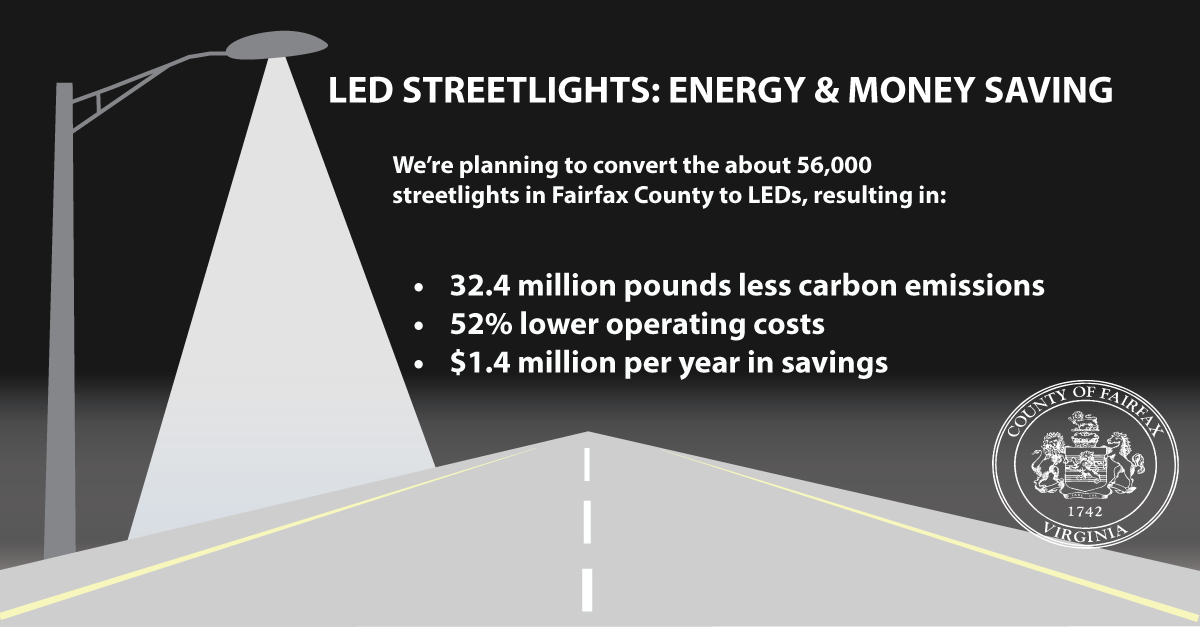
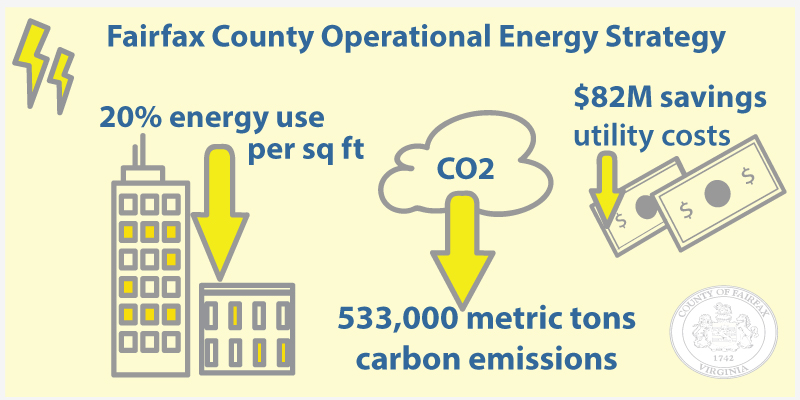
| Fairfax County Proposes $2.5 Million in New Energy Efficiency Projects for LED Streetlights and Electric Vehicle Charging Stations | Fairfax County is considering funding $2.5 million in new energy efficiency projects for LED streetlights and electric vehicle charging stations. The Board of Supervisors discussed funding for these new projects at their Feb. 12 Environmental Committee meeting. It is anticipated that the board will approve the money in March as part its third quarter review of the county’s current budget. These projects put into action the county’s ambitious Operational Energy Strategy that was adopted last year. This strategy aims to cut energy use in county buildings by 20 percent per square foot over the next 10 years. The overall strategy moves forward Fairfax County’s commitment to cut greenhouse gas emissions. As part of the energy strategy, county leaders previously approved $4.5 million in September to install LED lighting at 19 facilities, including libraries, community centers, the animal shelter and parks. Retrofiting incandescent and fluorescent bulbs with LEDs should be completed late this year. As a new project, the county is looking to replace the approximately 56,000 streetlights in the county with LEDs. Because Dominion Energy installs, owns, operates and maintains virtually all of these streetlights, the county must pay to convert them. However, Fairfax led the negotiations this past summer for a new regional agreement with the utility that lowered the conversion costs.
The total cost to change streetlights to LEDs is an estimated $9 million, and county officials are considering a phased conversion over five years. To begin the first phase, $1.8 million will be required. The change will yield both financial and environmental benefits. LEDs will cut operating costs for these streetlights by 52 percent, generating an estimated annual savings of $1.4 million once the conversions are complete. LED streetlights will also cut 32.4 million pounds of carbon emissions every year. This is equal to the greenhouse gas emissions from 1,760 homes for a year or 1,653,696 gallons of gasoline burned. As another energy efficiency measure, the county proposes installing electric vehicle charging stations at up to 20 county facilities phased over two consecutive years, such as its office buildings, community centers, libraries, RECenters and commuter parking lots. The stations would service county vehicles, but also would be available to the public for a fee. The total cost for designing, permitting and building the EV charging stations is $1.5 million over two years. To build the first set of stations, the county would allocate $750,000. The county will contract with a private company to own, operate and maintain these stations. Reducing the county’s electricity use is key to cutting greenhouse gas emissions. Electricity accounted for 51 percent of the county’s total energy use in 2016—and it produced 65 percent of carbon emissions. Electricity was also responsible for 69 percent of the county’s total energy bill. When fully implemented, the Operational Energy Strategy is expected to lower greenhouse gas emissions by 533,000 metric tons compared to today. This is equal to the amount of climate-warming gases that would be released from burning 1.24 million barrels of oil or 584 million pounds of coal.
The $2.5 million proposed for the streetlight conversions and EV charging stations makes up some of the $48 million investment called for by the strategy. However, the strategy’s energy saving projects will pay for themselves over 10 years, generating an estimated $80 million in utility cost avoidance. # # #
|
February 12, 2019 | February 12, 2019 | |
| Jill Cooper Appointed Clerk to the Board of Supervisors | At its meeting on July 16, the Board of Supervisors appointed Jill Cooper to the position of Clerk to the Board of Supervisors, effective Sept. 3. Cooper will continue to serve as director of the Department of Clerk Services (DCS), to which she was appointed in January. DCS consolidates the Planning Commission Office and the Office of the Clerk to the Board. The Department of Clerk Services includes three distinct groups. One provides the direct support of Board of Supervisors' meetings and Board committee meetings. Another provides the direct support of Planning Commission meetings and committee meetings as the Planning Commission staff currently does. The last group focuses on the functions that are in common to both the Board of Supervisors and the Planning Commission, including posting of legal notices and advertisements for public hearings, maintaining the public meetings calendar, scheduling public hearings, issuing clerk's letters and more. Cooper also serves as the executive director of the Fairfax County Planning Commission, a position she has held since 2013. Previously, she was as a senior assistant to the zoning administrator in the Zoning Administration Division of the Fairfax County Department of Planning and Zoning. During that time, she also managed the department’s legislative review team to coordinate departmental review of pertinent proposed and adopted legislation. Prior to her work with Fairfax County, Cooper was a land use planner for more than 10 years in the private sector and a senior associate in community outreach at the Urban Land Institute, where she worked with local communities to develop and implement smart growth policies and practices. Cooper has a bachelor of science in anthropology from James Madison University and a master's in urban planning from the University of Virginia. She also completed a graduate certificate in local government management through Virginia Tech. Cooper is a member of the American Planning Association, the American Institute of Certified Planners, the International City/County Management Association and the Urban Land Institute, and she is a Virginia Certified Planning Commissioner. |
July 16, 2019 | July 16, 2019 | |
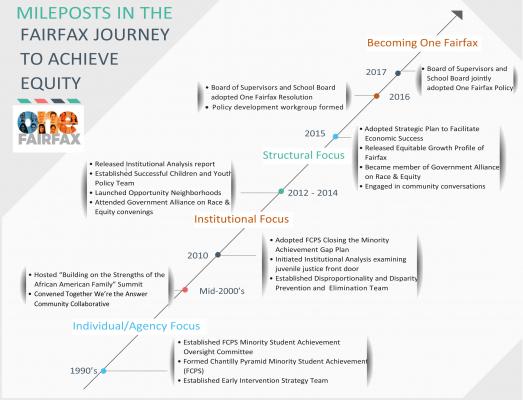
| New Case Study Documents the History Leading to the One Fairfax Policy | “One Fairfax: A Brief History of a Countywide Plan to Advance Equity and Opportunity,” was released Jan. 22, 2019, by The Center for the Study of Social Policy, which worked with Fairfax County to develop the plan. This case study presents an overview of the decades-long process and the milestones that led to the Fairfax County Board of Supervisors and School Board jointly adopting the One Fairfax policy in November 2017. One Fairfax is a framework—or “lens”—that will be used to consider equity in decision-making and in the development and delivery of future policies, programs and services. It will help county and school leaders look intentionally, comprehensively and systematically at barriers that may be creating gaps in opportunity. “Our willingness and ability to change to be more efficient, forward thinking and inclusive will ensure that we realize the transformational potential of government to advance equity through changes in policy and practice,” says Fairfax County Executive Bryan J. Hill. “There still is much work to do to become One Fairfax, but working together with partners, stakeholders and community, we can strategically and intentionally shape the structure of opportunity throughout the county so everyone can participate and prosper.” In the journey to One Fairfax, the Center for Study of Social Policy conducted an institutional analysis—or IA for short—in 2012 that provided a foundation for a conceptual shift in the county’s approach to racial and social equity. An IA gathers and analyzes information in a way that is designed to uncover the structural and institutional contributors to poor outcomes for children, youth, and families. “The Fairfax leadership used the results of the IA process very purposefully to create a series of dialogues among county departmental directors, meeting with individual directors, before arranging the series,” said Sarah Morrison, Center for the Study of Social Policy’s director of learning and evidence. “Their collective commitment to better understanding and addressing the institutional contributors to racial inequity was key to the success of the IA and led to the adoption of the One Fairfax policy.” “One Fairfax: A Brief History of a Countywide Plan to Advance Equity and Opportunity” includes interviews with many county staff key to advancing the policy. The case study points to Fairfax County’s story as, “instructive for other jurisdictions wrestling with similar issues or striving to create more equitable opportunities for all its residents. As Fairfax County has learned, there is no single strategy, beyond attunement to opportunities for advancing equity as they arise.” For more information about One Fairfax or its development, contact Fairfax County Chief Equity Officer, Karla Bruce, at 703-324-5360, TTY 711. # # #
|

|
January 22, 2019 | January 22, 2019 |
| How We're Reducing Electricity Costs in County Buildings | Did you know utilities costs for the Government Center, Herrity and Pennino buildings exceed $2 million annually? That's over $100,000 a month for the Government Center and more than $35,000 a month each for the Herrity and Pennino buildings. Becoming a more energy-efficient organization is a priority for our Facilities Management Department and the county in general. Not only are costs and carbon emissions considerations, but also our responsibility to be a good corporate citizen. This summer, Fairfax County adopted a new, broader operational energy strategy to significantly lower utility bills and carbon emissions. The strategy makes reducing electricity consumption a top priority. Electricity accounted for 51 percent of the county's total energy use in 2016—and it produced 65 percent of carbon emissions. Electricity was also responsible for 69 percent of the county's total energy bill. Recent funding was allocated as a first-year investment in the strategy, which aims to reduce energy consumption in county buildings and facilities by 20 percent per square foot over 10 years. The funds are being used to replace incandescent or fluorescent lighting with LEDs in 18 facilities, including libraries, community centers and athletic fields. Though implementing energy-saving technologies can require larger investments and longer-term planning, there are a host of solutions that can quickly, easily and inexpensively deliver significant savings, like the LED lighting retrofit, reducing lighting hours of operation and changing temperature set points during times when buildings are unoccupied or closed. What are we asking county employees to do? Simple, no-cost measures such as:
|
December 19, 2018 | December 19, 2018 | |
| Board Approves Retirement Systems Changes for New Hires After July 1, 2019 | At their meeting on Tuesday, Dec. 4, the Fairfax County Board of Supervisors voted to approve changes to all three county retirement systems, for employees hired on or after July 1, 2019 only. These changes include eliminating the pre-Social Security Supplement from the Employees' and Uniformed systems and eliminating the one-time 3 percent calculated retirement annuity increase for all three plans. Changes also include the addition of a cost-neutral Early Age Option for employees who retire prior to full retirement age under Social Security. The changes are intended to improve the system's long-term sustainability. Plan changes were also made in 2013, including changing minimum retirement age from 50 to 55 (and the rule of 80 to the rule of 85.) The Board requested another review of the systems this and staff presented a package of options in June that would apply only to employees hired on or after July 1, 2019, including:
Increasing the minimum retirement age and changing the rule of 85 to the rule of 90 were taken out of consideration due to lack of support for the measures. The Board voted separately on three provisions of the package, agreeing unanimously to eliminate the Social Security supplement and in a 6-4 vote to eliminate the 3 percent calculated annuity increase. The salary averaging period increase failed on a tie vote. The changes will also result in the elimination of the previously available high and low plan options for new hires, with only one plan available with the start of the new fiscal year. At a public hearing on the changes in November, more than 40 people testified on both sides of the issue, with employee groups, unions and others expressing concerns about the impact on hiring qualified employees and the risks of a two-tiered system, and others questioning the long-term viability of the system without changes. More information about Fairfax County retirement systems is available at www.fairfaxcounty.gov/retirement. |
December 5, 2018 | December 5, 2018 |
 At the ceremony, State Senator Scott A. Surovell will present Bugg with his official commission and Retired United States District Judge Gerald Bruce Lee of the United States District Court for the Eastern District of Virginia will ceremoniously administer the oath. Bugg previously took his oath of office on March 15.