Fairfax County, Virginia
Fairfax County Virginia

FFX Global Navigation

    • Emergency Management
    • About DEMS
      • Agency Information
      • What We Do
    • Ready Fairfax
    • Community Emergency Response Guide
    • Preparedness
      • Make an Emergency Plan
      • Assemble your Emergency Kits
      • Stay Informed
      • Get Involved
    • Response
    • Recovery
    • Mitigation
    • Natural Hazards
      • Coastal Flooding
      • Earthquake
      • Extreme Heat
      • Flooding
      • Hurricane/Tropical Storm
      • Pandemic Influenza
      • Thunderstorm
      • Tornado
      • Winter Weather/Extreme Cold
    • Human-Caused Hazards
      • Acts of Violence/Terrorism
      • CBRN
      • Civil Disorder
      • Cyber Attack
      • Dam Failure
      • HAZMAT
    • Everyday Emergencies
      • Medical Emergency
      • Power Outage/Blackout
      • Structural Fire
    • Community Preparedness Training
    • CERG Plan Templates
    • Houses of Worship Preparedness
    • Business Preparedness
    • County Emergency Plans
    • Important Contacts
    • Emergency Management Brochures
  • Residents
    • Animals & Pets
      • Adoptions
      • Animal Control & Regulations
      • Guide to Dogs
      • Lost & Found Pets
      • Shelter Support & Supplies
      • Wildlife
      • More
      Courts & Legal
      • Case Information
      • Circuit Court Docket
      • Jury Duty
      • Land Records
      • Magistrate
      • Public Law Library
      • Self-Help Resources
      • Traffic Court
      • Vital Records
      • More
      Environment & Energy
      • Invasive Species
      • Litter
      • Recycle, Trash & Compost
      • Sustain Fairfax
      • Trees
      • Watersheds
      • More
      Health & Human Services
      • Basic Needs & Assistance
      • Disability Services
      • Diseases & Conditions
      • Domestic & Sexual Violence
      • Health Clinics
      • Mental Health
      • Opioids
      • More
      Individuals & Families
      • Children & Youth
      • Federal Workforce
      • Immigrants
      • Military & Veterans
      • New Residents
      • Older Adults
      • Parents
      • People with Disabilities
      • Volunteers
      • More
      Land Use & Planning
      • Comprehensive Plan
      • County Capital Projects
      • Land Records
      • Parks Planning
      • Planning Projects
      • Research Tools
      • Transportation Projects
      • Urban Centers
      • More
      Library & Education
      • Adult Education
      • Early Childhood Programs
      • Library Branches
      • Library Catalog Search
      • Public Schools
      • More
      Parks & Recreation
      • Arts
      • Athletic Fields
      • Camps
      • Community Centers
      • Parktakes Classes
      • Rec Centers
      • Senior Centers
      • Teen Centers
      • Trails
      • More
      Permits & Licenses
      • Birth & Death Certificates
      • Building
      • Child Care
      • Dogs
      • Health
      • Marriage
      • Park Use
      • Solicitors
      • More
      Property & Housing
      • Affordable Housing
      • Code & Zoning
      • Neighborhoods
      • Real Estate Values
      • Recycling & Trash
      • Tenant Landlord Issues
      • Utilities
      • More
      Public Safety & Emergencies
      • 9-1-1
      • Emergency Preparedness
      • Fire & Rescue
      • Gun Violence Prevention
      • Police
      • Scams
      • Sheriff
      • Storm Center
      • More
      Roads & Commuting
      • Bike & Walk
      • Connector Bus
      • Metrobus & Metrorail
      • Park & Ride
      • Pedestrian Safety
      • Road Maintenance/VDOT
      • Street Parking
      • Toll Roads
      • Transportation Projects
      • More
      Taxes & Fees
      • Car Taxes
      • Park Fees
      • Real Estate Taxes
      • Tax Relief
      • Trash Disposal Fees
      • More
      Voting & Elections
      • Absentee Voting
      • Early Voting
      • Election Results
      • Polling Places
      • Voter Registration
      • More
      Weather & Climate
      • Air Quality
      • Climate Action Dashboard
      • Extreme Heat
      • Floods
      • Ready Fairfax
      • Resilient Fairfax
      • Snow
      • Tornadoes
      • More
  • Business
    • Business & Construction
      • Building Permits
      • Code & Zoning
      • Land Use
      • More
      Business Services
      • Business Emergency Preparedness
      • Business Taxes
      • Consumer Services
      • Employer Transportation Service
      • Green Business Partners Program
      • Home-Based Business
      • Regulation & Licensing
      • Small Business
      • Starting a Business
      • Workplace Issues
      • More
      Doing Business with Fairfax
      • Contracting and Procurement
      • Current Solicitations
      • Permits
      • Vendor Pitch Portal
      • More
  • Government
    • About
      • Codes & Standards
      • Countywide Strategic Plan
      • Facilities & Locations
      • History of Fairfax County
      • Operating Status
      • More
      Board of Supervisors
      • Auditor
      • Board Members
      • Boards, Authorities & Commissions
      • Clerk Services
      • Committees
      • Meetings & Agendas
      • More
      Budget & Finance
      • Bonds
      • Budget
      • Financial Transparency
      • Unclaimed Money
      • More
      Departments & Agencies
      Jobs & Employment
      • Full-Time Openings
      • Internships
      • Seasonal & Non-Merit
      Maps & Data
      • Countywide Data Analytics
      • Demographics
      • Geographic Information Systems
      • Interactive Data Tools
      • More
      One Fairfax
      • Digital Equity
      • Inclusive Engagement
      • Trust Policy
  • Fairfax County Virginia
  • Services
    • Find
      • Animal Services
      • Health Clinics
      • Jobs
      • Library Resources
      • Lost or Found Pet
      • Mental Health Support
      • Park Classes
      • Real Estate Values
      • Recycling & Trash
      • Volunteer Opportunities
      • More
      Pay
      • Business Taxes
      • Car Taxes
      • Dog Licenses
      • Driving & Parking Fines
      • False Alarm Fees
      • Real Estate/Property Taxes
      • SACC Payments
      • More
      Register/Apply
      • Basic Needs & Assistance
      • Building Inspections
      • Car Registration
      • Fairfax Alerts
      • Permits & Licenses
      • Tax Relief
      • Vote
      • More
      Report
      • Animal Control Issues
      • Consumer Complaints
      • Crime
      • Domestic Violence
      • Financial Crimes
      • Neighborhood Complaints
      • Road Issues to VDOT
      • Street Light Outages
      • More
  • Connect
    • Alerts, Emails & Apps
      • Email Subscriptions
      • Fairfax Alerts
      • Mobile App
      • More
      Community Engagement
      • Surveys & Projects
      Contact
      • Directory
      • Hotlines & Emergency Numbers
      • VDOT
      • VFOIA Requests
      • More
      News & Events
      • Daily Headlines
      • Emergency Information Blog
      • Events Calendar
      • NewsCenter
      • NotiCentro (Spanish)
      • Public Meetings Calendar
      • More
      Social Media
      • Comments Policy
      • Directory of Accounts
      • More
      TV, Video & Podcasts
      • Channel 16
      • Podcasts & Radio
      • YouTube
      • More
  • TRANSLATE
    • Language Selection

      To change the language of this website, click the drop-down list and select the desired language. The Fairfax County Web site is being translated through "machine translation" powered by Google Translate. Disclaimer

Emergency Management and Security

  1. Home
  2. Emergency Management
  3. Community Emergency Response Guide

Emergency Management and Security Alert:

CONTACT INFORMATION: Our office is open 8AM-4:30PM M-F
571-350-1000 TTY 711
dems@fairfaxcounty.gov
4890 Alliance Drive
Fairfax, VA 22030
@readyfairfax
Seamus Mooney
Coordinator

Community Emergency Response Guide

Disasters Happen.

They don’t happen often or everywhere, but they do happen sometimes and somewhere.

In some cases they are predictable, and in others they are unthinkable. Tornadoes touch down, hurricanes make landfall, floodwaters rise, fires burn, utilities are interrupted, terrorists strike.

But with planning and preparation, you can make a difference. You can reduce a disaster’s impacts on you, your family, and your community. You can save lives, homes, and livelihoods.

The Fairfax County Department of Emergency Management and Security is a resource for the community. Our mission is to make us all more ready for and resilient to all hazards. In a crisis, the government must focus on those in the greatest peril. The better prepared everyone else is, the better the outcomes are for all of us.

By reading this far, you’ve already taken the first step in preparing for the unexpected. Now it’s time to make a plan, build a kit, and help prepare your household and your community.

Department Resources

  • Emergency Management
  • About DEMS
    • Agency Information
    • What We Do
  • Ready Fairfax
  • Community Emergency Response Guide
  • Preparedness
    • Make an Emergency Plan
    • Assemble your Emergency Kits
    • Stay Informed
    • Get Involved
  • Response
  • Recovery
  • Mitigation
  • Natural Hazards
    • Coastal Flooding
    • Earthquake
    • Extreme Heat
    • Flooding
    • Hurricane/Tropical Storm
    • Pandemic Influenza
    • Thunderstorm
    • Tornado
    • Winter Weather/Extreme Cold
  • Human-Caused Hazards
    • Acts of Violence/Terrorism
    • CBRN
    • Civil Disorder
    • Cyber Attack
    • Dam Failure
    • HAZMAT
  • Everyday Emergencies
    • Medical Emergency
    • Power Outage/Blackout
    • Structural Fire
  • Community Preparedness Training
  • CERG Plan Templates
  • Houses of Worship Preparedness
  • Business Preparedness
  • County Emergency Plans
  • Important Contacts
  • Emergency Management Brochures

Related Resources

  • COVID-19 After-Action Report (AAR)
  • DEMS Monthly Newsletter
  • Monthly Webinars
  • Emergency Blog

Community Emergency Response Guide


Community Emergency Response Guide

Click on the appropriate link below to download a PDF copy of Community Emergency Response Guide.

English (PDF) | Spanish (PDF) | Korean (PDF) | Arabic (PDF) | Mandarin (PDF) | Vietnamese (PDF)

Help us improve and let us know how the Community Emergency Response Guide is helping you!

Take the Short Survey

Request a workshop or presentation on the Community Emergency Response Guide!

CERG presentation/workshop request form
 

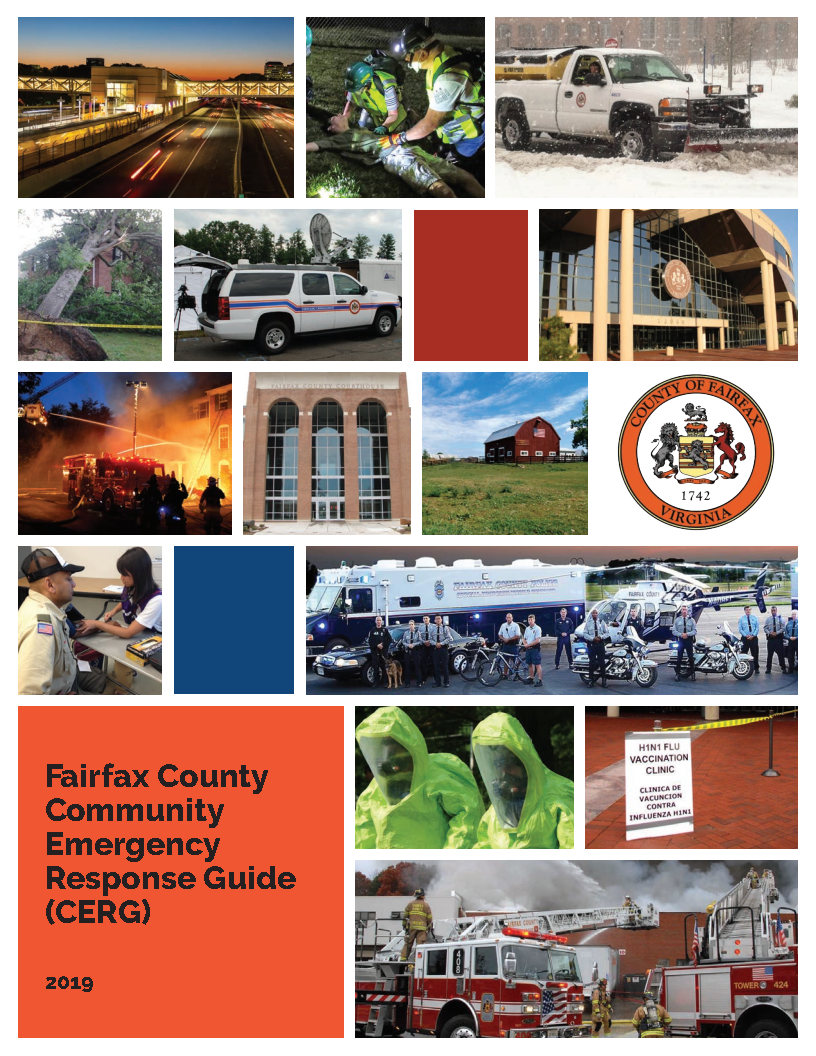
Disasters happen, and they can affect you, your family, and your community. The number of disasters in the United States each year is increasing, according to the Federal Emergency Management Agency (FEMA). Fairfax County faces many hazards. Some are difficult to predict; a few strike without any warning at all. In the past several years, our community has responded to major storms, hurricanes, and power outages. Instead of thinking “it will never happen to me,” use this Guide to help prepare for an emergency, so you know what to do when disaster strikes.

In an emergency, Fairfax County first responders will do all they can to respond to everyone in need. In a big disaster, the priority is those in the most dire circumstances. That means we all need to be prepared to be our own “first responder” for the first three to five days after a major disaster.

This is why it is so important for you to have an emergency plan that is written and practiced at home, have the necessary supplies in case you need to shelter-in-place or evacuate, know how to get information about the emergency, and know how to support your community by helping your neighbors.

When you prepare for a disaster, you should take what emergency management professionals call an “all-hazards” approach. This means making general preparations that will help you, your family, and your neighbors – regardless of the nature of the emergency.

The county’s Emergency Operations Plan provides the basis for the county’s emergency management program, including all county activities and procedures intended to save lives and minimize damage during and after disasters. This Community Emergency Response Guide adapts the Emergency Operations Plan for use by county residents. For more, click here

This Community Emergency Response Guide will provide you with the tools you need to help you become more prepared. It will help you create:

  • A family emergency plan.
  • A business preparedness plan.
  • A neighborhood preparedness plan.
  • An emergency supply kit.

The Guide also includes:

  • Emergency contact information and recovery resources.
  • Specific actions you can take before, during, and after each of Fairfax County’s likeliest hazards.
  • A list of ways to get involved in your community through volunteer efforts.
  • Information about the links between you and the county’s emergency management professionals.
  • When you are prepared, that helps you and your community. Prepared families and businesses result in resilient communities. Resilient, self-sufficient residents can keep themselves safe and secure while first responders care for those with the greatest need.

We are all in this together.

By using the resources provided in this Community Emergency Response Guide, Fairfax County residents will become more resilient and self-sufficient during an emergency.

In support of residents, the county brings significant first responder and recovery resources, including not just Fire and Rescue and Police, but also the departments of Health, Family Services, and many others. State and federal assets may also be requested to support a county emergency. All of these resources are coordinated by the Fairfax County Office of Emergency Management (OEM).

OEM coordinates all hazard mitigation, response, and disaster recovery services for the residents of Fairfax County.

Fairfax County OEM also works to support residents as they build resilience by preparing for emergencies before they happen. This includes:

  • Ready Fairfax (see below)
  • Sending “Fairfax Alert” messages to keep residents informed of emergency conditions
  • Emergency planning for government agencies and residents for overall emergency operations, including people with access and functional needs, and continuity of operations
  • Managing the county Citizen Corps program
  • Conducting training and exercise programs for Fairfax County government agencies, and in partnership with neighboring local governments and businesses.

READY FAIRFAX

Ready Fairfax is a Fairfax County Office of Emergency Management preparedness program designed to educate and empower community members to prepare for, respond to, and recover from emergencies, including natural and human-caused disasters. The goal of the program is to promote preparedness through public engagement. This is achieved through signature programs such as Student Tools for Emergency Planning (STEP), Preparedness Awareness Weekend (PAW), seasonal programs, and social media.

Ready Fairfax asks you and your neighbors to take four actions: (1) stay informed about the different types of emergencies that could occur and their appropriate responses; (2) make an emergency plan; (3) build an emergency supply kit; and (4) get involved in your community by taking action to prepare for emergencies.


To ready the community to respond to all hazards, Fairfax County OEM works with its partners to maintain several important plans. Our primary emergency plans are accessible to residents to support public understanding of county operations before, during, and after a disaster.

The county’s emergency plans can be viewed on OEM’s website here.

Most Prevalent Hazards

Fairfax County is vulnerable to a wide range of hazards (natural, human-caused, and everyday). These hazards threaten the safety of residents. They have the potential to damage or destroy property and disrupt the economy. While we cannot eliminate hazards, we can lessen their potential impacts.

Hazards may occur in isolation, or – more commonly – in ripple-effect clusters. For example, a hurricane may trigger a flood as well as power outages and medical emergencies. Or a thunderstorm may produce lightning that causes a structural fire.

The Northern Virginia Hazard Mitigation Plan and other sources were used to identify the hazards detailed below. These identified hazards are those that pose the greatest risk to the county (that is, the highest probability of causing the most severe impacts to exposed lives and property). The analyses are based on detailed reviews of prior hazard history, as well as forecasting and probabilistic modeling tools.

The hazard annexes are grouped by common characteristics, and do not imply any rank-order:

Natural Hazards:

Thunderstorm
Hurricanes/Tropical Storms
Flooding
Winter Weather/Extreme Cold
Extreme Heat
Tornado
Earthquake
Pandemic Influenza and Infections Disease

Human-caused hazards (including accidents and intentional acts):

Cyber Attack
Civil Disorder
Acts of Violence/Terrorism
HAZMAT
Chemical, Biological, Radiological, or Nuclear
Dam Failure

"Everyday" emergencies:

Structural Fire
Power Outage/Blackout
Medical Emergency

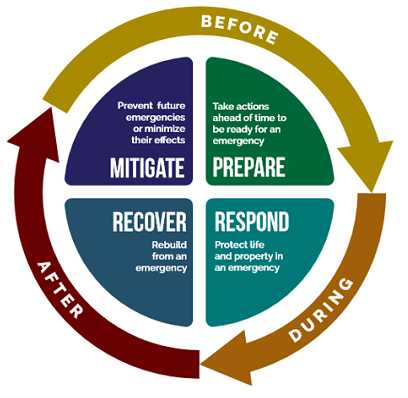
The "Four Phases" of Emergency Management

Emergency management professionals typically break down their responsibilities into four phases, which form a cycle. This four-phase cycle applies to you too.

Phases of Emergency Management


It begins with PREPAREDNESS activities that get a community ready before an emergency (including planning, training, and exercising).

Next are the RESPONSE actions that help protect lives and property during a disaster.

RECOVERY efforts are how we build back after a disaster.

MITIGATION projects reduce future risks from hazards – these may be put in place before or after a disaster, but they are always intended to improve conditions before the next event.
 

Recent Interactions

    Ask Fairfax

    Terms & Conditions
    Live chat available Search our site

    Related Resources

    • COVID-19 After-Action Report (AAR)
    • DEMS Monthly Newsletter
    • Monthly Webinars
    • Emergency Blog
    • Translate
    • Awards
    • Site Feedback
    • PRIVACY POLICY & COPYRIGHT
    Main Address

    12000 Government Center Pkwy
    Fairfax, VA 22035

    Phone

    703-324-7329

    TTY 711

    Site Tools
    • Website Accessibility
    • Translate
    • Download Mobile App
    Support
    • ADA Accessibility
    • FOIA Requests
    • Website Administrator
    Additional Resources
    • Fairfax County Public Schools
    • Economic Development Authority
    • Visit Fairfax
    • Council of Governments
    • Commonwealth of Virginia
    • USA.gov
    • Calendar
    • Channel 16
    • Mail
    • Security
    • WIFI
    • Facebook
    • Twitter
    • Instagram
    • YouTube
    • Mobile

    The Official Site of Fairfax County