


What is ERS?
It was first established in 1955 as the retirement system for general county employees. Today, this also includes certain employees of the Fairfax County Public Schools (FCPS), including all non-teacher and non-administrator positions.
Who is a member of the ERS?
In most cases, you automatically become a member of the System on your date of hire if you are:
- A full-time merit employee or a part-time merit employee working at least 20 hours per week;
- A School Board employee who is not a substitute teacher and in a position where VRS membership is not mandatory;
- A food service employee working at least 15 hours per week;
- A crossing guard or a clinic room aide and are eligible to participate in other County fringe benefit programs;
- A Department of Public Safety Communications employee who elected to remain in this system; or
- An FCPS full-time educational position who moved to a part-time position or non-educational position.
Is membership mandatory?
Yes. You can opt out if and only if you are at least 59 ½ years old when hired, an elected official, appointed by an elected official as a deputy or assistant, or a constitutional officer. You must elect in writing to opt out at the time you are hired.
How do I confirm if I am a member of the ERS?
Check your paystub to see if yours look like either example below.
Fairfax County Government Paystub Example | Fairfax County Public Schools Pay Stub Example |
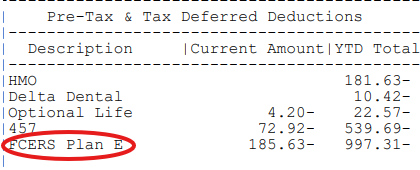 | 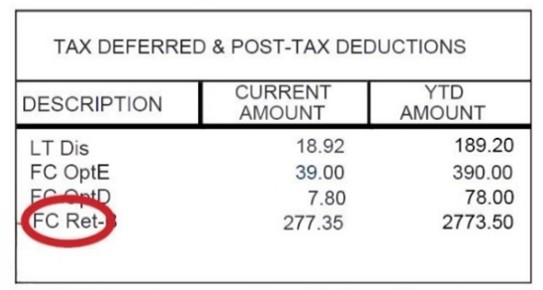 |
How much am I contributing to my pension?
The ERS is made up of five plans. The chart below provides an overview of employee contributions for each plan. All contributions are pre-tax and do not include overtime.
| Plan Participants | Contributions |
Plan A | Employees hired before January 1, 2013 | 4.0% of salary up to the Social Security taxable wage base and 5.33% of salary over |
Plan B | 5.33% | |
Plan C | Employees hired between January 1, 2013 and June 30, 2019 | 4.0% of salary up to the Social Security taxable wage base and 5.33% of salary over |
Plan D | 5.33% | |
Plan E | Employees hired on or after July 1, 2019 | 5.33% |
When can I retire?
You are eligible for normal service retirement when you are at least 65 years old with 5+ years of active service; or if hired before 1/1/2013, you must be at least 50 years old and your age plus years of service must total 80 or more; or if hired on or after 1/1/2013, you must be at least 55 years old and your age plus years of service must total 85 or more.
How much will I receive when I retire?
The amount of your normal retirement benefit depends on what plan you are in. Plans A, B, C, and D are also eligible to receive an additional Pre-Social Security Benefit if you retire before the age at which you will be eligible to receive unreduced Social Security benefits. The retirement benefit formula is as follows: Multiplier (%) x Final Average Salary (FAS) x Benefit Service x 103%
Plans A & C | 1.8% | FAS up to SS Breakpoint | Benefit Service | 103% |
2.0% | FAS over SS Breakpoint | Benefit Service | 103% | |
Plans B & D | 2.0% | FAS | Benefit Service | 103% |
Plan E | 2.0% | FAS | Benefit Service | --- |
What other retirement options do I have?
In addition to Normal Service Retirement, employees may be eligible for Early Service Retirement, Deferred Vested Retirement, Disability Retirement (Ordinary or Service-Connected), or the Deferred Retirement Option Program (DROP). More information, eligibility details, and retirement benefit amount can be found on the Retirement Types page.
Are there classes I can take to prepare for retirement?
Virtual classes are available for every stage of an employee’s career – from new hire to mid-career to approaching retirement. Class descriptions and schedule can be found on the Retirement Classes page.
How can I learn more about ERS?
Handbooks for ERS active employees and retirees are available on our Handbooks page.
Please Note: You can find more detailed information in the County Code (Chapter 3). All System benefits are subject to the provisions of the Code of Virginia and the Fairfax County Code, as well as applicable rules, regulations, and resolutions of the Board of Trustees of the Retirement System. Those statutes, ordinances, rules, regulations, and resolutions are controlling in the event of any conflict with this web page.