

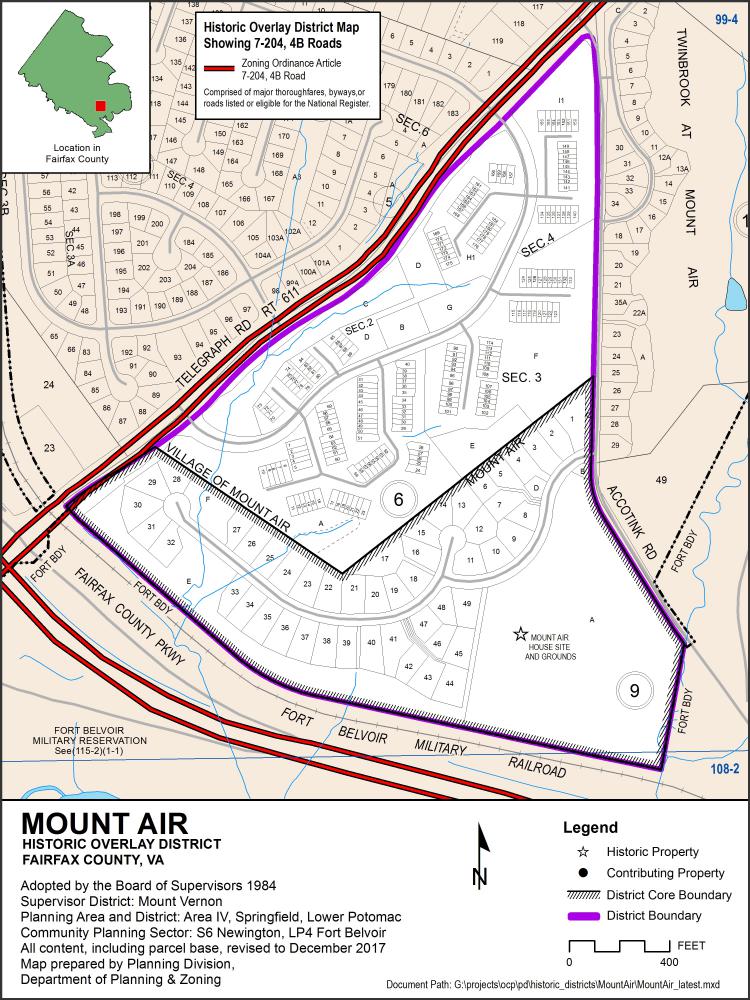
Though the main house of eighteenth-century plantation Mount Air burned in 1992, the site, containing the ruins of the house along with several remaining accessory structures, is significant for its association with past owners, historic events, and archaeology. Like many rural houses, Mount Air had a succession of owners and building campaigns. The McCartys, a prominent colonial Virginia family, owned the Mount Air property in the 18th century. Several maps prepared by George Washington show his neighbors' properties and identify this site as Colonel McCarty's residence. Historical documentation and archaeological evidence indicate that the McCarty era house burned in 1859 and was reconstructed.
The property remained in the McCarty and Chichester families until 1860 when Aristides Landstreet of Baltimore purchased it. While he served in the Confederate Army, his family lived at Mount Air. Confederate and Union troops stopped at Mount Air for supplies, and, in the case of the Union troops, even used the property and house as a camp. Mary Landstreet was imprisoned for three months on charges of giving aid to the Confederates. After her release, she successfully signaled Southern troops at Pohick Church that Union troops occupied Mount Air.
Army engineers building a railroad spur to the site of Camp Humphrey (now Fort Belvoir) camped on the Mount Air property during its construction in 1918. They named their encampment 'Camp Merry Widow' in honor of the owner, Mrs. Kernan. Condemnation by the Corps of Engineers for the expansion of adjacent Fort Belvoir reduced the Mount Air property to its current twenty-six acres. Mount Air’s archaeological significance includes a complex and extensive archaeological record that has yielded multiple preContact, 18th, 19th, and early 20th century archaeological resources. The site has a high potential to yield additional archaeological deposits that have yet to be identified. Today, the remains of the antebellum Mount Air plantation provide a link to the Colonial era, the Civil War, World War I, the subdivision and purchase of larger landholdings by an influx of newcomers in the early 20th century, and the construction of Fort Belvoir.
Related Resources
Mount Air Historic Overlay District Aerial Map
Mount Air Historic Overlay District Design Guidelines
Mount Air Historic Overlay District Proposal