Fairfax County Solid Waste Management Program Launches Request for Expressions of Interest to Shape the Future of Waste, Recycling, and Zero Waste Innovation
West Springfield Government Center – Purple Can Temporary Removal
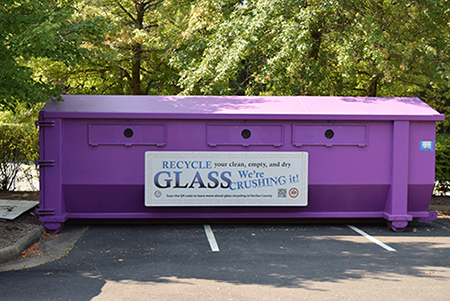
Due to road paving, the Purple Can will be temporarily removed beginning July 31, 2026. Residents will not be able to drop off glass at this site during repaving. Please use the map below to find other Purple Can locations. The container will return to this site by early September.
Franconia District Office Purple Can Relocated
The last day to drop off glass bottles and jars at the Franconia District Office’s current location on 6121 Franconia Road will be Sunday, April 12, 2026. After that date, the purple can will be relocated to the parking lot of the NEW District Office at 7130 Silver Lake Blvd, Alexandria, VA 22315 (near the corner of Springfield-Franconia Parkway and Beulah Street).
Glass deposited in the purple cans is used to make food and beverage containers, fiberglass insulation, and reflective materials.
Glass bottles and jars are not accepted in most curbside recycling programs throughout the region.
What happens to the glass bottles and jars I put in the purple container?
Purple cans have cameras to let the county know when they need to be emptied.
Glass from purple cans is consolidated at the I-66 Transfer Station and transported to a glass recycling facility in Pennsylvania.
The glass bottles and jars are sorted by color and processed into cullet. [Photo Credit- O-I Glass]
The cullet is then transported to manufacturing facilities where it is used to make new and food and beverage containers, fiberglass insulation, and reflective materials. [Photo Credit- O-I Glass]
Some of the cullet goes to O-I Glass bottle manufacturing plants in Virginia where it is made into new bottles and jars. [Photo Credit- O-I Glass]
Circular Economy
Did you recycle a glass jar last month? You may be drinking out of it right now! A glass bottle can go from the purple can back to the store in as little as 30 days. Check your glass bottle or jar to see if it was made right here in Virginia. Use the following link to learn how to read a glass bottle manufactured by O-I.
You can recycle glass in Fairfax County, but not always in your curbside recycling bin. When glass is mixed with other recyclables at the curb, it often breaks during transport. The small pieces can ruin the other recyclables. Depending on the facility, broken glass might be treated as waste and either burned or sent to a landfill. Since glass is heavy, it costs more to recycle because fees are based on weight. It can also damage recycling machines. Separating glass from other curbside recyclables also created a market for recycled glass.
The Purple Can Club allows glass to be truly recycled. Glass is sold to a recycling company and used to make new food and beverage containers, fiberglass insulation, and reflective materials.
The way your glass is handled depends on your waste collector. If you put glass in your trash or recycling bin, it might be burned or sent to a landfill. Glass can also be used to cover landfills at the end of the day. Before putting glass in your curbside recycling bin, check with your waste collector to see where they send the glass and if it will be recycled to make new products.
There are over 24 purple containers throughout Fairfax County and adjacent localities where you can drop off your glass bottles and jars. See the Northern Virginia Glass Recovery Map for container locations.
The purple containers are open and available every day. Please use from 6:00 am to 9:00 pm only to not disturb neighbors with your glass recycling effort.
Clean glass bottles and jars of all colors are accepted.
Glass items not accepted include lamps, light bulbs, ceramics, porcelain, mirrors, windows, and sheet glass.
Rinse as best as possible.
Lids and labels can remain on to be sorted out later during processing.
Natural cork can be composted and synthetic corks can be recycled at certain retailers.
Avoid leaving behind cardboard boxes or other non-glass containers (try to use reuseable bags to transport).
Mirrors, windows, vases, ornaments and other glass that is not in the form of a bottle or jar cannot be recycled. They should be taken to the 66 Transfer Station or 95 Landfill Complex for disposal.
Carefully package the glass into a rigid container. Label the package "GLASS" and set out with your trash for disposal.