


(Posted 2026 November)
Meet Roger Sabin, Court Accompaniment Volunteer, Legislative Analyst Volunteer, and Fatality Review Team Volunteer
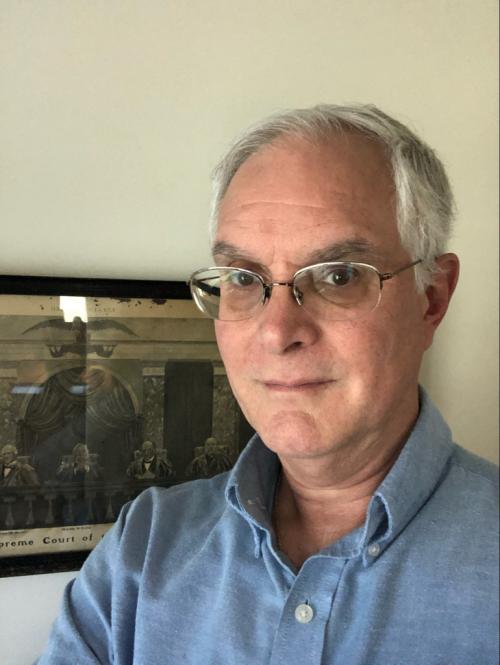
Tell us a little about yourself. What is your professional background?
I am a Washington, D.C., native, raised in Alexandria, schooled for the most part in Virginia. After serving as an assistant commonwealth’s attorney, I joined the federal government and practiced law there for more than 40 years before retiring in 2021.
How long have you been volunteering? What led to your initial desire to volunteer and serve others?
Now it’s time to give back. I wanted to put my legal training to use in the community. Being in the federal service, I spent very little of my professional life serving the community where I lived.
What interested you in volunteering with Fairfax County’s Domestic and Sexual Violence Services?
I was initially attracted by DSVS offering volunteer opportunities that involved working with the courts as a “court accompanist,” a role where I felt I could do some good.
I began volunteering at DSVS when I entered Tier 1 training in March 2022. By July of that year, I was supporting the Domestic Violence Action Center (DVAC) doing mostly administrative duties. One project was clearing a multi-year backlog of data updates to CarePaths system. In January 2023, I picked up a different volunteer role supporting the county’s Legislative Review team within DSVS to analyze proposed laws for their impact on the County and (more importantly for me) the cohort of domestic violence victims.
In late January 2023, I began working as a court accompanist in the Juvenile and Domestic Relations Court in Fairfax. This is the work I signed up for and where I have most of my volunteer focus. The work involves meeting with people who have petitioned to have a protective order issued against someone for family abuse or domestic violence. I have worked with victims seeking a preliminary protective order, where their testimony is unchallenged. But most of my work has been with victims seeking a full protective order, where there is a trial with the introduction of evidence and challenges to testimony. These hearings can be much more fraught and tense–situations where the victim may benefit from having an individual with them who knows the system and can give them some idea of what to expect. Typically, I am in court with our clients on Tuesdays, and occasionally other days if needed.
My most recent additional role began in February 2023 when I started supporting the Domestic Violence Fatality Review Team (DVFRT) at their monthly meetings. Mostly, I support the secretary to the team with notes on the proceedings and completing data forms. As part of the team, however, I get a view of how the county and its partner agencies deal with the worst of domestic and sexual violence–that is cases that result in death.
What is the most challenging part of volunteering? How did you overcome this challenge?
Each of my volunteer roles has its own challenges. In court accompaniment, I usually have never met the client before they appear for court. Establishing rapport, often with only minutes before a case is called and often through a language barrier, can be very difficult. You develop some sense of who the client is within a crowded waiting area, and I can say I have gotten less reticent about asking strangers if they are my client.
The challenge in supporting the DVFRT is not so much the work itself but the psychic impact of the crimes being reviewed. Our co-chair is a clinical psychotherapist who takes great care that team members, including the volunteers, are cared for.
In analyzing bills for the Legislative Review Team, the challenge is time–or the lack of it. Whoever is available to grab a piece of legislation gets that assignment. And once assigned, it is a 48 hour turn around to complete the assignment. The key is not to raise your hand to do the analysis unless you know you have the free time right then.
What’s the best part of volunteering? Share your most memorable experience.
Throughout all of these roles, I think the best part of volunteering are the people we serve. First, there are the clients. Sincere appreciation and thanks from one client cancels out all of the dismissals, continuances, and no shows. The second-best part of volunteering is working with our dedicated staff and partner organizations. I see my job as not just to help the clients, but also to free up the paid staff to do their important work.
I’ve had a number of memorable experiences. Here’s one. During a protective order hearing, I followed the client and her attorney to the court lobby when the judge called a short recess. The attorney was somewhat at odds about what to do with the case at that point. I suggested that this juncture might be a perfect place to move for a summary judgment. (I can never offer legal advice to the client, but I felt a suggestion to her attorney was fair game.) He took that suggestion, made the motion, and won the case for our client!
What has been your favorite training? What did you like about it? What did you learn?
I have benefitted from different training with DSVS, but I’d have to say that Tier One was my favorite because that was my first real introduction to the field where I wanted to work. I volunteered before fully realizing what I signed up for. As I mentioned, I completed Tier I in 2022. It would be great if the court accompaniment team–especially the volunteers–could get a refresher and an update on legal developments in the field of family law and domestic violence. I’m sure some things have changed since 2022.
What are your three greatest strengths? How have you been able to display and use these strengths when serving others?
I think I’m a pretty good listener. I have no problem keeping quiet so a client can express themselves. I have some training in counseling and one thing I learned from that is our role is not necessarily to fix everything. Just being there with some encouragement is what it’s about.
What advice do you have for people who may be thinking about becoming a DSVS volunteer?
I have known people who considered volunteering for DSVS who were put off by the bureaucracy. It seemed to me one part of the county was often not speaking to the other. My fingerprints got lost twice. My advice: The reward of helping people is worth the hassle. Also, I fully understand the need for clearances and reviews given the clientele involved.
What are some of your hobbies and interests?
I like to think I have a pretty good life in retirement. People who know me know I write a blog focused on Virginia wine and wineries: vawinejourneys.blogspot.com. This gets me out of the house and on the road all over the state. I also take classes at George Mason University, which has been a great way to learn new things without the specter of grading and papers hanging over me. For the fall semester, for instance, I’m taking History of Latin America. Prior courses have included modern poetry and History of American Sport. I am active in my church, through which I help deliver meals to unhoused people through the Fairfax Area Christian Emergency and Transitional Services (FACETS) organization. I also lead our church’s men’s group.
This article posting is part of the Domestic and Sexual Violence Services' Volunteer Voices monthly newsletter for current and potential volunteers. If you're not already a volunteer, learn how to get involved. Find out about upcoming trainings, volunteer trainings, happenings around the DSVS office and information about articles, books, media recommendations and more.
Learn more about the Domestic and Sexual Violence Services (DSVS).