Our native garden lines the walkways in front of the nature center, created through a collaboration between staff and volunteers with generous support from the Friends of Hidden Oaks Nature Center (FOHONC), Earth Sangha, and park visitors. This website provides a list of plants currently growing in the garden.
Interested in helping maintain the native plant garden? We would greatly appreciate your support! Contact kristina.watts@fairfaxcounty.gov to get involved.
Featured Native Plants:
The Native Plants are indexed below alphabetically by plant name.
Actaea racemosa (Black Cohosh)
- Light: Partial shade to shade
- Height: 3-8'
- Spread: 3-4'
- Bloom: White flower clusters in May-August
- Habitat: moist, rich forests. Northern hardwood forests, cove forests, rocky streamsides, forest edges, river bluff forests, and basic mesic forests. Wooded slopes, ravines, creek margins. Moist to wet humus-rich, moderately acidic soil
- Ecological significance: Attracts bees
- Fun fact: Popular herbal remedy in treating "hot flashes"
- Other information:
- Herbaceous perennial, spreads by rhizomes
- Moderate growth rate
- Habitat: Found moderately widespread in eastern North America
- Flowers can act as a biting bug repellent if rubbed on the skin
- High deer resistance

Actaea racemosa (Black Cohosh)
Aquilegia canadensis (Wild Columbine (Eastern or Red))
- Light: Sun to partial shade
- Height: ½ to 3 feet
- Spread: 1 to 1½ feet
- Bloom: Red and yellow March-July
- Habitat: forests, woodlands, and rock outcrops. Well-drained moist to dry soil
- Ecological significance: Attracts hummingbirds, butterflies, bees, hawk moths; larval host for Columbine Duskywing butterfly and the Purplish Winged Skipper
- Other information:
- Erect and branching herbaceous perennial
- Spreads by rhizomes
- Medium growth rate
- Found widespread in eastern Northern America
- High deer resistance
Aruncus dioicus (Goat's Beard)
- Light: Partial shade to shade
- Height: 3 to 6 feet
- Spread: 2 to 4 feet
- Bloom: Small white flowers on large, feathery clusters in May-August
- Habitat: forests, seepage slopes, forest edges. Moist to wet nutrient soils
- Ecological significance: Attracts butterflies; larval host to the Dusky Azure butterfly
- Other information:
- Herbaceous perennial
- Dioecious (males and females are separate plants)
- Smooth arching stems
- Spreads from rhizomes
- Moderate growth rate
- Found in eastern and central United States
- High deer resistance
Carex pensylvanica (Pennsylvania Sedge)
- Light: Sun to shade
- Height: ½ to 1 foot
- Spread: 2 feet
- Bloom: Green leaves in May-July
- Habitat: northern hardwood forests, red oak forest, grassy balds, rock outcrops, and forest edges. Well-drained moist to wet soils
- Ecological significance: Attracts mammals and birds
- Other information:
- Low-growing, grass-like sedge
- Drooping stems
- Spreads vegetatively by long and short rhizomes
- Slow growth rate
- Found widespread in eastern North America
- High deer resistance
Chelone glabra (White Turtlehead)
- Light: Sun to partial shade
- Height: 1 to 4 feet
- Spread: 1½ to 2½ feet
- Bloom: White with lavender tinge July-October
- Habitat: Moist woods, seeps, along streams, rocky streamsides and mountain bogs. Requires humus-rich, moist to wet soils.
- Ecological significance: Attracts hummingbirds, bumblebees, butterflies; larva host for Baltimore Checkerspot butterfly and sawflies.
- Fun fact: Contains toxins called iridoid glycosides which makes it unpleasant for all herbivores but the checkerspot butterfly and sawflies. This also protects these species from other predators.
- Other information:
- Herbaceous perennial
- Single root system and spread by short rhizomes
- Moderate growth rate
- Found widespread in eastern North America and south to Georgia
- Moderate deer resistance
Corylus americana (American Hazelnut)
- Light: Partial shade to shade
- Height: 6 to 12 feet
- Spread: 8 to 13 feet
- Bloom: yellowish brown catkins in March-June later become an edible nut
- Habitat: upland forests, rocky hillsides, and pastures. Moist to dry, well-drained soil
- Ecological significance: Attracts mammals and birds
- Fun fact: Produces hazelnuts, which lots of animals eat - including humans
- Other information:
- Dense and mounded-shaped shrub
- Spread by rhizomes
- Moderate to fast growth rate
- Found widespread in eastern North America
- Low deer resistance
Dicentra eximia (Wild Bleeding Heart)
- Light: Partial shade to shade
- Height: ½ to 2 feet
- Spread: 1½ to 2 feet
- Bloom: pink to magenta flowers April-June
- Habitat: rich acidic wooded slopes, coves, and gorges in the Appalachian mountains. Moist, well-drained, humus-rich, rocky, acidic soils.
- Ecological significance: Attracts hummingbirds and bees
- Fun fact: Produces hazelnuts, which lots of animals eat - including humans
- Other information:
- Mounding evergreen herbaceous perennial
- Scaley rhizomes which grow slow colonies
- Slow growth rate
- Found in eastern United States from Vermont to Illinois and south in the mountains from Georgia to Tennessee
- High deer resistance
Eupatorium perfoliatum (Common Boneset)
- Light: Sun to shade
- Height: 3 to 6 feet
- Spread: 1 to 4 feet
- Bloom: Tiny white flower clusters June-October
- Habitat: damp prairies, alluvial woods, and bogs. Moist to wet soils containing significant amount of organic matter
- Ecological significance: Attracts birds, butterflies, and bees
- Fun fact: Dried leaves have been used to make a boneset tea and is thought to be effective for treating colds, cough, and constipation. When taken in large doses, it is known to cause vomiting, act as a laxative, and potentially harm the liver due to pyrrolizidine alkaloids which are contained within the plant.
- Other information:
- Root system produces rhizomes which create small colonies
- Slow growth rate
- Found widespread in eastern North America, south to Florida, and west to Texas
- High deer resistance
Geranium maculatum (Wild Geranium)
- Light: Sun, Part Shade, Shade
- Height: 1-2'
- Spread: Forms colonies by rhizomes 1-2'
- Bloom: White, Pink, Purple. March to July
- Habitat: rich forest, fields, meadows, and thickets. Humid, rich, acidic soil.
- Ecological significance: Attracts bees and small butterflies
- Other information:
- Also known as spotted geranium, wood geranium, and cranesbill.
- Showiest of the native geraniums with larger flowers than the other species.
- Propagated from divisions of the rhizomes or from seed. Divide roots in early spring or fall, cutting them where they form right angles.
Heuchera americana (American Alumroot)
- Light: Sun to partial shade
- Height: 1½ to 3 feet
- Spread: 1 to 1½ feet
- Bloom: Red, green, purple and brown colors April-June
- Habitat: rocky woodlands and outcrops of various geological formations. Well-drained, moist to dry soils.
- Ecological significance: Attracts hummingbirds, butterflies, bee
- Other information:
- Hardy and reliable perennial
- Tall leafless stalks grow from fleshy branching rhizomes
- Moderate growth rate
- Found widespread in eastern North America, west to Illinois
- Used as ground cover
- High deer resistance
Lobelia cardinalis (Cardinal Flower)
- Light: Sun to partial shade
- Height: 1 to 6 feet
- Spread: 1 to 2 feet
- Bloom: Red flowers in July-October
- Habitat: Rocky streamsides, mountain bogs, swamp forests, meadows, and roadsides. Moist to wet, humus-rich, sandy and clay soils
- Ecological significance: Attracts hummingbirds, butterflies, and bees
- Fun Fact: Poisonous to humans and pets. Foliage contains alkaloids which are very toxic if ingested.
- Other information:
- Perennial
- Upright and unbranched with several stems
- Rhizomes over winter with small rosettes of leaves
- Moderate to fast growth rate
- Found widespread in eastern North America
- High deer resistance; tolerates rabbits
Phlox Divaricata (Wild Blue Phlox)
- Light: Partial shade to shade
- Height: ¾ to 1½ feet
- Spread: ¾ to 1 foot
- Bloom: Purple to pink flowers in March-June
- Habitat: deciduous woods and bluffs. Organic, moist, rich, acidic, well-drained soils. Calcareous areas. Loams and clays.
- Ecological significance: Attracts hummingbirds and butterflies (hairstreaks and swallowtails)
- Other information:
- Herbaceous perennial
- Mat-forming evergreen
- Stoloniferous or rhizomatous
- Moderate growth rate
- Found widespread in eastern North America
- Used as groundcover
- Moderate deer resistance; low rabbit resistance

Forest Service, Eastern Region
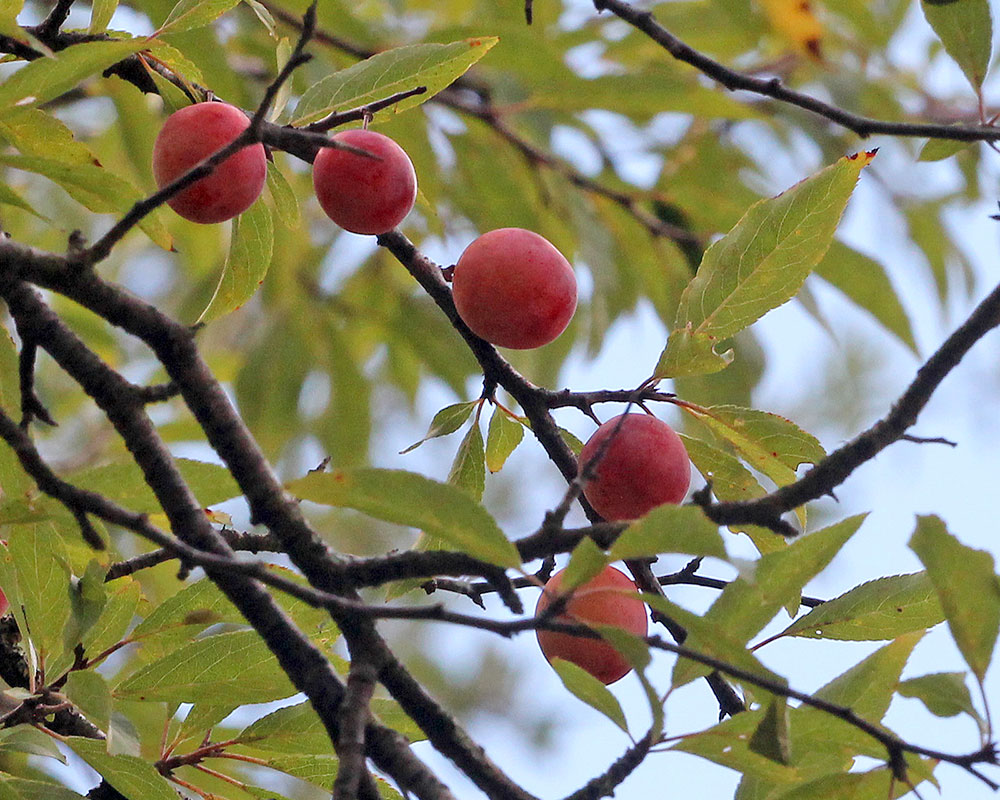
Prunus angustifolia (Chickasaw Plum)
- Light: Sun, Part Shade
- Height: 10 to 25 feet
- Spread: 10 to 20 feet
- Bloom: White flowers, Feb - May
- Fruit: Red plums in Aug-Sept
- Habitat: Thickets, pastures, fields, fencerows, stream banks and disturbed areas. Dry, sandy, loose soil.
- Ecological significance: Birds and mammals eat the fruit. Various insects visit the flowers. Host plant for the larvae of a number of butterflies. Provides cover and nesting sites for wildlife.
- Fun facts: Cultivated by the Chickasaw Indians and other indigenous peoples before the arrival of Europeans. This plum can be eaten fresh or made into jelly, pie, preserves, or wine.
- Other information:
- A twiggy, thicket-forming shrub or small tree with slender, spreading branches and with fragrant white flowers in flat-topped clusters and yellow fruit ripening to red in August or September.
- Short, crooked trunk and flat-topped crown. Scaly, nearly black bark. Reddish branches are covered with thorn-like side branches.
- Low to medium water use, tolerates drought.
- Pale-yellow fall foliage.
- In full sun, it will be more dense and full and will colonize more thickly. In the part shade of woodlands, will be more airy, loose, and delicate in appearance and will colonize more loosely.
Solidago caesia (Blue-Stemmed Goldenrod)
- Light: Sun to partial shade
- Height: 1 to 3 feet
- Spread: 1 to 2 feet
- Bloom: yellow clusters in August-October
- Habitat: open upland woods, shaded bluffs, slopes, ravines, and rocky cliffs. Moist to dry well-drained soil. Can tolerate loam, clays and rocky soils.
- Ecological significance: Attracts birds, butterflies, and bees; larval host for some moth species
- Fun facts: Mistakenly believed to cause hayfever
- Other information:
- Clump-forming perennial with smooth, arching stems
- Spreads by rhizomes
- Moderate growth rate
- Found in central and eastern North America from Quebec to Florida and west to Texas
- Moderate deer resistance
Solidago odora (Sweet Goldenrod)
- Light: Sun to partial shade
- Height: 2 to 5 feet
- Spread: 1 to 2 feet
- Bloom: Cylindrical yellow flower clusters July-October
- Habitat: dry open woods, savannas, and sandy pinelands. Moist, slightly acidic, sandy or well-drained acidic soils
- Ecological significance: Attracts birds, butterflies, and bees
- Fun fact: Mistakenly believed to cause hayfever
- Other information:
- Upright and clumping perennial
- Glossy, anise-scented foliage
- Expands from rhizomes
- Slow growth rate
- Found widespread in eastern North America, south to Florida, and west to Texas
Symphyotrichum lateriflorum (Calico Aster)
- Light: Sun to partial shade
- Height: 1 to 5 feet
- Spread: 3 feet
- Bloom: Small white or pale purple August-November
- Habitat: wet meadows, bottomland forests, seeps, and swamps. Thrives in moist soil
- Ecological significance: Attracts butterflies and bees
- Fun fact: Mistakenly believed to cause hayfever
- Other information:
- Found widespread in eastern North America, north to Ontario, south to Georgia, west to Arkansas
- Moderate deer resistance; low rabbit resistance
Tradescantia virginiana (Spiderwort)
- Light: Sun to shade
- Height: 1 to 3 feet
- Spread: 1 to 1½ feet
- Bloom: Blue-purple clusters in May-July
- Habitat: prairies, open woods, rocky cliffs and outcrops, and meadows Moist, well-drained, loamy, acidic soils.
- Ecological significance: Attracts hummingbirds, butterflies, and bees
- Fun fact: Mistakenly believed to cause hayfever
- Other information:
- Erect and clump-forming herbaceous perennial
- Thick and fleshy rhizomes
- Fast growth rate
- Found in eastern North America from Maine to Georgia and west from Minnesota and Louisiana
- Leaves or sap may irritate when touched
- High deer resistance